Artificial Intelligence Blogs

  • Signs Your Mobile App Needs an AI Upgrade

    In today’s fast-paced digital era, mobile apps have become an essential part of our daily lives. From ordering food and booking cabs to managing finances and learning new skills, users rely on apps for nearly everything. However, as user expectations evolve, traditional mobile apps often struggle to keep up. This is where Artificial Intelligence (AI) comes into play, helping apps become smarter, more intuitive, and more personalized than ever before.

    AI is no longer a futuristic concept, it’s already transforming the way users interact with mobile applications. By using machine learning, natural language processing, and predictive analytics, AI allows apps to understand user behavior, anticipate their needs, and deliver real-time, personalized experiences. This kind of innovation not only improves user satisfaction but also enhances business efficiency and revenue.

    For app owners and businesses, recognizing the right time to upgrade their app with AI is crucial. Many applications start strong but eventually lose user engagement or fail to provide competitive features. Upgrading your app with AI-driven capabilities can revitalize its performance, automate manual processes, and create a more engaging digital experience.

    If you’re considering an upgrade, start by collaborating with professionals who specialize in app development and AI integration. You can explore some of the top mobile app development companies that focus on innovation, scalability, and user experience. Additionally, to understand what leading AI firms can offer, explore popular AI companies that deliver intelligent, customized solutions for mobile platforms.

    Before diving into the specifics, it’s helpful to understand how AI is redefining the mobile app ecosystem. The concept of AI-first app development illustrates how developers are now designing apps with AI as a core component rather than an afterthought. This approach allows apps to continuously learn and evolve with user interactions, ensuring long-term relevance and success.

    In this article, we’ll explore the key signs that indicate your mobile app needs an AI upgrade. From declining engagement and overwhelmed customer support to missed opportunities in data utilization and automation, these indicators will help you decide when it’s time to bring AI into your app’s ecosystem.

    1. User Engagement is Declining

    One of the first and most noticeable signs that your mobile app needs an AI upgrade is a drop in user engagement. If users are spending less time on your app, uninstalling it soon after download, or ignoring your notifications, it’s an indication that your app may not be meeting their evolving expectations. In a digital world where personalization and convenience are key, users expect apps to feel more like digital companions rather than static tools.

    Many apps lose engagement over time because they fail to deliver relevant, timely, and personalized experiences. Traditional apps often treat every user the same, offering generic recommendations, repeated notifications, or static interfaces. This one-size-fits-all approach no longer works when users are accustomed to platforms like Netflix, Spotify, or Amazon that seem to “understand” them. The difference lies in how these companies leverage AI to create highly customized user journeys.

    How AI Helps Improve Engagement

    Artificial Intelligence has the power to completely transform user engagement. Through data-driven insights and predictive behavior analysis, AI helps apps tailor their content, design, and interactions based on individual user patterns. Instead of reacting to user behavior, AI enables your app to proactively anticipate what users might need next.

    • Personalized Recommendations: AI algorithms analyze how users interact with your app ,  from what features they use most to when they’re most active. By learning these patterns, AI can suggest relevant products, content, or actions that keep users interested and coming back.
    • Smart Notifications: Instead of sending random alerts, AI can determine the optimal time to deliver notifications that are relevant and engaging. For example, a fitness app might remind users to log a workout at the time they usually exercise, making notifications feel helpful rather than intrusive.
    • Dynamic User Interfaces: AI allows apps to adapt their interface based on user behavior. If a user frequently accesses certain features, AI can rearrange the layout to make those features more accessible, improving the overall user experience.
    • Predictive Personalization: By combining machine learning and predictive analytics, AI can forecast user needs before they even realize them. For instance, an e-commerce app might recommend restocking an item just before the user runs out, building a seamless and intuitive interaction cycle.

    AI-powered personalization makes your app feel more human and responsive. When users sense that an app “gets” them, they are far more likely to remain loyal. This personalized engagement doesn’t just improve retention; it also increases revenue opportunities through cross-selling, upselling, and brand advocacy.

    According to research, personalization can boost user retention rates by up to 30%. It shows that AI’s impact goes beyond fancy features ,  it strengthens the emotional connection between users and your product. By recognizing user behavior patterns and responding intelligently, your app becomes an indispensable part of their daily routine.

    If your app engagement metrics have been steadily dropping, it’s not necessarily a failure ,  it’s an opportunity. Integrating AI-driven personalization can breathe new life into your mobile experience, making it smarter, more relevant, and more adaptive to user expectations.

    2. Customer Support is Overwhelmed

    Another clear sign that your mobile app needs an AI upgrade is when your customer support team becomes overwhelmed by user requests. As your app grows and attracts more users, the volume of inquiries, complaints, and feedback naturally increases. Without the right systems in place, your support channels can quickly become overloaded, leading to slow responses, frustrated users, and negative reviews.

    Users today expect instant solutions. If they encounter a problem while using your app and can’t get quick help, they are more likely to abandon it altogether. Even the most dedicated human support teams cannot operate 24/7 at full efficiency. This is where artificial intelligence steps in to bridge the gap, automating responses, improving resolution time, and enhancing user satisfaction.

    How AI Helps in Customer Support

    AI-driven customer support is no longer just a futuristic idea ,  it’s a practical necessity for any growing app. By integrating AI into your support ecosystem, you can offer immediate, personalized assistance without overburdening your human team. Here are a few powerful ways AI can transform customer support in mobile apps.

    • AI-Powered Chatbots: Modern chatbots are capable of understanding natural language and responding contextually to user queries. They can resolve common issues instantly, such as password resets, order tracking, or feature navigation. Unlike static FAQs, these AI chatbots can learn from previous interactions, improving accuracy over time. This ensures that users receive consistent, reliable answers at any hour of the day.
    • Virtual Assistants for Personalized Help: AI-driven virtual assistants can guide users through complex tasks or app features. For example, a banking app can use an AI assistant to help users check balances, transfer funds, or set up reminders without waiting for human support. These assistants add an interactive layer to the app, making users feel supported and engaged.
    • Intelligent Ticket Management: For issues that require human involvement, AI can streamline the process by automatically categorizing and prioritizing support tickets. This helps teams focus on high-priority problems while the AI continues handling simpler, repetitive ones in the background.
    • Sentiment Analysis: AI tools can analyze customer messages or reviews to detect frustration, satisfaction, or confusion. By monitoring sentiment in real time, businesses can identify emerging problems and respond proactively before they escalate.
    • 24/7 Availability: With AI, your support system never sleeps. Whether a user faces an issue at 2 a.m. or during peak hours, AI ensures they get instant responses. This round-the-clock accessibility significantly boosts user trust and loyalty.

    The best part is that AI learns continuously. Over time, it gathers data from thousands of interactions and becomes smarter in predicting what users need. It can even suggest solutions before users finish typing their queries. This proactive assistance turns your customer support from reactive problem-solving into a predictive, user-friendly system.

    If you’ve noticed your support team struggling to keep up with repetitive inquiries or delays in response times, integrating AI could dramatically improve efficiency. It’s not about replacing human agents but empowering them. By allowing AI to handle repetitive, low-level tasks, your human team can focus on complex, high-value interactions that require empathy and expertise.

    To understand how companies are using AI to revolutionize user experiences, you can explore this detailed guide on AI in mobile app development. It highlights how AI can enhance customer engagement, streamline operations, and make apps more intelligent overall.

    Ultimately, investing in AI-powered support tools is not just about improving response time, it’s about building stronger relationships with your users. When customers feel heard, understood, and valued, they’re far more likely to stay loyal to your app and recommend it to others.

    3. Data is Being Underutilized

    In the digital age, data is often described as the new oil. Every interaction users have with your mobile app ,  from clicks and searches to session duration and preferences ,  generates valuable information. However, many app owners fail to use this data effectively. They collect it, store it, and then let it sit unused. When your app is rich in data but poor in insights, that’s a major sign it needs an AI upgrade.

    Raw data by itself doesn’t create value unless it’s analyzed and translated into actionable insights. Many businesses make the mistake of focusing solely on data collection without having the tools to interpret it. Without intelligence built into your app, you might miss out on critical trends such as which features users love, what causes them to churn, or what content drives engagement.

    AI brings the capability to transform raw data into meaningful intelligence. Through machine learning and predictive analytics, AI systems can process massive datasets, identify hidden patterns, and deliver actionable insights that inform decision-making. The goal isn’t just to track what users are doing ,  it’s to understand why they’re doing it and how to respond effectively.

    How AI Helps Unlock the Power of Data

    When implemented correctly, AI acts as a bridge between your app’s data and its strategic decisions. It provides a continuous feedback loop that helps businesses stay aligned with user needs. Here’s how AI makes the most of your data:

    • Deep Behavioral Analysis: AI can analyze how users interact with your app in granular detail ,  what screens they visit most, which actions they repeat, and where they drop off. This analysis helps developers identify pain points and optimize the user experience accordingly.
    • Personalized Content Delivery: Instead of displaying the same information to every user, AI uses behavioral insights to customize the app interface, recommendations, and notifications. This makes each user’s experience feel unique and relevant.
    • Predictive Analytics for Business Growth: AI can forecast future trends such as purchase likelihood, subscription renewals, or potential churn. These predictions help businesses proactively design retention strategies rather than react to problems after they occur.
    • Data-Driven Product Development: AI turns usage data into insights that guide product evolution. For instance, if data shows that users abandon the app after a specific step, developers can redesign that process for better retention.
    • Real-Time Decision Making: Unlike manual analytics, which rely on delayed reporting, AI systems provide real-time dashboards and alerts. This enables app owners to take immediate action when trends shift, ensuring they stay responsive and competitive.

    Without AI, understanding large volumes of app data can be like searching for a needle in a haystack. Human analysts can only process a limited number of metrics, while AI algorithms can evaluate thousands of data points simultaneously. This comprehensive approach allows businesses to identify correlations that would otherwise go unnoticed ,  like how certain user actions predict conversion or how time-of-day usage affects engagement.

    For example, an e-commerce app might discover through AI-driven analysis that users who add products to their wishlists are 40% more likely to make a purchase within a week. With this insight, the app can send targeted reminders or personalized offers to increase conversion rates. Similarly, a news app can use AI to learn which categories interest each reader and tailor the homepage content to their preferences.

    By leveraging AI, your app’s data becomes more than just a collection of numbers. It becomes a continuous learning mechanism that evolves along with your users. This adaptability is what separates an intelligent, forward-thinking app from one that’s simply functional.

    If your app already gathers data but you’re not seeing meaningful insights or automated actions, it’s time to consider AI integration. You can read more about how to upgrade your existing platform through AI integration in mobile apps. This guide explains how to connect AI technologies to your current systems without starting from scratch, maximizing the value of your existing data infrastructure.

    In short, underutilized data is a silent killer of app growth. AI transforms that dormant data into actionable intelligence, enabling smarter decisions, better user experiences, and stronger business performance. When your app can learn, adapt, and predict, it becomes far more than a digital product ,  it becomes a living, evolving ecosystem.

    4. Poor Search and Navigation Experience

    Imagine opening an app and spending minutes trying to find what you need ,  a product, a song, a service, or even a specific feature. Frustrating, right? A poor search and navigation experience is one of the fastest ways to lose users. In today’s digital landscape, users expect apps to understand what they want, even when they don’t type it perfectly. If your app struggles to deliver relevant search results or intuitive navigation, it’s a strong sign that it’s due for an AI upgrade.

    Traditional search systems rely on keyword matching, which can be very limiting. If a user misspells a term or phrases it differently, your app might fail to deliver accurate results. The same goes for rigid navigation structures ,  if users can’t find their way around easily, they’ll abandon the app and look for better alternatives. Modern apps, powered by AI, can overcome these challenges by understanding user intent, context, and behavior patterns.

    How AI Improves Search and Navigation

    AI technology has transformed how users interact with digital interfaces. Instead of expecting users to adapt to rigid search logic, AI adapts to users. It can interpret natural language, understand the intent behind queries, and even predict what users are looking for before they finish typing. Here’s how AI can elevate your app’s search and navigation experience:

    • Natural Language Processing (NLP): AI-based search engines use NLP to understand the meaning behind user queries, not just the words themselves. For instance, if a user types “comfortable shoes for running,” the system understands the intent and displays relevant results instead of just matching the words “comfortable” or “shoes.” This makes searches more conversational and effective.
    • Voice Search and Conversational AI: With the rise of voice assistants like Siri and Google Assistant, users are becoming accustomed to speaking rather than typing. Integrating voice search in your app using AI makes the experience more natural, accessible, and hands-free. It’s especially useful in fitness, travel, and navigation apps where users may be on the move.
    • Predictive Search Suggestions: AI can predict what users are likely to search for based on their previous interactions and popular trends. As a result, your app can display auto-suggestions or shortcuts that help users find what they want faster, saving time and effort.
    • Personalized Navigation Paths: Every user interacts differently with an app. AI can analyze user journeys and customize the interface accordingly. For example, it can prioritize frequently used features, hide unused sections, or rearrange the layout to suit each user’s preferences. This level of personalization makes the app feel more intuitive and user-friendly.
    • Context-Aware Search Results: AI doesn’t just look at what users type ,  it also considers the context. Location, time, and recent behavior all influence how AI delivers results. For instance, if a user searches for “coffee,” an AI-driven app can show nearby coffee shops instead of unrelated content, enhancing convenience and relevance.

    These AI-driven improvements transform the search experience from being reactive to predictive. Users no longer have to struggle to find what they need because the app “learns” their preferences and anticipates their actions. The result is a smoother, faster, and more enjoyable user experience.

    Consider an e-commerce app that uses AI-based visual search. Instead of typing product names, users can upload a photo, and the app instantly finds similar items. Or think of a recipe app that understands when a user says, “Show me vegetarian dinner options under 20 minutes.” This kind of functionality not only simplifies the experience but also makes the app feel more intelligent and engaging.

    If your app’s search or navigation still relies on basic keyword systems, it’s time to explore how AI can take it to the next level. To learn how AI-first approaches are reshaping digital platforms across industries, check out this article on AI-first web development. It highlights how artificial intelligence is being used to make websites and apps more responsive, interactive, and adaptive to user needs.

    Ultimately, great search and navigation are not just about functionality ,  they’re about user satisfaction. AI ensures that your users feel understood and supported every step of the way. By upgrading your app’s search and navigation systems with AI, you can eliminate frustration, boost engagement, and create a seamless experience that keeps users coming back.

    5. Manual Processes Are Slowing You Down

    As your mobile app grows, managing its day-to-day operations can become increasingly complex. From updating content and moderating user submissions to tracking analytics and managing customer data, many of these tasks still rely heavily on manual effort. While manual management might work in the early stages, it quickly becomes inefficient as your user base expands. If your team spends more time on repetitive, time-consuming tasks than on innovation, it’s a strong indicator that your app needs an AI upgrade.

    Manual processes slow down performance, increase the risk of human error, and make it difficult to scale operations efficiently. They also drain valuable time and resources that could otherwise be used to enhance the app’s features or improve user experience. Artificial Intelligence can automate many of these tasks, improving accuracy and freeing your team to focus on strategic growth.

    How AI Automation Streamlines Operations

    AI excels at managing repetitive or data-heavy tasks that would otherwise take significant manual effort. By automating these workflows, AI not only saves time but also ensures greater consistency and reliability. Here are several ways AI automation can transform your mobile app operations:

    • Automated Content Management: If your app regularly publishes new content ,  such as blog posts, product listings, or reviews ,  AI can help automate the process. For instance, AI algorithms can categorize new content, tag it appropriately, and even suggest related items to users based on their preferences. This reduces the manual workload on your content team and keeps your app’s interface fresh and organized.
    • Intelligent Data Entry and Processing: Manual data entry is one of the most error-prone and tedious tasks. AI can automatically capture, clean, and process data from multiple sources. For example, an AI system can extract user information from forms, verify accuracy, and integrate it directly into your database without human intervention. This improves accuracy while reducing the risk of duplication or inconsistency.
    • Predictive Maintenance and Monitoring: For apps that rely on back-end systems, AI can continuously monitor performance metrics to detect potential issues before they cause downtime. It can identify unusual patterns such as slow response times or high server loads and alert the technical team to act preemptively, improving overall reliability.
    • Automated Customer Segmentation and Marketing: AI can analyze user behavior and automatically segment your audience based on activity, demographics, or interests. This enables personalized marketing campaigns that reach the right users at the right time without requiring manual sorting or setup.
    • Fraud Detection and Quality Control: For platforms that allow user submissions, reviews, or transactions, AI can flag suspicious or inappropriate activity automatically. It learns from historical patterns and continuously improves detection accuracy, ensuring a safe and reliable user environment.

    Beyond automation, AI also brings predictive intelligence to operational management. By analyzing historical data, it can forecast trends, such as peak usage times or potential user churn periods, and help you plan resources accordingly. This proactive approach prevents performance bottlenecks and allows your team to make informed decisions backed by data.

    Let’s take an example. Suppose you manage a food delivery app. Without AI, your team may have to manually track delivery patterns, driver efficiency, and customer feedback. But with AI integration, the app can automatically predict demand surges, assign deliveries to the nearest drivers, and even adjust delivery routes in real time based on traffic conditions. This level of automation not only reduces operational stress but also improves customer satisfaction through faster and more reliable service.

    Similarly, e-commerce apps can use AI to handle massive product inventories. Instead of manually updating stock availability or product recommendations, AI algorithms can detect when an item is running low, reorder automatically, and recommend complementary products to users. These capabilities create a seamless, efficient backend that keeps your app running smoothly around the clock.

    If your development team or support staff is constantly overwhelmed by manual updates and repetitive tasks, it’s time to consider AI as a strategic partner. By automating operations, you not only save time and money but also create space for creativity and innovation. AI transforms your app from being simply operational to being intelligently optimized for growth.

    In essence, AI doesn’t just help you work faster ,  it helps you work smarter. Automation ensures your app can scale effortlessly, adapt to demand changes, and deliver consistent quality without human fatigue or delay. Businesses that integrate AI into their operations experience increased efficiency, lower costs, and faster development cycles ,  all while delivering superior user experiences.

    6. Security or Fraud Issues Are Increasing

    Security is one of the biggest concerns in mobile app development today. As your app gains more users, the volume of data and transactions increases, making it a more attractive target for hackers and fraudulent activity. If you’ve noticed a rise in fake accounts, suspicious logins, or unauthorized transactions, it’s a clear sign your app needs an AI-powered security upgrade.

    Traditional security systems rely on predefined rules ,  for example, blocking a user after multiple failed login attempts or using static encryption keys. While these measures are useful, they often fall short against sophisticated cyberattacks that evolve rapidly. Hackers constantly adapt their tactics, which means your defense system needs to evolve just as fast. This is where AI-powered security comes into play.

    AI enhances mobile app security by continuously learning from new threats and adapting to changing attack patterns. Unlike static systems, AI-based protection evolves dynamically, identifying anomalies, flagging suspicious behavior, and responding to potential threats in real time. This not only protects user data but also preserves your brand reputation and user trust.

    How AI Strengthens App Security

    AI brings intelligence and adaptability to your app’s defense mechanisms. It doesn’t just react to attacks ,  it predicts and prevents them before they cause damage. Here are key ways AI can improve your app’s security and fraud prevention:

    • Behavioral Biometrics: Instead of relying solely on passwords, AI can analyze user behavior ,  such as typing speed, gesture patterns, and touch pressure ,  to verify identity. If unusual behavior is detected, the app can trigger additional authentication steps. This adds an invisible yet powerful layer of protection.
    • Anomaly Detection: AI systems can monitor millions of transactions or logins in real time, detecting deviations from normal user patterns. For instance, if a user typically logs in from one region but suddenly accesses the app from a distant location, AI can flag it for verification instantly.
    • Fraud Prevention in Transactions: In fintech, e-commerce, and booking apps, AI can detect fraudulent payment activities by analyzing transaction data, device information, and user behavior. It can identify patterns that indicate possible fraud ,  such as multiple purchases from new cards or repeated failed payment attempts ,  and automatically block or review them.
    • Dynamic Risk Assessment: Instead of applying the same security checks to all users, AI adjusts the level of verification based on perceived risk. For example, a high-risk user may be asked for two-factor authentication, while a verified, long-term user may proceed without friction.
    • Real-Time Threat Response: AI can instantly isolate compromised accounts or suspicious devices, preventing large-scale breaches. It continuously learns from each incident, improving its ability to recognize and counter new threats over time.

    AI also enhances encryption and data privacy. By using intelligent key management and automated encryption techniques, it ensures that sensitive information such as payment details and personal data remain secure even in the event of an attempted breach. Moreover, AI can audit user permissions, ensuring that sensitive data is not being accessed or shared inappropriately within your app’s ecosystem.

    Real-World Use Cases of AI in App Security

    AI-driven security isn’t just theoretical ,  it’s already being used by leading apps across industries. For instance:

    • Banking Apps: AI models analyze spending behavior and instantly flag suspicious transactions, reducing fraud losses significantly.
    • E-commerce Platforms: Machine learning algorithms detect fake reviews, fraudulent sellers, and bot-generated activity to maintain platform credibility.
    • Social Media Applications: AI systems identify and block malicious accounts or spam content before they spread.

    These examples highlight how AI creates a proactive security infrastructure. Instead of waiting for a threat to occur, AI identifies weak points and strengthens them automatically, creating a safer experience for both users and businesses.

    If your app currently relies on traditional security systems or manual monitoring, upgrading to AI-based protection can provide peace of mind and compliance with modern data protection standards. To understand how AI can be strategically integrated into your app’s framework, explore this guide on AI integration in mobile apps, which explains how AI tools can enhance both functionality and security layers.

    In today’s digital environment, trust is everything. Users are more likely to engage with and recommend apps that prioritize security. By investing in AI-based fraud detection and adaptive protection, you not only safeguard your users but also gain a competitive edge in a market where safety and reliability define success.

    Conclusion

    As mobile technology continues to evolve, user expectations are rising faster than ever. People no longer want apps that simply perform tasks ,  they want apps that understand, anticipate, and respond intelligently to their needs. If your app is struggling with user engagement, operational inefficiency, data underutilization, or security issues, it’s time to recognize that an AI upgrade is no longer optional; it’s essential for long-term success.

    Integrating AI into your mobile app unlocks new possibilities across every function ,  from personalized user experiences and predictive insights to intelligent automation and advanced security. AI turns static systems into learning ecosystems that continuously improve through user interactions. This not only boosts engagement but also helps businesses stay ahead in a highly competitive market where innovation defines survival.

    Why You Shouldn’t Delay AI Integration

    Delaying an AI upgrade means your competitors could capture your audience by offering smarter, faster, and more personalized experiences. The benefits of early adoption are immense ,  you can streamline operations, reduce costs, enhance security, and make data-driven decisions that fuel growth. Moreover, AI helps your team focus on creativity and strategy rather than manual tasks, leading to faster innovation cycles.

    Even if your app is already performing well, AI can take it to the next level. Machine learning algorithms can identify new user behavior trends, optimize app navigation, and even suggest improvements automatically. This ensures that your app remains adaptive, efficient, and future-ready, capable of meeting evolving market and user demands.

    Choosing the Right Path for AI Implementation

    Upgrading to AI doesn’t mean starting from scratch. You can gradually integrate AI technologies into your existing infrastructure by partnering with experts who specialize in AI development. Whether it’s enhancing your recommendation engine, improving your chatbot, or automating analytics, every small AI enhancement contributes to a smarter ecosystem.

    If you’re unsure where to begin, explore this comprehensive guide on the best AI app builders to find tools and platforms that simplify AI integration without requiring extensive coding knowledge. These builders make it easier for businesses to experiment with AI-driven features like image recognition, natural language understanding, and predictive modeling.

    You can also find inspiration for your next upgrade by reviewing this list of innovative AI app ideas. It explores how developers are using OpenAI and other advanced technologies to create next-generation apps that stand out in today’s crowded marketplace. From AI-powered virtual assistants to smart healthcare solutions, the possibilities are nearly endless when you adopt an AI-first mindset.

    Final Thoughts

    AI isn’t just another technological trend ,  it’s a long-term shift that’s redefining how mobile applications operate and engage with users. Businesses that embrace AI early are already seeing measurable benefits, from improved retention and stronger security to faster scalability and increased revenue. On the other hand, apps that ignore this transition risk falling behind in usability, performance, and customer loyalty.

    By upgrading your app with AI-driven features, you’re not just adding technology ,  you’re creating a smarter, more responsive, and future-ready product that evolves with your audience. The shift to intelligent automation and personalized experiences ensures that your app remains competitive, efficient, and valuable to users for years to come.

    In short, the signs are clear. If your app feels outdated, disconnected, or inefficient, it’s time to take the next step and invest in artificial intelligence. With the right AI strategy and development partner, you can transform your mobile app into a truly intelligent digital experience that delights users and drives business growth.
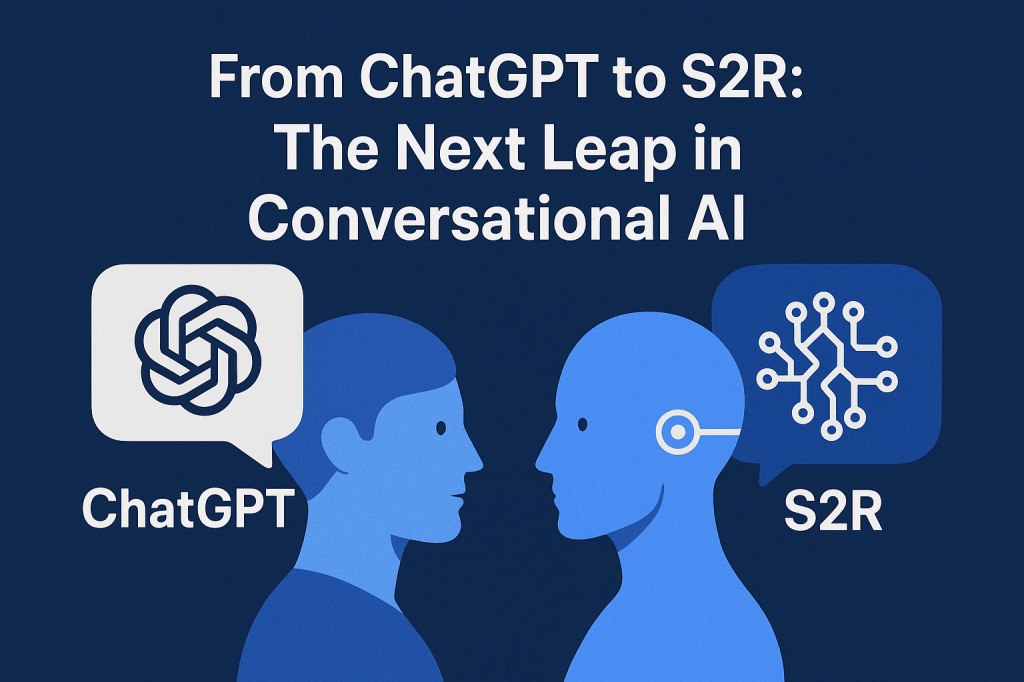
  • From ChatGPT to S2R: The Next Leap in Conversational AI

    The field of conversational AI has undergone a remarkable transformation over the past decade. From simple chatbots that could answer basic questions to advanced systems capable of engaging in context-aware conversations, artificial intelligence has steadily become more sophisticated. One of the most notable breakthroughs in this journey has been ChatGPT, a language model developed by OpenAI, which allows humans to communicate with machines in a way that feels natural and intuitive. ChatGPT can understand context, generate coherent and relevant responses, and even maintain the flow of a multi-turn conversation, making it one of the most widely recognized AI conversational tools today.

    Despite its impressive capabilities, ChatGPT primarily operates in a text-based environment. While this is sufficient for many applications such as content creation, education, and customer support, it limits the potential of truly immersive human-computer interactions. People naturally speak rather than type, and in many scenarios, voice interaction is more convenient, faster, and engaging. Recognizing this gap has led to the development of the next-generation AI systems such as Speech-to-Retrieval (S2R), which are designed to process spoken language and generate real-time intelligent responses.

    Speech-to-Retrieval (S2R) represents a significant leap in the evolution of conversational AI. By combining advanced speech recognition with natural language processing and retrieval-based response generation, S2R allows humans to communicate with AI using their natural voice. This creates a more fluid, interactive experience, and opens new opportunities for applications in sectors such as healthcare, education, customer service, and more. For readers interested in understanding the tools that are revolutionizing voice-enabled AI, exploring Speech-to-Retrieval tools can provide in-depth insights into the technology and its potential applications.

    In this blog, we will explore the journey from ChatGPT to S2R, examining the strengths and limitations of each, the opportunities that S2R opens up, the challenges that need to be addressed, and the potential future of conversational AI as it continues to evolve toward more natural, voice-driven interactions.

    The Era of ChatGPT

    Capabilities and Applications

    ChatGPT has established itself as one of the most advanced conversational AI models in the world. Its strength lies in understanding natural language and generating contextually relevant responses. Unlike earlier AI chatbots that relied on predefined scripts, ChatGPT uses deep learning models trained on massive datasets, enabling it to interpret complex questions, maintain the context of a conversation, and provide nuanced responses. This allows users to interact with the AI in a conversational manner rather than following rigid command structures.

    ChatGPT is widely used across different sectors, including:

    • Customer Service: Businesses deploy ChatGPT to handle customer inquiries, provide instant support, and resolve common issues efficiently. For example, e-commerce platforms can use ChatGPT to guide customers through product searches, process returns, or answer FAQs without requiring human intervention for every interaction.
    • Education: Educators and students use ChatGPT as a learning aid. It can explain complex topics, provide study guides, help with language learning, and even simulate tutoring sessions. Its ability to answer questions in a conversational style makes it an effective tool for personalized learning experiences.
    • Content Creation: Individuals and businesses use ChatGPT for generating blog posts, marketing content, social media updates, and creative writing. Its ability to produce coherent and context-aware content reduces the time and effort required for writing, while also providing inspiration for creative projects.
    • Programming Assistance: Developers leverage ChatGPT to generate code snippets, debug issues, and understand programming concepts. By providing explanations and suggestions in natural language, ChatGPT can help streamline the development process.

    Limitations

    Despite its capabilities, ChatGPT has certain limitations that highlight the need for the next generation of conversational AI. Firstly, ChatGPT is primarily text-based. While it can produce sophisticated textual responses, it cannot engage in real-time voice conversations. This limits its usability in situations where hands-free interaction or real-time speech input is preferred.

    Secondly, ChatGPT relies on the information available in its training dataset and does not have real-time access to current events unless integrated with external tools. This can result in outdated or incomplete responses in dynamic scenarios.

    Another limitation is that ChatGPT struggles with maintaining long-term context over extended conversations. While it can handle short conversations effectively, it may lose track of details in longer interactions, which can reduce the effectiveness of complex, multi-turn dialogues.

    Finally, ChatGPT does not inherently understand non-verbal cues, emotional tone, or speech nuances. This is a key area where human communication excels, and it underscores the need for conversational AI systems that integrate voice, emotion, and real-time understanding, such as Speech-to-Retrieval (S2R) technologies.

    Introducing S2R

    Definition and Concept

    Speech-to-Retrieval, commonly referred to as S2R, represents the next major advancement in conversational AI. While traditional models like ChatGPT focus primarily on text-based interactions, S2R emphasizes real-time processing of human speech and generating accurate, context-aware responses instantly. This technology combines speech recognition, natural language understanding, and retrieval-based AI to create a system that can comprehend spoken language and provide intelligent answers in a fraction of a second.

    The key innovation of S2R lies in its ability to bridge the gap between human speech and AI retrieval systems. Unlike traditional voice assistants that rely on pre-programmed commands or simple keyword matching, S2R can understand nuanced speech patterns, extract intent, and retrieve the most relevant information from large knowledge bases. This makes interactions feel more natural, conversational, and closer to speaking with a human expert.

    Key Differences from ChatGPT

    There are several critical differences between ChatGPT and S2R:

    • Mode of Interaction: ChatGPT is text-based, requiring users to type their inputs, whereas S2R allows users to speak naturally and receive immediate responses.
    • Real-Time Speech Processing: S2R incorporates advanced speech recognition algorithms to understand spoken language in real-time, enabling seamless voice conversations.
    • Contextual Retrieval: S2R uses retrieval-based AI to fetch accurate information from databases, documents, or online sources, ensuring responses are precise and up-to-date.
    • Emotional and Tonal Awareness: S2R has the potential to recognize vocal cues, tone, and intent, which allows for more empathetic and personalized responses compared to purely text-based systems.

    This combination of real-time voice interaction and intelligent retrieval makes S2R an ideal technology for applications that require speed, accuracy, and a natural user experience. Whether it’s providing instant customer support, assisting medical professionals during consultations, or acting as an interactive educational tool, S2R is set to redefine the way humans interact with AI. For a detailed understanding of its potential applications and impact on voice search technology, you can explore Speech-to-Retrieval.

    Benefits and Opportunities

    The adoption of Speech-to-Retrieval (S2R) technology brings numerous benefits and creates opportunities across multiple sectors. By combining real-time speech understanding with intelligent response generation, S2R enhances the way humans interact with machines and opens up new possibilities for business, education, healthcare, and accessibility.

    Enhanced User Experience

    One of the most significant benefits of S2R is the improved user experience. Voice interactions are faster and more natural than typing, which allows users to communicate with AI effortlessly. This is particularly useful in scenarios where hands-free operation is necessary, such as driving, cooking, or multitasking. Users no longer need to navigate complex menus or type queries; instead, they can ask questions and receive instant responses in natural language.

    Multimodal Applications

    S2R supports multimodal applications, combining voice interaction with visual or textual information. For example:

    • Virtual Assistants: Assistants can provide spoken instructions while displaying relevant visual information on a screen.
    • Interactive Displays: Voice commands can control digital signage or kiosks, offering a seamless and intuitive interface.
    • Smart Homes: Users can interact with multiple devices simultaneously using voice, improving convenience and automation.

    Accessibility

    S2R technology can significantly improve accessibility for individuals with disabilities. Voice interaction allows users who may have difficulty typing or navigating traditional interfaces to access information and services independently. This creates a more inclusive digital environment and ensures that technology can reach a broader audience.

    Business Transformation

    Businesses stand to benefit greatly from S2R technology. AI-powered voice agents can handle a higher volume of customer inquiries, reduce response time, and improve overall customer satisfaction. For instance:

    • Customer Support: AI agents can answer repetitive queries, allowing human agents to focus on more complex issues.
    • Sales and Marketing: Voice assistants can guide customers through product selection, provide recommendations, and even complete transactions.
    • Operational Efficiency: Automating routine communication tasks reduces costs and improves efficiency across organizations.

    Healthcare Applications

    In healthcare, S2R technology can revolutionize how medical professionals interact with patient data. Voice-enabled AI can transcribe consultations, provide instant access to medical records, and assist in diagnosing or recommending treatment options. This not only saves time but also improves accuracy and reduces human error.

    Education

    Voice-enabled AI tutors powered by S2R can deliver personalized lessons, answer student questions in real-time, and create interactive learning environments. This approach makes education more engaging and allows students to learn at their own pace while receiving instant feedback, which enhances knowledge retention and comprehension.

    Overall, S2R technology offers transformative potential across industries by enabling faster, more natural, and contextually aware interactions. By combining voice recognition with intelligent retrieval, it empowers users and businesses alike to achieve more efficient, inclusive, and engaging communication experiences.

    Challenges and Considerations

    While Speech-to-Retrieval (S2R) technology offers transformative benefits, it also comes with several challenges that must be addressed for successful implementation. Understanding these limitations is crucial for developers, businesses, and users to ensure effective, ethical, and secure deployment of S2R systems.

    Technical Hurdles

    Developing S2R systems requires sophisticated technology and careful optimization. Some of the main technical challenges include:

    • Latency and Real-Time Processing: S2R must process spoken input and retrieve accurate responses instantly. Delays or lag can disrupt the user experience, so optimizing speed without compromising accuracy is essential.
    • Speech Recognition Accuracy: Understanding human speech is complex due to variations in accents, dialects, pronunciation, and background noise. Ensuring high accuracy across diverse users is a key challenge.
    • Context Retention: Maintaining context over long or multi-turn conversations is difficult. S2R systems must remember previous interactions to provide coherent and relevant responses.

    Ethical and Privacy Concerns

    Voice-enabled AI involves processing sensitive user data, which raises important ethical and privacy considerations:

    • Data Security: Voice data must be securely stored and transmitted to prevent unauthorized access and breaches.
    • Bias and Fairness: AI models can inherit biases from training data, leading to unfair or inaccurate responses for certain user groups. Addressing these biases is critical for equitable AI use.
    • User Consent: Users should be informed about how their voice data is collected, stored, and used, ensuring transparency and compliance with privacy regulations.

    Training and Optimization

    Creating effective S2R models requires large-scale training on diverse datasets. Some considerations include:

    • Data Quality: High-quality, representative datasets are necessary to train models that can understand diverse speech patterns and contexts.
    • Computational Resources: Training large models for real-time speech understanding and retrieval demands significant computational power and optimization strategies.
    • Continuous Improvement: S2R models must be regularly updated to incorporate new vocabulary, languages, and knowledge sources to remain relevant and effective.

    Adoption and Integration

    Finally, integrating S2R into existing systems and workflows can be challenging. Businesses must ensure compatibility with current technology infrastructure, train staff to use the system effectively, and design user interfaces that support natural voice interactions. Without proper integration, even the most advanced S2R technology may fail to deliver its full potential.

    Addressing these challenges is essential for building reliable, secure, and user-friendly S2R systems that can achieve widespread adoption across industries.

    Future Outlook

    The future of conversational AI beyond Speech-to-Retrieval (S2R) is both exciting and transformative. As AI technologies continue to advance, we can expect systems that not only understand speech but also integrate seamlessly with other modalities and environments, creating truly immersive human-computer interactions.

    Integration with Emerging Technologies

    S2R is likely to evolve alongside augmented reality (AR), virtual reality (VR), and the Internet of Things (IoT). This integration can enable:

    • Immersive Virtual Assistants: AI companions that interact with users in virtual environments, responding to voice commands while providing visual and contextual cues in AR/VR spaces.
    • Smart Homes and IoT: Voice-driven AI can control multiple connected devices simultaneously, creating more intuitive and responsive living and work environments.
    • Enhanced Human-Machine Collaboration: Professionals in industries like manufacturing, healthcare, and logistics can interact with AI assistants through voice while performing hands-on tasks, improving productivity and safety.

    Human-Like Interaction

    Future S2R systems may incorporate emotional intelligence, understanding vocal tone, sentiment, and user intent to respond empathetically. This can create more natural, human-like interactions, improving user satisfaction and engagement. For example, AI could detect frustration or confusion in a user’s voice and adjust its responses accordingly, making conversations feel more personalized and supportive.

    Applications Across Industries

    The potential applications of advanced S2R technology are vast:

    • Healthcare: AI assistants could support doctors during surgeries or consultations, transcribe complex medical conversations, and provide instant access to patient data.
    • Education: Interactive, voice-enabled AI tutors can deliver adaptive learning experiences, track student progress, and provide feedback in real-time.
    • Customer Experience: Businesses can deploy AI agents capable of handling complex queries through voice, improving customer satisfaction while reducing operational costs.
    • Entertainment and Gaming: Voice-driven AI characters in games or virtual experiences can create interactive, personalized narratives for users.

    Continuous Evolution

    The evolution of conversational AI is ongoing. As S2R technology improves, we may see AI systems that combine multiple sensory inputs, such as vision and touch, with speech understanding. This can lead to fully immersive, multimodal AI companions capable of perceiving and responding to their environment just like humans. The shift from text-based to voice-driven AI is not merely an incremental improvement; it represents a fundamental change in how humans and machines interact.

    Ultimately, S2R sets the stage for a future where conversational AI becomes an integral part of everyday life, seamlessly integrating into work, education, healthcare, and entertainment. Its development marks a critical milestone in creating AI systems that are more natural, responsive, and human-like.

    Conclusion

    The journey from ChatGPT to Speech-to-Retrieval (S2R) represents a significant leap in the evolution of conversational AI. ChatGPT has laid the foundation by enabling intelligent, text-based interactions that are context-aware, coherent, and highly useful across various domains. It demonstrated the potential of AI to assist humans in tasks ranging from content creation to education, customer support, and programming assistance.

    However, the limitations of text-based systems, such as the lack of real-time voice interaction, difficulty maintaining long-term context, and inability to detect emotional cues, highlighted the need for more advanced solutions. S2R addresses these limitations by combining real-time speech processing with retrieval-based AI, enabling natural, voice-driven interactions that are faster, more intuitive, and capable of delivering accurate responses in context.

    The benefits of S2R are extensive. It enhances user experiences by allowing hands-free, natural communication, supports multimodal applications that combine voice with visual interfaces, improves accessibility for individuals with disabilities, and transforms industries such as healthcare, education, and customer service. Despite the challenges related to technical complexity, data security, and model training, the potential impact of S2R technology is undeniable.

    Looking forward, S2R is poised to integrate with emerging technologies like AR, VR, and IoT, creating immersive and interactive environments where AI can assist humans in increasingly intelligent and empathetic ways. As AI continues to evolve, systems may become fully multimodal, capable of perceiving voice, vision, and environmental cues simultaneously, leading to human-like interactions that redefine how we engage with technology.

    In conclusion, the shift from ChatGPT to S2R is more than just an incremental improvement—it represents a fundamental transformation in conversational AI. It lays the groundwork for AI that is not only intelligent and responsive but also intuitive, accessible, and capable of understanding human speech in its natural form. For those interested in exploring the companies driving these innovations and shaping the future of AI, checking out conversational AI companies can provide valuable insights.

    The evolution from text to voice signifies a new era where human-AI interaction is seamless, efficient, and immersive, setting the stage for the next generation of conversational experiences.

  • Python vs JavaScript for Data Science and AI

    In today’s technology-driven world, Data Science and Artificial Intelligence (AI) are transforming industries at an unprecedented pace. Businesses are leveraging AI for tasks ranging from predicting market trends, improving customer experiences, automating repetitive processes, to developing intelligent decision-making systems. With this rapid adoption, the choice of programming language has become a critical factor in the success of AI and Data Science projects.

    Among the wide range of programming languages available, Python and JavaScript stand out due to their versatility, popularity, and ecosystem support. Python is renowned for its simplicity and robust libraries, which make it a favorite in AI and machine learning research. JavaScript, traditionally a web development language, is evolving to support AI applications directly in the browser, making it suitable for interactive and real-time applications.

    This article aims to provide a detailed comparison between Python and JavaScript for Data Science and AI. We will explore the strengths, weaknesses, use cases, performance, libraries, and future trends of both languages. By understanding these factors, you can make a more informed decision about which language is the best fit for your projects. For companies seeking expert help, Python development companies offer specialized solutions for AI and Data Science applications, ensuring projects are implemented efficiently and effectively.

    Whether you are a beginner stepping into the world of AI or a business evaluating technology stacks for your next data-driven project, this comparison will help you understand the potential of Python and JavaScript and how each can be leveraged to achieve your goals.

    Language Overview

    Python

    Python is one of the most widely used programming languages for Data Science and AI. First released in 1991 by Guido van Rossum, Python was designed with readability, simplicity, and versatility in mind. Its clean syntax allows developers to write code quickly and with fewer errors, which is particularly important in data-intensive projects where clarity and maintainability are critical.

    One of Python’s greatest strengths is its extensive ecosystem of libraries and frameworks. These libraries provide pre-built functionalities that simplify complex tasks such as statistical analysis, machine learning, deep learning, and data visualization. For instance, NumPy allows efficient numerical computation, pandas offers robust data manipulation tools, and Matplotlib or Seaborn enable sophisticated data visualization. For AI and machine learning, frameworks like TensorFlow, PyTorch, and Scikit-learn empower developers to build, train, and deploy complex models without starting from scratch.

    Python’s popularity in the AI and Data Science community is also driven by its readability and beginner-friendly nature. Its code resembles natural language, making it easier for newcomers to understand logic and structure. Additionally, Python supports multiple programming paradigms, including object-oriented, procedural, and functional programming, giving developers flexibility to approach problems in different ways.

    Due to these advantages, Python has become the default language for research and production in AI, machine learning, and scientific computing. Whether you are building a predictive model, analyzing large datasets, or creating a deep learning application, Python provides the tools and support needed to streamline development.

    JavaScript

    JavaScript was originally created in 1995 as a language for web browsers to make web pages interactive. Over the years, it has evolved into a full-stack programming language, thanks to environments like Node.js that allow JavaScript to run on the server side. This evolution has made JavaScript highly versatile, suitable for both client-side and server-side development.

    In recent years, JavaScript has started playing a growing role in AI and Data Science. While it does not have as extensive a set of AI libraries as Python, frameworks such as TensorFlow.js and Brain.js allow developers to build and run machine learning models directly in the browser or on a Node.js server. JavaScript’s asynchronous nature and event-driven architecture make it particularly effective for real-time applications, including interactive visualizations, dashboards, and AI-powered web applications.

    Another advantage of JavaScript is its seamless integration with web technologies. AI applications built with JavaScript can be deployed directly to websites or web apps without requiring separate backend processing. This is particularly valuable for startups or companies focusing on interactive AI applications that need to engage users through browsers.

    Although JavaScript is less common for heavy-duty AI or scientific computing, its strength lies in enabling AI at the edge, particularly in environments where browser-based processing, user interactivity, and fast deployment are priorities. Developers familiar with web development can leverage JavaScript to extend AI applications beyond traditional desktop or server environments, creating new possibilities for user-driven intelligence in applications.

    Comparison: Python vs JavaScript for Data Science and AI

    Libraries and Frameworks

    One of the most important factors when choosing a programming language for Data Science and AI is the availability and strength of its libraries and frameworks. Libraries allow developers to handle complex tasks efficiently without reinventing the wheel, which is crucial in AI projects that involve large datasets and sophisticated algorithms.

    Python has an unparalleled ecosystem for AI and Data Science. Some of the key libraries include:

    • NumPy: Offers high-performance numerical computation and multidimensional array objects.
    • pandas: Provides tools for data manipulation and analysis, including dataframes for handling tabular data.
    • Matplotlib and Seaborn: Used for data visualization, allowing the creation of charts, plots, and interactive graphics.
    • Scikit-learn: A machine learning library that supports classification, regression, clustering, and model evaluation.
    • TensorFlow and PyTorch: Frameworks for deep learning that simplify building neural networks, training models, and deploying AI systems.

    These libraries not only save development time but also provide reliable, optimized functions that improve performance and scalability of AI projects.

    JavaScript also provides AI and machine learning libraries, though its ecosystem is more limited compared to Python. Some of the popular JavaScript libraries include:

    • TensorFlow.js: Enables running machine learning models directly in the browser or on Node.js servers.
    • Brain.js: A lightweight neural network library for basic AI applications in JavaScript.
    • D3.js: A data visualization library that allows interactive and dynamic charting on the web.

    JavaScript is suitable for AI tasks that require user interaction and web integration, but it is less ideal for heavy-duty computations and large-scale AI modeling.

    Community Support and Resources

    A large and active community is critical for troubleshooting, learning, and staying updated with the latest advancements in AI and Data Science. Python has one of the most extensive communities globally, including forums, online courses, tutorials, and open-source contributions. This community ensures that developers have access to guidance and pre-built tools that can simplify even the most complex AI problems.

    JavaScript also has a vast community, primarily focused on web development. While AI resources are increasing, the community is smaller for AI-specific topics compared to Python. Developers familiar with JavaScript can leverage existing knowledge for AI projects, but may find fewer specialized tutorials or research-oriented libraries.

    Performance and Scalability

    Performance is another major factor when choosing a language for AI projects. Python is highly optimized for heavy computations, especially when used with libraries like NumPy, TensorFlow, or PyTorch. These libraries provide optimized C and C++ backends that speed up numerical operations and model training. However, Python’s interpreted nature means it may run slower for some lightweight real-time applications, especially in web-based environments.

    JavaScript, particularly when used with Node.js, is very fast in execution for web-based applications and real-time data processing. It can handle asynchronous operations efficiently, making it suitable for interactive AI tools. However, for complex deep learning models or large-scale data processing, Python generally outperforms JavaScript due to its specialized frameworks and computational optimizations.

    Learning Curve

    Python is widely regarded as one of the easiest programming languages to learn. Its readable and concise syntax allows beginners to grasp programming concepts quickly, while its extensive libraries provide ready-to-use tools for AI and Data Science. Python’s simplicity reduces development errors and allows developers to focus on problem-solving rather than language syntax.

    JavaScript has a steeper learning curve, particularly for beginners unfamiliar with asynchronous programming or web technologies. However, developers with web development experience can easily adapt JavaScript for AI applications. Understanding concepts like callbacks, promises, and event-driven programming is essential for implementing efficient AI solutions in JavaScript.

    Use Cases

    Python

    • Data Analysis and Visualization: Python’s libraries allow efficient exploration and visualization of large datasets.
    • Machine Learning and Deep Learning: Ideal for building predictive models, neural networks, and AI-driven applications.
    • Scientific Computing and Research: Preferred by researchers for numerical simulations, modeling, and AI experiments.
    • Automation and Data-driven Applications: Python’s flexibility allows automation of repetitive tasks and integration with AI pipelines.

    JavaScript

    • Web-based AI Applications: Enables AI functionality directly in browsers for interactive experiences.
    • Real-time Analytics and Dashboards: JavaScript’s asynchronous capabilities allow real-time data processing and visualization.
    • Interactive Visualizations: Libraries like D3.js make AI insights visually accessible to users.
    • AI Models in Browsers: TensorFlow.js allows running trained AI models directly on client-side environments without server dependency.

    For readers who want a deeper comparison, the detailed article on Python vs JavaScript provides insights into strengths, weaknesses, and real-world applications of both languages.

    Future Trends

    The fields of Data Science and Artificial Intelligence are evolving at a rapid pace, and the programming languages used to develop AI solutions must keep up with these changes. Both Python and JavaScript are expected to continue playing important roles in the AI ecosystem, but in different ways based on their strengths and applications.

    Python’s Continued Dominance

    Python is likely to maintain its position as the primary language for research, development, and deployment of AI and Data Science projects. Its mature libraries, strong community support, and simplicity make it the first choice for heavy computational tasks, deep learning, and machine learning research. New developments in Python libraries, such as optimized versions of TensorFlow and PyTorch, will continue to accelerate model training and deployment.

    In addition, Python’s role in data analytics and scientific computing will expand as organizations increasingly rely on data-driven decision-making. With the rise of automated machine learning (AutoML) tools, Python will provide the backbone for platforms that enable businesses to build AI solutions with minimal coding expertise, further solidifying its relevance in enterprise AI projects.

    JavaScript’s Growing Role in Web-based AI

    While Python excels in heavy computation, JavaScript is becoming a key player in AI for web-based applications. With libraries like TensorFlow.js and Brain.js, developers can create AI models that run entirely in the browser or on web servers using Node.js. This allows for real-time, interactive AI experiences that engage users directly through web interfaces.

    JavaScript’s future in AI is particularly promising for applications that require instant feedback, such as personalized user interfaces, real-time analytics dashboards, and interactive educational tools. As more AI models are adapted for client-side execution, JavaScript will allow businesses to deliver AI-driven features without relying heavily on server-side processing, reducing latency and server costs.

    Hybrid Approaches

    The future of AI development is likely to involve hybrid approaches that leverage the strengths of both Python and JavaScript. For instance, Python can be used on the backend to handle data processing, model training, and deployment, while JavaScript powers the frontend to provide interactive visualizations and real-time AI-driven user experiences.

    This hybrid model offers several advantages:

    • Efficiency: Heavy computations are handled by Python, while user interactions are managed by JavaScript, optimizing system performance.
    • Seamless Integration: AI models can be deployed in web applications without sacrificing computational power or user experience.
    • Scalability: Businesses can scale AI solutions across platforms, from web browsers to server-side applications, without rewriting code in multiple languages.

    Emerging Trends

    Some of the emerging trends that will shape the future of Python and JavaScript in AI include:

    • Edge AI: Running AI models on client devices to reduce latency and improve responsiveness, where JavaScript can be highly effective.
    • Automated Machine Learning (AutoML): Simplifying AI model creation using Python-based frameworks.
    • Cross-platform AI Applications: Combining Python for backend computation and JavaScript for frontend interaction to create seamless user experiences.
    • AI Democratization: Tools and libraries that make AI accessible to non-technical users, increasing reliance on Python for backend AI logic and JavaScript for web integration.

    Overall, Python and JavaScript will continue to complement each other in the AI ecosystem. Developers and businesses that leverage both languages strategically will be able to build powerful, interactive, and scalable AI solutions that meet the demands of the modern digital landscape.

    Conclusion

    Choosing the right programming language for Data Science and AI projects is critical for success, and both Python and JavaScript offer unique advantages depending on the project’s needs. Python excels in heavy computational tasks, deep learning, and research-driven AI applications. Its rich ecosystem of libraries, extensive community support, and beginner-friendly syntax make it the preferred language for data scientists, AI researchers, and developers working on large-scale machine learning projects.

    JavaScript, on the other hand, has emerged as a strong contender for web-based AI applications. Its ability to run AI models directly in the browser using libraries like TensorFlow.js, combined with its asynchronous execution capabilities, makes it ideal for real-time, interactive dashboards, and web applications where user experience is a priority. Developers familiar with web technologies can leverage JavaScript to create AI-powered applications without relying heavily on server-side processing.

    In many modern projects, a hybrid approach that combines Python and JavaScript can deliver the best results. Python can handle backend computations, data processing, and model training, while JavaScript powers the frontend for visualization, interactivity, and user engagement. This combination allows businesses to build scalable, efficient, and interactive AI solutions that leverage the strengths of both languages.

    Ultimately, the choice between Python and JavaScript depends on the nature of your project, the expertise of your team, and your deployment environment. For research-focused or data-intensive AI projects, Python remains the most efficient and reliable option. For web-based, interactive AI applications, JavaScript offers flexibility and seamless integration with web technologies.

    For businesses looking to implement AI solutions using web technologies, consulting JavaScript development companies can provide expert guidance and support, ensuring that AI applications are developed efficiently and meet industry standards. By understanding the strengths and limitations of each language, organizations can make informed decisions and leverage the right technology to achieve their AI and Data Science goals.

  • Transforming Your Mobile App with AI: Everything You Need to Know

    Mobile apps have become an integral part of our daily lives, serving as the primary interface for communication, shopping, entertainment, health tracking, banking, and much more. Over the past decade, mobile app technology has advanced significantly, and users now expect apps to be more intelligent, interactive, and responsive to their needs. Traditional mobile applications were limited to predefined functionalities, offering a static experience. However, the integration of Artificial Intelligence (AI) is changing this landscape, enabling apps to become dynamic, adaptive, and highly personalized.

    AI is not just a buzzword; it is a technology that empowers apps to understand user behavior, predict preferences, automate tasks, and provide real-time solutions. From smart assistants like Siri and Google Assistant to recommendation engines in e-commerce apps, AI is already shaping the way users interact with mobile applications. Businesses that fail to leverage AI risk falling behind in an increasingly competitive app ecosystem.

    For organizations looking to implement AI solutions in their mobile apps, professional guidance from mobile app development companies can be invaluable. These companies specialize in designing, developing, and integrating AI features that align with business objectives and user expectations. By collaborating with experts, businesses can build AI-driven apps that not only meet market demands but also create superior user experiences.

    In this comprehensive guide, we will explore the role of AI in mobile apps, the technologies powering it, strategies for integration, real-world examples, and the emerging trends that will define the future of mobile app development. Whether you are a business owner, developer, or tech enthusiast, this article will provide you with actionable insights to transform your mobile app with AI.

    Understanding AI in Mobile Apps

    Artificial Intelligence (AI) refers to the capability of machines to perform tasks that typically require human intelligence, such as reasoning, learning, problem-solving, and decision-making. In mobile app development, AI is a game-changer because it allows apps to go beyond static functions and deliver intelligent, adaptive experiences that respond to users’ behavior in real time.

    Modern mobile apps increasingly rely on AI to provide personalized interactions, enhance usability, and automate routine tasks. By leveraging AI, businesses can make their apps more engaging, efficient, and valuable to users, which often results in higher retention rates, improved customer satisfaction, and increased revenue.

    Key AI Technologies Used in Mobile Apps

    • Machine Learning (ML)
      Machine Learning is a branch of AI that enables systems to learn from historical data and improve their performance over time without being explicitly programmed. In mobile apps, ML can be used for personalized recommendations, predictive analytics, fraud detection, and behavior analysis. For example, streaming apps like Spotify use ML algorithms to suggest songs based on listening history, while e-commerce apps like Amazon recommend products based on browsing and purchase patterns.
    • Natural Language Processing (NLP)
      NLP enables apps to understand, interpret, and respond to human language. This technology powers chatbots, virtual assistants, voice search, and messaging enhancements. For instance, NLP allows apps like Google Assistant to understand voice commands, provide relevant answers, and even carry out complex multi-step tasks. It makes interactions with apps more natural and human-like.
    • Computer Vision
      Computer Vision allows apps to analyze and interpret visual data from images and videos. This technology is widely used in facial recognition, augmented reality experiences, object detection, and image-based search. For example, apps like Snapchat and Instagram use computer vision to apply filters to faces, while retail apps enable users to search for products using images.
    • Predictive Analytics
      Predictive analytics uses AI algorithms to analyze historical data and forecast future trends or user behaviors. Fitness and health apps use predictive analytics to suggest workouts, track progress, and even recommend lifestyle adjustments. Similarly, finance apps leverage predictive models to provide investment advice or detect unusual spending patterns, ensuring users make informed decisions.

    Benefits of AI in Mobile Apps

    • Personalization: AI helps apps deliver content and recommendations tailored to individual user preferences, increasing engagement and satisfaction.
    • Automation: Repetitive tasks such as notifications, reminders, and customer support can be automated, reducing manual effort and improving efficiency.
    • Enhanced User Experience: AI-driven insights enable apps to offer intuitive interfaces, context-aware suggestions, and dynamic functionality that align with user needs.
    • Data-Driven Decisions: Businesses can leverage AI to analyze large volumes of user data, optimize app features, and make strategic decisions that improve performance and user retention.

    By understanding the technologies and benefits of AI, businesses can design mobile apps that are not only functional but also intelligent, adaptive, and capable of providing meaningful experiences. Integrating AI into a mobile app requires careful planning, data analysis, and the selection of appropriate technologies, which we will discuss in the next section.

    How to Integrate AI into Your Mobile App

    Integrating AI into a mobile app is a strategic process that requires careful planning, technical expertise, and an understanding of user needs. Simply adding AI features without a clear purpose can lead to underwhelming results or even frustrate users. The key is to identify areas where AI can add value, select the right technologies, and implement them effectively.

    1. Identify App Areas That Can Benefit from AI

    The first step is to analyze your app’s current functionality and user behavior to determine where AI can have the most impact. Common areas for AI integration include:

    • Personalized Recommendations: Suggest products, content, or services based on user behavior and preferences.
    • Predictive Analytics: Anticipate user actions, such as likely purchases, preferred content, or activity trends.
    • Chatbots and Virtual Assistants: Provide real-time customer support and answer user queries automatically.
    • Voice Recognition and NLP: Enable voice commands, language translation, and context-aware suggestions.
    • Image and Object Recognition: Allow features like augmented reality, QR scanning, and visual search.

    2. Select the Right AI Tools and Frameworks

    Choosing the right AI technologies is crucial to successful integration. The selection depends on the app’s platform, type of AI functionality, and the amount of data available. Popular frameworks include:

    • TensorFlow: Widely used for machine learning and deep learning applications, suitable for both iOS and Android apps.
    • PyTorch: Known for flexibility and ease of use in research and mobile deployment.
    • Core ML: Apple’s framework for integrating machine learning into iOS apps.
    • IBM Watson: Provides AI services such as NLP, chatbots, and predictive analytics with cloud support.

    Selecting the right framework ensures the AI solution is efficient, scalable, and compatible with your app’s ecosystem.

    3. Data Collection and Model Training

    AI models rely heavily on high-quality data. Collecting relevant data from user interactions, transactions, and app usage is the foundation of any AI implementation. Once collected, this data is cleaned, structured, and used to train machine learning models. For example:

    • Streaming apps analyze listening history to train recommendation algorithms.
    • Fitness apps track workout patterns to predict when a user may skip an exercise.
    • Retail apps monitor purchase history to suggest relevant products or discounts.

    Proper data handling and preprocessing are critical to ensure that AI models are accurate and effective.

    4. Deployment and Continuous Improvement

    Once the AI model is trained, it must be integrated into the app and tested thoroughly. Deployment involves embedding the AI features into the app’s code, ensuring smooth performance across devices and operating systems. After deployment, continuous monitoring is essential:

    • Track how users interact with AI-driven features.
    • Collect feedback and usage metrics to identify areas for improvement.
    • Update and retrain AI models regularly to adapt to changing user behavior and trends.

    Continuous improvement ensures that the AI system remains relevant, accurate, and valuable over time.

    Common Challenges in AI Integration

    • Data Privacy and Security: Handling sensitive user data responsibly is critical. Compliance with regulations like GDPR and ensuring encryption of personal data is essential.
    • Complexity of AI Models: Advanced AI models require expertise in data science, machine learning, and mobile development for successful implementation.
    • Cost and Resources: AI integration may require significant investment in infrastructure, software tools, and skilled personnel.
    • User Acceptance: Users may initially be hesitant to trust AI-powered features, so clear communication about the benefits and functionality of AI is important.

    For a step-by-step guide on AI integration, businesses can explore integrate AI into existing mobile app for detailed strategies, best practices, and real-world examples.

    Examples of AI in Mobile Apps

    AI is no longer a futuristic concept; it is actively transforming mobile apps across industries. Businesses are leveraging AI to provide more personalized, efficient, and intelligent experiences. Here are some of the most common and impactful examples of AI in mobile applications:

    1. Personalized Recommendations in E-commerce Apps

    E-commerce apps like Amazon, Flipkart, and eBay use AI to analyze user behavior, purchase history, and browsing patterns to deliver personalized product recommendations. Machine learning algorithms identify which products a user is most likely to buy and suggest them in real time. This not only improves user engagement but also increases sales and customer loyalty. For instance, if a user frequently purchases sports gear, the app may highlight related items such as fitness accessories or apparel, creating a highly relevant shopping experience.

    2. Chatbots and Virtual Assistants

    AI-powered chatbots and virtual assistants, such as Siri, Google Assistant, and Alexa, provide instant support and guidance to users. Chatbots can handle frequently asked questions, process transactions, and even assist with troubleshooting technical issues. For example, banking apps use chatbots to provide account balances, process payments, and guide users through complex financial tasks. This reduces the dependency on human customer service agents and ensures users receive 24/7 support.

    3. Voice Recognition and Natural Language Processing (NLP)

    Voice recognition and NLP allow apps to understand and respond to spoken commands. Messaging apps, translation apps, and voice-enabled productivity tools use NLP to improve user interaction. Google Translate, for example, leverages NLP to provide accurate translations in real time, while voice assistants understand natural language requests to perform tasks like setting reminders, sending messages, or playing music.

    4. Image Recognition and Augmented Reality (AR)

    Computer vision and image recognition are widely used in apps that require visual input from users. Social media apps like Snapchat and Instagram apply facial filters, detect objects in photos, and provide AR experiences. Retail apps, such as IKEA Place, allow users to visualize furniture in their homes using AR, helping customers make informed purchase decisions. AI-powered image recognition is also applied in health apps to analyze medical images or in security apps for facial authentication.

    5. Predictive Analytics for User Engagement

    Predictive analytics helps apps anticipate user behavior and provide proactive recommendations. Fitness apps like MyFitnessPal and Fitbit analyze activity patterns and offer suggestions for workouts or diet plans. Similarly, finance apps can predict spending behavior, alert users about unusual transactions, or provide investment insights based on market trends. By predicting user needs, apps can deliver timely and relevant experiences that increase satisfaction and engagement.

    These examples demonstrate how AI can enhance mobile apps by making them smarter, more interactive, and user-centric. By integrating AI, businesses can provide personalized experiences, automate routine tasks, and leverage insights from user data to improve decision-making and app performance.

    Future Trends: AI in Mobile App Development

    The impact of AI on mobile app development is only expected to grow in the coming years. As AI technologies advance, apps will become more autonomous, intelligent, and capable of delivering hyper-personalized experiences. Understanding these future trends can help businesses prepare for innovation and stay competitive in the rapidly evolving mobile ecosystem.

    1. AI-Driven App Design

    AI is starting to influence the design process itself. AI-driven design tools can analyze user behavior and interface interactions to suggest design improvements, optimize layouts, and enhance usability. These tools can automatically adjust features based on real-time data, making apps more intuitive and user-friendly. This reduces the time and effort required for manual design testing and ensures a seamless user experience across devices.

    2. Hyper-Personalization

    While personalization is already common, the future of AI in mobile apps will involve hyper-personalization. Apps will tailor content, notifications, product suggestions, and services not only based on user preferences but also on real-time context, location, and activity. For example, a travel app might suggest nearby restaurants and attractions based on current location, past travel history, and even the weather, creating a highly relevant and engaging experience for the user.

    3. Autonomous Apps

    Autonomous apps are capable of making decisions and taking actions without direct user intervention. AI can enable apps to manage tasks, optimize settings, or generate content automatically. For instance, a financial app could automatically rebalance an investment portfolio based on market trends, or a fitness app could adjust workout routines based on performance data and user goals. Autonomous apps offer convenience, efficiency, and smarter decision-making for users.

    4. Enhanced Security and Performance

    AI is becoming essential in improving app security and performance. Machine learning algorithms can detect unusual behavior, prevent fraudulent activities, and identify potential vulnerabilities in real time. Additionally, AI can optimize app performance by predicting server load, identifying bottlenecks, and managing resources more efficiently. These improvements ensure safer and faster experiences for users, which is critical in industries like finance, healthcare, and e-commerce.

    5. Integration with Emerging Technologies

    The future of AI in mobile apps is closely linked with other emerging technologies. Integration with Internet of Things (IoT), blockchain, and augmented reality will enable apps to offer smarter, more interactive, and secure experiences. For example, AI combined with IoT devices can monitor health conditions in real time, while AI-powered AR apps can create immersive shopping or educational experiences. Businesses that embrace these integrations will be able to deliver innovative solutions that stand out in the market.

    6. Industry Case Studies

    Several companies are already leveraging AI to stay ahead of the curve. Retail apps use recommendation engines to boost sales and customer engagement. Healthcare apps utilize predictive analytics and AI-driven diagnostics to improve patient care. Financial apps detect fraud, provide personalized investment advice, and manage risks using AI models. These case studies demonstrate how AI adoption can lead to measurable business benefits and enhanced user experiences.

    By understanding and adopting these future trends, businesses can ensure that their mobile apps remain competitive, innovative, and aligned with user expectations. AI is not just a feature; it is becoming a central pillar of app development strategy, shaping the next generation of intelligent mobile experiences.

    Conclusion

    Artificial Intelligence is revolutionizing the way mobile apps are developed, deployed, and experienced. By integrating AI into mobile applications, businesses can transform static apps into intelligent systems that understand user behavior, provide personalized experiences, automate tasks, and deliver actionable insights. From recommendation engines and chatbots to predictive analytics and computer vision, AI empowers apps to be more interactive, efficient, and valuable to users.

    Businesses that adopt AI in their mobile apps gain several advantages, including:

    • Improved User Engagement: AI-driven personalization and predictive features keep users engaged and increase retention rates.
    • Enhanced Efficiency: Automation of routine tasks saves time and reduces operational costs.
    • Data-Driven Decision Making: Insights derived from AI analytics help businesses make informed strategic decisions.
    • Competitive Advantage: AI-powered apps provide innovative experiences that differentiate businesses from competitors.

    As AI technology continues to advance, mobile apps will become even more intelligent, autonomous, and capable of delivering hyper-personalized experiences. Organizations that embrace AI now are positioning themselves for long-term success in a competitive digital landscape. Understanding how AI works, where to implement it, and how to optimize it for your users is critical for building next-generation apps.

    For businesses looking to explore more about the role of AI in mobile app development, detailed insights, case studies, and practical strategies can be found in AI in mobile apps. By leveraging AI effectively, mobile apps are no longer just tools for interaction, but intelligent solutions that enhance everyday life, streamline business operations, and create meaningful user experiences.

  • AI-first web development: Is it really cost-effective?

    In today’s digital era, businesses of all sizes face increasing pressure to maintain a strong online presence. Customers expect fast, personalized, and seamless experiences when visiting websites or interacting with digital platforms. At the same time, business owners are looking for cost-efficient ways to launch and maintain these websites without draining resources. This is where AI-first web development comes into play.

    AI-first web development is an innovative approach where artificial intelligence is integrated at the core of website design, functionality, and management. Unlike traditional development methods, which often rely on manual coding, repetitive processes, and static content, AI-first approaches use intelligent systems to automate tasks, personalize experiences, and optimize operations in real-time.

    The key promise of AI-first development is efficiency, speed, and cost savings, but the reality is more nuanced. While AI can reduce certain operational costs, there are upfront investments, training requirements, and ongoing maintenance considerations that businesses must take into account. For startups, small businesses, and even large enterprises, the question remains: is AI-first web development truly cost-effective, or does it create hidden costs that could outweigh the benefits?

    In this article, we will explore what AI-first web development is, how it works, the cost factors involved, and strategies businesses can adopt to make the most out of AI-driven websites. We will also examine how to make websites AI-agent ready, build an effective AI strategy, choose the right AI agent developers, and ultimately evaluate whether this approach is worth the investment.

    Understanding AI-First Web Development

    AI-first web development is not just a trend; it represents a shift in how websites are conceptualized, designed, and maintained. Traditionally, websites were built around manual coding, predefined templates, and static content updates. With AI-first development, artificial intelligence is embedded at every stage of the process, allowing businesses to create smarter, faster, and more adaptive websites.

    Key Components of AI-First Web Development

    • Automated Design: AI-powered design tools can analyze user behavior, preferences, and industry trends to create layouts that are optimized for engagement and conversion. Instead of relying on multiple design iterations, businesses can use AI to generate design options in minutes, saving both time and costs.
    • Content Generation: AI algorithms can produce high-quality, SEO-optimized content tailored to the target audience. For example, AI can generate blog posts, product descriptions, and landing page content, while continuously adapting based on user engagement metrics. This reduces the need for large content teams and accelerates the publishing process.
    • User Experience Optimization: AI monitors how users interact with a website in real-time. It can identify friction points, such as pages with high bounce rates, and automatically suggest or implement improvements. Personalization features, like recommending products based on browsing history, are also AI-driven, creating a more engaging experience for each visitor.

    Benefits for Businesses

    • Reduced Dependency on Large Teams: AI automates repetitive tasks such as coding, testing, and content updates. This allows smaller teams to manage complex websites effectively, reducing labor costs.
    • Faster Project Delivery: With AI handling repetitive and analytical tasks, businesses can launch websites faster, respond to market changes quicker, and implement updates more efficiently.
    • Data-Driven Decisions: AI collects and analyzes user data to provide actionable insights. Businesses can make informed decisions about content strategy, design changes, and marketing efforts, which improves ROI.
    • Continuous Improvement: Unlike static websites, AI-first websites evolve over time. They adapt to changing user behaviors and market trends, ensuring that the digital presence remains competitive without requiring frequent manual interventions.

    While these benefits are significant, it is important for businesses to understand that implementing AI-first development involves more than just adopting new tools. It requires careful planning, data readiness, and sometimes a cultural shift towards automation and AI-driven decision making. This approach is most effective when combined with a clear strategy that aligns with the business’s goals and audience expectations.

    Cost Considerations of AI-First Web Development

    While AI-first web development offers significant advantages, businesses need to carefully evaluate the costs involved. Cost-effectiveness is not just about the initial investment but also about long-term savings, hidden expenses, and the overall impact on operations. Understanding these factors can help businesses make informed decisions and maximize return on investment.

    Upfront Investment vs. Long-Term Savings

    Implementing AI-first web development requires an upfront investment in AI tools, software platforms, and sometimes custom-built AI systems. Businesses may also need to hire AI specialists or collaborate with AI development companies for integration and maintenance. While these initial costs can be higher than traditional development, the long-term benefits often justify the expense.

    • Time Savings: AI automates repetitive tasks such as coding, content generation, and testing, significantly reducing the time required for development.
    • Operational Efficiency: Automation allows smaller teams to handle complex projects, reducing labor costs and overheads.
    • Faster Launch and Updates: AI enables quicker deployment of websites and features, allowing businesses to respond rapidly to market changes.

    In many cases, businesses recoup the initial investment within months due to these efficiency gains. However, the exact savings depend on factors such as the complexity of the website, the AI tools used, and the scale of operations.

    Traditional vs. AI-Driven Development Costs

    Traditional web development relies heavily on manual processes. Developers write code, designers create layouts, and content teams manually produce material. While this approach may seem cost-effective upfront, it can result in longer timelines, higher labor costs, and increased errors that require additional resources to fix.

    AI-first development, by contrast, automates many of these processes. For example, AI can generate adaptive website layouts, automate testing across multiple devices, and even suggest content improvements based on user engagement. While the initial cost may be higher, the reduction in manual labor and faster delivery often leads to significant overall savings.

    Hidden Costs

    Despite the clear benefits, businesses should be aware of hidden costs associated with AI-first development:

    • Maintenance and Updates: AI systems require regular updates, monitoring, and fine-tuning to ensure accuracy and efficiency. Without ongoing attention, AI tools may become less effective over time.
    • Training and Learning: Staff may need training to understand and manage AI-driven systems. Additionally, AI algorithms require proper data input and occasional supervision to deliver optimal results.
    • Integration Complexity: Integrating AI with existing systems, third-party applications, and databases can involve additional technical complexity, which may incur extra costs.

    Overall, startups and small businesses often benefit the most from AI-first development because automation allows them to launch sophisticated websites without large teams. Larger enterprises may also see benefits, but they need to plan for the complexity of AI integration and ensure that the potential savings outweigh the setup and maintenance costs.

    Making Your Website AI-Ready

    To fully leverage the benefits of AI-first web development, businesses must ensure their websites are AI-agent ready. An AI-agent ready website is capable of interacting intelligently with visitors, understanding their preferences, and providing personalized experiences in real-time. Without this readiness, the potential of AI integration may not be fully realized, and businesses could miss out on efficiency and cost savings.

    Steps to Make a Website AI-Ready

    • Data Collection and Management: AI systems rely heavily on data to function effectively. Businesses should implement robust data collection mechanisms, including user behavior tracking, form submissions, browsing patterns, and purchase history. Properly structured data allows AI algorithms to generate meaningful insights and personalize user experiences accurately.
    • Personalization: AI-ready websites should be able to deliver tailored experiences based on individual user preferences. For example, e-commerce sites can recommend products based on past purchases, while content platforms can suggest articles that match a user’s reading habits. Personalization improves engagement, conversion rates, and overall customer satisfaction.
    • Integration with AI Agents: AI agents, such as chatbots, virtual assistants, or recommendation engines, should be seamlessly integrated into the website. These agents can answer customer queries instantly, guide users through product selections, and provide real-time support. Integrating AI agents reduces the need for extensive customer support teams and ensures round-the-clock service.
    • Responsive and Adaptive Design: AI-ready websites must be responsive across devices and capable of adapting to different user behaviors. AI algorithms can automatically adjust page layouts, navigation menus, and content display to enhance the user experience based on the device being used and the user’s interactions.
    • Security and Compliance: Collecting and processing user data comes with responsibility. Ensure that AI systems comply with data protection regulations such as GDPR or CCPA. Implement robust security measures to protect user information while enabling AI functionality.

    Implementing these steps ensures that your website is not only ready for AI integration but also capable of maximizing its potential benefits. Businesses that optimize their websites for AI can achieve higher engagement rates, improved conversions, and operational efficiencies. For more insights on making your website AI-ready, check out AI-agent ready website strategies.

    Benefits of an AI-Ready Website

    • Enhanced User Experience: AI-driven personalization and real-time responses create a more satisfying and interactive experience for visitors.
    • Reduced Operational Costs: Automated customer service and intelligent recommendations reduce the need for large support teams.
    • Higher Conversion Rates: Personalized product suggestions, content, and services encourage users to take desired actions more effectively.
    • Continuous Learning: AI agents collect ongoing data, enabling the website to continuously adapt and improve based on user interactions.

    Building an AI Strategy for Your Business

    Integrating AI into web development without a clear strategy can lead to wasted resources and suboptimal outcomes. A well-defined AI strategy ensures that AI tools align with your business goals, deliver measurable results, and maximize the return on investment. Businesses of all sizes benefit from a structured approach, whether they aim to enhance customer engagement, reduce operational costs, or streamline internal processes.

    Steps to Create an AI-Driven Web Development Strategy

    • Defining Objectives: The first step is to identify what you want AI to achieve for your business. Objectives may include improving website personalization, reducing development time, automating content creation, or enhancing customer support. Clear objectives provide a roadmap for AI implementation and help measure success.
    • Assessing Infrastructure: Evaluate your existing digital infrastructure to determine whether it can support AI integration. This includes assessing server capacity, data storage capabilities, network reliability, and cybersecurity measures. A solid infrastructure ensures smooth deployment and reliable performance of AI systems.
    • Selecting the Right AI Tools: Not all AI solutions are created equal. Choose tools and platforms that align with your website’s goals and the complexity of your operations. Options may include machine learning platforms, natural language processing tools, AI-powered analytics, and automated design systems. Selecting the right tools reduces implementation challenges and improves efficiency.
    • Data Preparation and Management: Data is the foundation of AI. Ensure that your data is accurate, well-organized, and compliant with privacy regulations. High-quality data enables AI algorithms to deliver better predictions, recommendations, and insights.
    • Monitoring and Optimization: AI implementation is not a one-time task. Continuous monitoring is essential to evaluate performance, identify areas for improvement, and refine AI models based on real-world user interactions. Regular updates and optimizations ensure that the AI system continues to deliver value over time.
    • Integration with Business Goals: Your AI strategy should directly support overarching business objectives, such as increasing sales, improving customer satisfaction, or reducing operational costs. Aligning AI initiatives with business goals ensures measurable outcomes and justifies investment.

    Benefits of a Strong AI Strategy

    • Improved ROI: A structured strategy helps businesses focus on AI initiatives that generate tangible value and avoid unnecessary expenditures.
    • Reduced Implementation Risks: Planning and preparation minimize the chances of project delays, technical failures, or poor performance.
    • Data-Driven Decision Making: Businesses can leverage AI-generated insights to make informed decisions about content, design, and customer engagement strategies.
    • Scalability: A strong strategy allows AI systems to scale with business growth, supporting new features, products, or markets efficiently.

    By following these steps and aligning AI initiatives with clear business objectives, companies can unlock the full potential of AI-first web development. For more detailed guidance, businesses can refer to AI strategy resources.

    Choosing the Right AI Agent Developers

    Partnering with the right AI agent developers is crucial for the success of AI-first web development. Even the most advanced AI tools cannot deliver results without proper implementation, customization, and ongoing support. Experienced developers bring technical expertise, industry insights, and practical solutions that ensure seamless integration and optimal performance of AI systems.

    Key Considerations When Selecting AI Agent Developers

    • Experience and Track Record: Look for developers or companies with a proven history of delivering successful AI projects. Check case studies, client testimonials, and portfolios to evaluate their expertise in AI-powered web development. Experienced developers are better equipped to handle complex integrations and unexpected challenges.
    • Customization Capabilities: Every business has unique requirements. Ensure that the developers can create AI solutions tailored to your specific needs, rather than offering generic, one-size-fits-all systems. Customization ensures that the AI agents effectively address your business goals, user experience, and operational workflows.
    • Support and Maintenance: AI systems require ongoing monitoring, updates, and fine-tuning to maintain their effectiveness. Choose developers who offer continuous support, maintenance services, and performance optimization to ensure your AI agents remain efficient and reliable.
    • Integration Expertise: AI agents need to work seamlessly with your existing systems, databases, CRM tools, and third-party applications. Ensure the developers have experience in integrating AI solutions into complex infrastructures without disrupting ongoing operations.
    • Compliance and Security: AI systems often handle sensitive user data. Developers should prioritize data security, privacy compliance, and ethical AI practices. This is critical for maintaining trust and avoiding regulatory penalties.

    Benefits of Working with Experienced AI Agent Developers

    • Faster Deployment: Skilled developers can implement AI agents more efficiently, reducing project timelines and accelerating time-to-market.
    • Optimized Performance: Experienced developers ensure that AI agents operate effectively, delivering personalized experiences, accurate insights, and reliable automation.
    • Reduced Risks: Expert guidance minimizes implementation risks, technical errors, and integration challenges, helping businesses avoid costly mistakes.
    • Scalable Solutions: Professional developers design AI systems that can scale as your business grows, supporting new features, products, or markets seamlessly.

    For businesses looking to find the right AI agent development partners, a curated directory can save time and provide access to reputable companies with proven expertise. Explore top options through AI Agent developers.

    Conclusion: Is AI-First Web Development Cost-Effective?

    AI-first web development offers businesses a unique opportunity to improve efficiency, reduce operational costs, and deliver personalized experiences to users. By integrating artificial intelligence at the core of website design and management, businesses can automate repetitive tasks, optimize layouts and content, and provide real-time insights that enhance decision-making. However, whether it is truly cost-effective depends on careful planning, strategic implementation, and the scale of investment.

    Key Takeaways

    • Initial Investment vs. Long-Term Savings: While the upfront costs of AI tools, software, and integration can be higher than traditional web development, businesses often realize significant savings over time due to reduced labor costs, faster deployment, and improved operational efficiency.
    • AI-Ready Infrastructure: To maximize cost-effectiveness, websites must be AI-agent ready, with proper data collection, personalization, and seamless AI integration. AI-ready websites can adapt to user behavior, enhance engagement, and reduce the need for large support teams.
    • Strategic Planning: A clear AI strategy aligned with business goals ensures that AI initiatives are focused, measurable, and deliver tangible ROI. Without a well-defined plan, AI implementation risks becoming expensive without delivering significant benefits.
    • Expert Partnership: Working with experienced AI agent developers ensures that AI solutions are customized, secure, and scalable. Professional developers help minimize risks, optimize performance, and enable smooth integration with existing systems.

    Who Benefits the Most?

    Startups and small businesses often see the highest cost-effectiveness from AI-first web development. Automation allows them to achieve capabilities that would otherwise require large teams and extended timelines. Large enterprises can also benefit, but they must carefully plan for integration complexities, maintenance, and ongoing optimization to ensure a positive ROI.

    Final Thoughts

    AI-first web development is more than a technological trend; it is a strategic approach that can deliver measurable benefits when implemented correctly. By combining AI-ready websites, a strong AI strategy, and the right development partners, businesses can achieve operational efficiencies, personalized user experiences, and significant cost savings. The key to success lies in planning, execution, and continuous optimization.

    For businesses ready to explore AI-driven digital solutions, consulting with top web development companies can provide guidance, expertise, and access to proven AI-first development solutions, ensuring a smooth and cost-effective implementation.

  • The Role of Generative AI in Wearable Experiences

    Wearable technology has rapidly evolved from simple fitness trackers and pedometers to sophisticated smart devices that seamlessly integrate into our daily lives. Today, wearables include smartwatches, smart glasses, AR and VR headsets, and even intelligent clothing that can monitor health metrics or interact with digital environments. These devices are no longer limited to tracking steps or heart rates; they actively engage with users, provide personalized insights, and enhance human interaction with technology.

    One of the most exciting advancements in this domain is the integration of generative artificial intelligence, or generative AI. Unlike traditional AI systems that focus on analyzing data or predicting outcomes, generative AI has the ability to create entirely new content, such as text, images, audio, and even video. This means wearable devices can now offer adaptive, intelligent, and immersive experiences that are tailored specifically to individual users.

    Generative AI enables wearables to understand context, anticipate needs, and interact in real time, transforming them from passive devices into proactive companions. For instance, a smartwatch equipped with generative AI can create personalized workout plans, suggest mindfulness exercises based on stress levels, or even generate immersive AR experiences for entertainment or education.

    The goal of this article is to explore the role of generative AI in enhancing wearable experiences. We will examine how this technology is applied across various domains such as health, fitness, AR/VR, personalization, and accessibility. Additionally, we will discuss the challenges, future trends, and the significant role AI companies play in driving innovation in wearable technology.

    Generative AI: An Overview

    Types of Generative AI

    Generative AI refers to a class of artificial intelligence systems designed to create new content rather than just analyze existing data. These systems have advanced rapidly in recent years and are now being integrated into wearable technology to enhance user experiences. There are several types of generative AI, each with unique applications for wearables.

    • Text-based AI: This type of AI is capable of understanding and generating human-like text. In wearables, text-based AI powers conversational voice assistants, smart notifications, and real-time feedback. For example, a smartwatch can respond intelligently to user queries, provide explanations about health metrics, or even generate motivational messages during a workout.
    • Image and Video Generation: Generative AI can create realistic images and dynamic visual content. In the context of wearables, this enables augmented reality (AR) and virtual reality (VR) applications to produce immersive environments that adapt to user actions in real time. Users can experience lifelike gaming worlds, interactive training simulations, or educational AR overlays tailored to their surroundings.
    • Audio-based AI: This AI can generate soundscapes, speech, and music that are personalized for the user. Wearable devices can use audio-based AI to provide contextual alerts, modify notification sounds based on the environment, or create calming soundscapes to improve focus or relaxation. For example, a headset could generate a custom meditation soundtrack based on the user’s stress levels detected from physiological sensors.

    Core Capabilities Relevant to Wearables

    The unique features of generative AI make it particularly powerful for wearable technology. Its ability to create content in real time, provide predictive insights, and deliver highly personalized experiences opens up numerous possibilities for enhancing the value and functionality of wearable devices.

    • Real-time Content Generation: Generative AI enables wearables to provide instant and contextually relevant content. For instance, a smartwatch can generate a customized fitness recommendation during exercise or an AR headset can overlay dynamic visual guides in response to user movement.
    • Predictive Analytics: Wearables can analyze historical data combined with AI predictions to anticipate user needs. This might include detecting early signs of fatigue, suggesting breaks, or alerting users to potential health issues before they occur. Predictive AI allows devices to be proactive rather than reactive, enhancing user safety and convenience.
    • Personalization: Generative AI can learn from individual user behavior, preferences, and physiological metrics. This means wearable devices can adapt their interface, notifications, recommendations, and even entertainment options to suit each user uniquely. Personalization ensures a more intuitive and engaging experience, making the device feel like a personal assistant rather than a static tool.

    Overall, the combination of these capabilities allows wearables to move beyond mere tracking devices and become intelligent companions that actively improve daily routines, enhance productivity, and promote well-being. As generative AI continues to advance, its integration into wearable technology will expand, creating richer, more immersive, and more helpful experiences for users.

    Applications of Generative AI in Wearable Experiences

    Health and Fitness

    One of the most impactful applications of generative AI in wearable technology is in the health and fitness domain. Traditional wearables track basic metrics such as steps, heart rate, or calories burned. Generative AI takes this a step further by actively generating insights, recommendations, and adaptive programs tailored to individual users.

    • Personalized Workout Plans: Generative AI can analyze data from wearable sensors to create workout routines that match the user’s current fitness level, goals, and progress. For instance, a smartwatch might generate a running schedule that adapts in real-time if the user is overexerting or not achieving target heart rate zones.
    • Predictive Health Monitoring: Continuous monitoring of physiological metrics such as heart rate, sleep patterns, and stress levels allows generative AI to detect early signs of potential health issues. The device can generate alerts or actionable suggestions, helping users take preventive measures before problems escalate.
    • Dynamic Nutrition and Lifestyle Recommendations: Wearables can create personalized diet plans, hydration reminders, and lifestyle suggestions based on real-time activity and biometrics. For example, if a wearable detects fatigue due to insufficient sleep, it can suggest rest periods or calming exercises to improve recovery.

    Augmented and Virtual Reality

    Generative AI is transforming AR and VR experiences by enabling dynamic, adaptive, and immersive content creation. Wearable devices such as AR glasses and VR headsets can deliver personalized experiences that respond to user actions and context.

    • Dynamic AR Overlays: Generative AI can produce real-time visual content overlaid on the physical environment. Examples include navigation aids, interactive educational content, or gaming elements that adapt based on the user’s movement and surroundings.
    • Immersive VR Worlds: In VR applications, AI can generate interactive virtual environments that respond to user interactions. This allows for realistic training simulations, entertainment experiences, or social interactions in virtual spaces.
    • AI-Generated Avatars: Generative AI can create realistic avatars and interactive characters that respond intelligently to users. This enhances gaming, virtual meetings, and educational applications, making interactions more engaging and human-like.

    Personalization and Adaptive Experiences

    Wearables equipped with generative AI provide highly personalized experiences that adapt to each user’s habits and preferences. This goes beyond standard customization, allowing devices to anticipate needs and deliver relevant content.

    • Smart Notifications: Generative AI enables wearables to deliver notifications intelligently based on context. For example, a smartwatch can suggest a short break after detecting prolonged inactivity or alert a user to hydrate after an intense workout session.
    • Adaptive Interfaces: Devices can dynamically adjust interface layouts, features, and accessibility options depending on usage patterns and user preferences. This ensures a more intuitive and efficient interaction, reducing cognitive load and improving usability.

    Accessibility and Assistance

    Generative AI is also making wearable technology more inclusive and accessible. Devices can assist users with disabilities, providing adaptive support tailored to individual needs.

    • Voice and Gesture Recognition: Generative AI allows wearables to understand and interpret spoken commands or subtle gestures, enabling hands-free operation. This is especially beneficial for users with mobility challenges, enhancing independence and convenience.
    • Adaptive Feedback Systems: Wearables can provide real-time guidance to visually or hearing-impaired users. This may include audio descriptions of surroundings, haptic feedback for alerts, or visual cues to support navigation and interaction with the device.

    In summary, generative AI significantly expands the capabilities of wearable devices. By creating adaptive, personalized, and immersive experiences, wearables move beyond passive tracking tools and become intelligent companions that enhance health, productivity, accessibility, and entertainment. These applications demonstrate the transformative potential of AI in shaping the next generation of wearable technology.

    Challenges and Considerations

    While generative AI brings immense potential to wearable technology, there are significant challenges and considerations that must be addressed to ensure these devices are safe, reliable, and effective. Developers, manufacturers, and users need to understand these limitations and implement solutions to mitigate potential risks.

    • Privacy and Data Security: Wearable devices collect vast amounts of personal and sensitive information, including biometric data, health metrics, location tracking, and behavioral patterns. If this data is mishandled, it can lead to privacy breaches, identity theft, or misuse of personal information. Strong encryption, secure data storage, anonymization techniques, and strict access controls are critical to protecting user privacy. Users must also be informed about what data is collected and how it is used to maintain trust.
    • AI Accuracy and Reliability: Generative AI systems, while powerful, are not infallible. Predictive health analytics, for example, may occasionally produce incorrect recommendations or alerts. Inaccurate insights can potentially result in health risks, reduced user confidence, or poor decision-making. Continuous model training, rigorous testing, and validation of AI algorithms are essential to ensure accuracy and reliability in real-world applications.
    • Integration with Hardware: Wearable devices have inherent hardware limitations, including small form factors, limited processing power, battery constraints, and storage capacity. Generative AI models often require substantial computational resources, which can strain these devices. To overcome these challenges, manufacturers may use lightweight AI models, edge computing, or cloud-based processing. Optimizing AI algorithms for low-power devices ensures smooth performance without draining battery life or affecting user experience.
    • Ethical and Bias Concerns: AI models can unintentionally incorporate biases based on the training data used. In the context of wearables, this could lead to inaccurate health insights for specific demographics or biased personalization features. Manufacturers must ensure AI fairness, regularly audit models for biases, and include diverse datasets to create inclusive experiences for all users.
    • User Adaptation and Trust: Introducing generative AI into wearables may require users to adapt to a new level of interaction. Users may be hesitant to trust AI-driven recommendations, especially when it comes to health or personal data. Transparent explanations of AI decisions, intuitive interfaces, and gradual user onboarding can help build trust and encourage adoption.

    Addressing these challenges is crucial for the successful integration of generative AI into wearable technology. By ensuring privacy, accuracy, ethical practices, and effective hardware integration, developers can maximize the benefits of AI while minimizing risks. These considerations not only protect users but also pave the way for wider acceptance and adoption of intelligent wearable devices in everyday life.

    Future Outlook

    Enhanced Personalization

    The future of wearable technology is moving toward unprecedented levels of personalization, powered by generative AI. Wearable devices will not just respond to user commands but anticipate needs based on patterns detected from daily activities, physiological metrics, and behavioral data. For example, a smartwatch could suggest an optimal workout routine before the user even starts exercising or adjust reminders and alerts based on current stress levels or workload. This anticipatory capability will transform wearables into proactive companions that guide users in real time, enhancing productivity, health, and overall well-being.

    Seamless Human-AI Interaction

    Generative AI will enable more natural and seamless interaction between humans and wearable devices. Future wearables will move beyond simple notifications and basic data tracking to providing interactive, context-aware assistance. Users may interact through voice, gestures, or even subtle biometric cues, and AI will interpret these signals to respond intelligently. For instance, an AR headset could provide navigation prompts or contextual information about the surroundings without requiring manual input, or a smartwatch could adjust recommendations based on subtle changes in heart rate or body temperature. Such human-AI collaboration will make devices feel more intuitive, empathetic, and integrated into everyday life.

    Collaboration Between AI Companies and Wearable Brands

    The integration of generative AI in wearables will be accelerated by strategic collaborations between AI technology companies and wearable device manufacturers. AI companies are developing advanced models and algorithms optimized for edge devices, real-time processing, and adaptive personalization. Wearable brands can leverage these innovations to enhance device functionality and user experience.

    These partnerships are critical for driving innovation in areas such as health monitoring, AR/VR experiences, and accessibility solutions. By combining expertise in AI research with knowledge of wearable hardware and user behavior, companies can create products that are both technologically advanced and highly user-centric. For users and industry observers, resources like Top AI Companies provide insight into the key players shaping the future of AI-powered wearables.

    Emerging Trends

    • Predictive Health Management: Wearables will increasingly predict health risks and suggest interventions proactively, potentially reducing the need for reactive medical treatment.
    • Immersive AR/VR Experiences: Generative AI will enhance entertainment, education, and professional training applications through adaptive and interactive virtual environments.
    • AI-Powered Accessibility: Devices will continue to become more inclusive, offering personalized support for users with disabilities through adaptive interfaces, audio feedback, and haptic alerts.
    • Energy-Efficient AI: Advances in AI optimization for low-power devices will allow wearables to run sophisticated AI algorithms without compromising battery life or performance.

    Overall, the future outlook for generative AI in wearables is promising. As personalization, seamless human-AI interaction, and strategic collaborations continue to evolve, wearables will transition from simple monitoring tools to intelligent, proactive companions that significantly enhance everyday life.

    Conclusion

    Generative AI is revolutionizing wearable technology by transforming devices from simple data trackers into intelligent, adaptive, and interactive companions. Across health, fitness, augmented and virtual reality, personalization, and accessibility, generative AI enables wearables to offer experiences that are tailored to individual users, predictive of their needs, and responsive in real time. This technology not only enhances convenience and productivity but also promotes well-being and inclusivity.

    The integration of generative AI into wearables is not without challenges. Privacy, data security, AI accuracy, ethical considerations, and hardware constraints are critical factors that developers must address to ensure safe and reliable use. By implementing strong security measures, rigorous testing, and optimized AI models, manufacturers can mitigate these risks and build trust with users.

    Looking forward, the role of AI in wearable technology will continue to expand. Enhanced personalization, seamless human-AI interaction, and AI-driven accessibility solutions will make wearables more proactive and empathetic. Collaboration between AI companies and wearable brands is pivotal in driving innovation. AI companies provide cutting-edge models and algorithms, while wearable manufacturers bring hardware expertise and insights into user behavior. For those interested in exploring the key players in this space, directories such as Top AI Companies showcase innovators shaping the future of AI-powered wearables.

    In essence, the combination of generative AI and wearable technology represents a new era in human-device interaction. Devices are no longer passive tools but active partners that anticipate needs, provide personalized guidance, and create immersive experiences. As these technologies continue to evolve, wearables will play an increasingly central role in our daily lives, enhancing health, productivity, entertainment, and accessibility in ways previously unimaginable.

    Ultimately, generative AI is not just improving wearable technology—it is redefining the relationship between humans and devices, creating a future where intelligent wearables seamlessly integrate into every aspect of life.

  • How do Generative AI tools work?

    Generative AI tools are a revolutionary category of artificial intelligence that can produce entirely new content by learning from vast amounts of data. Unlike conventional AI, which typically analyzes data and provides insights or predictions, Generative AI tools have the ability to create text, images, music, code, and even videos that can appear as if they were produced by humans. This capability is transforming industries ranging from marketing and entertainment to healthcare and software development.

    The importance of Generative AI tools lies in their ability to enhance creativity while significantly increasing efficiency. Companies no longer have to rely solely on human effort for generating ideas, content, or designs. For instance, content writers can use AI to draft articles in minutes, graphic designers can produce multiple visual concepts quickly, and software developers can generate functional code snippets automatically. These tools not only save time but also expand the creative possibilities available to professionals across different fields.

    Understanding how these tools work is essential for businesses and creators who want to implement them effectively. Generative AI tools rely on sophisticated algorithms, large datasets, and continuous feedback to produce outputs that are accurate, relevant, and contextually appropriate. By understanding the mechanics behind these tools, organizations can make informed decisions, customize AI solutions to their specific needs, and ensure ethical and responsible use of AI-generated content.

    The adoption of Generative AI tools is growing rapidly because they provide a combination of automation, creativity, and intelligence that traditional tools cannot match. Whether it is for generating marketing content, designing user interfaces, creating educational materials, or producing entertainment media, these tools are opening up new opportunities for innovation and productivity. To explore some of the leading Generative AI solutions currently available, you can visit Generative AI tools, which provides a curated list of top-performing applications and platforms in this space.

    How Generative AI Tools Work Step by Step

    Collecting and Preparing Data for Generative AI Tools

    The foundation of any Generative AI tool is high-quality and diverse data. These tools require extensive datasets to learn patterns and structures that they can use to generate new content. The type of data depends on the tool’s purpose. For example, text-generating AI tools are trained on books, articles, websites, and other written materials, while image-generating tools rely on millions of images with detailed annotations. Music-generating AI tools are trained on audio tracks, notes, and melodies from various genres.

    Once the data is collected, preprocessing is essential to ensure the AI learns effectively. Preprocessing involves cleaning the data to remove errors, duplicates, or irrelevant information. For text data, this could include correcting grammar, removing spam, and standardizing formats. For images, preprocessing might involve resizing, adjusting colors, and labeling objects accurately. Proper preprocessing ensures that the AI tool receives high-quality inputs, which directly impacts the accuracy, creativity, and reliability of the generated outputs.

    Data diversity is another critical factor. A Generative AI tool trained on a narrow or biased dataset may produce outputs that are repetitive or fail to generalize across different contexts. By using a diverse dataset, the AI can learn a wide range of patterns, styles, and nuances, allowing it to generate content that is not only accurate but also creative and adaptable to various scenarios.

    Training Generative AI Models

    After preparing the data, the next step is training the Generative AI model. This process allows the tool to learn patterns and relationships within the data so that it can produce new content that mirrors the style and structure of the original material. Different machine learning techniques are used during training to achieve this goal.

    Supervised learning is commonly employed, where the AI model is given input-output pairs to learn the relationship between them. For instance, a text-generation model may receive a sentence and the expected continuation. Unsupervised learning is used to help the AI recognize patterns in unlabelled data, such as clustering similar images or understanding the structure of language without explicit instructions. Reinforcement learning is another key technique, where the AI receives feedback or rewards for producing desirable outputs. This helps fine-tune the model to generate high-quality content consistently.

    Modern Generative AI tools often rely on neural networks and transformer architectures. Neural networks are designed to mimic the human brain’s ability to recognize complex patterns, while transformers, such as GPT, excel at understanding context in long sequences of data. Transformers enable the tool to generate coherent, contextually accurate text or maintain stylistic consistency in images and music. These architectures form the backbone of the most advanced Generative AI tools available today.

    Content Generation by Generative AI Tools

    Once the model is trained, it is ready to generate content. The generation process involves predicting the next element in a sequence based on the patterns the AI has learned. In text generation, this means predicting the next word or sentence. In image generation, it involves determining pixel patterns and structures. In music generation, the AI predicts subsequent notes or rhythms. The process is probabilistic, meaning the AI considers multiple possible outputs and selects the one that best fits the context, which introduces creativity and variety into the generated content.

    Generative AI tools are capable of producing outputs that range from highly structured to creatively flexible. Text-generating tools can draft articles, write product descriptions, or compose poetry. Image-generating tools can create realistic visuals, conceptual art, or even photorealistic human faces. Music-generating tools can compose melodies in different styles, while code-generating tools can produce functional programming scripts. These tools are not only capable of creating content rapidly but also maintain a level of quality and coherence that was previously achievable only by humans.

    The use of Generative AI tools is transforming industries by streamlining workflows and enhancing creativity. Businesses can automate repetitive content generation tasks while focusing on strategy and innovation. Designers can explore multiple concepts in less time, and marketers can produce personalized content for diverse audiences. The industrial impact of these tools is immense, and you can learn more about this transformation in practice by exploring Generative AI Tools Are Revolutionizing Industries.

    Fine-tuning and Optimizing Generative AI Tools

    Even after training, Generative AI tools often need fine-tuning to perform optimally for specific tasks or industries. Fine-tuning involves training the model on specialized datasets to enhance its accuracy and relevance. For example, a general-purpose text-generating AI can be fine-tuned to write legal documents, marketing copy, or technical manuals. Similarly, an image-generating AI can be adapted to focus on specific artistic styles or product design standards.

    Optimization also includes adjusting hyperparameters, testing different configurations, and evaluating performance iteratively. Transfer learning is widely used in this stage, allowing a pre-trained model to adapt quickly to a new domain without extensive retraining. Fine-tuning and optimization ensure that the Generative AI tool not only generates content efficiently but also meets the quality and contextual requirements necessary for professional or commercial use.

    Human-in-the-loop and Feedback in Generative AI Tools

    Despite their advanced capabilities, Generative AI tools benefit significantly from human oversight. Human-in-the-loop mechanisms involve reviewing the AI-generated outputs, providing corrections, and guiding the AI to produce more accurate and contextually appropriate content. This approach ensures that the AI aligns with ethical, cultural, and creative standards, which is essential for real-world applications.

    Feedback mechanisms are integrated into most modern Generative AI tools to improve their learning continuously. Users can rate outputs, suggest edits, or provide additional examples, which the AI incorporates to refine its future content generation. This combination of AI efficiency and human judgment results in outputs that are reliable, high-quality, and tailored to specific user needs or industry requirements.

    Conclusion: Harnessing Generative AI Tools for Business and Creativity

    Generative AI tools are redefining the boundaries of creativity and productivity across industries. By learning patterns from extensive datasets, leveraging sophisticated architectures such as neural networks and transformers, and integrating human feedback, these tools can produce content that is not only accurate but also highly creative and contextually relevant. The ability to generate text, images, music, code, and other forms of content opens new possibilities for businesses, content creators, and developers, allowing them to achieve more in less time.

    The step-by-step process behind Generative AI tools—from data collection and preprocessing to model training, content generation, fine-tuning, and human-in-the-loop feedback—ensures that the outputs are reliable, adaptable, and aligned with specific needs. Data collection and preprocessing lay the groundwork by providing the model with quality information, while training enables the AI to recognize complex patterns. The generation phase transforms these patterns into tangible content, which is further refined through fine-tuning and optimization. Human oversight ensures that the results maintain ethical standards, creativity, and practical usefulness.

    The impact of Generative AI tools is evident in numerous industries. Marketing teams can automate content creation, producing personalized messages for diverse audiences without sacrificing quality. Designers can experiment with multiple visual concepts quickly, accelerating the creative process and reducing time-to-market. Developers can generate functional code or prototypes, speeding up software development cycles and improving innovation. Even the entertainment industry is leveraging these tools to produce music, videos, and visual effects at an unprecedented pace. These applications highlight how Generative AI tools are not just technological novelties but practical instruments that enhance efficiency, creativity, and business outcomes.

    Adopting Generative AI tools also encourages strategic innovation. Businesses can use these tools to identify new opportunities, explore creative directions, and maintain a competitive edge in a fast-paced market. The combination of automation and creativity allows organizations to allocate human resources to higher-level decision-making and strategy while the AI handles repetitive or pattern-based tasks. This synergy between human intelligence and artificial intelligence is what makes Generative AI tools indispensable in today’s digital landscape.

    For organizations looking to implement Generative AI solutions or leverage the expertise of professionals in this domain, connecting with specialized companies can provide significant advantages. These companies offer tailored solutions, training, and support to ensure that the tools are integrated effectively and deliver measurable results. To explore expert providers and development companies specializing in Generative AI, you can visit Generative AI development companies.

    In summary, Generative AI tools are more than just technological innovations. They are powerful instruments that empower businesses and creators to produce high-quality content at scale, drive innovation, and achieve new levels of productivity. Understanding how these tools work, leveraging them thoughtfully, and integrating human feedback can unlock their full potential and open doors to possibilities that were unimaginable just a few years ago. As the technology continues to evolve, the role of Generative AI tools in shaping industries, enhancing creativity, and driving efficiency will only become more significant, making them essential for any organization or individual looking to thrive in the modern digital world.

  • How AI Is Elevating Visa Applications and Approvals in the UAE?

    Artificial intelligence has become a cornerstone of technological advancement across many sectors, and the immigration and visa system in the United Arab Emirates is one of its most remarkable areas of application. The traditional process of applying for and approving visas often involved multiple visits to offices, stacks of paper, and waiting for long periods while officials manually verified documents. This older system was time consuming for applicants and resource intensive for government authorities. Today, artificial intelligence has introduced a smarter, faster, and more reliable way of handling these procedures.

    Through machine learning models, intelligent document scanning, automated chat support, and advanced biometric verification, the visa process in the UAE is being transformed into a seamless journey. Applicants can submit their documents online, receive instant feedback on errors, and track the status of their applications in real time. Government agencies, on the other hand, can handle large volumes of requests efficiently while maintaining strict security standards. This evolution reflects the UAE’s commitment to building a future ready, technologically empowered state that offers world class services to its citizens, residents, and international visitors.

    Why the UAE Is Adopting AI

    The adoption of artificial intelligence in visa applications is not accidental. It is a deliberate move aligned with the nation’s vision for innovation and digital transformation. The UAE has been steadily working towards becoming a leader in the field of artificial intelligence, and the immigration process offers a high impact opportunity to showcase this ambition. Every year, the country receives millions of travelers, workers, and investors who contribute to its economy and cultural diversity. Managing this influx efficiently and securely requires more than just human effort; it requires smart, adaptable systems.

    Artificial intelligence offers the tools to handle these challenges. By automating repetitive tasks and using predictive analytics to forecast demand, the government ensures that services remain accessible and reliable even during periods of high traffic such as holiday seasons, large scale events, or tourism peaks. It also reflects a broader mission to improve the overall experience for residents and visitors while minimizing operational costs for government institutions.

    National Vision and Policy Alignment

    The United Arab Emirates has outlined its strategic goals through initiatives like the National Strategy for Artificial Intelligence 2031. This plan aims to place the country at the forefront of global innovation by integrating intelligent technologies into core public services. Visa processing was selected as one of the primary fields to benefit from this transformation. By doing so, the government demonstrates its commitment to transparency, efficiency, and citizen centric services. Policies that support artificial intelligence adoption include the creation of shared digital platforms, unified identity management, and cross agency collaboration. Together, these measures create a robust foundation for scaling up intelligent solutions without compromising on privacy or legal compliance.

    Demand Growth and Service Experience

    Travel, tourism, and international employment in the UAE continue to grow year after year. Events such as global exhibitions, business summits, and sports tournaments bring in significant numbers of visitors within short timeframes. Traditional systems often struggled to keep up with such surges, leading to delays and backlogs. Artificial intelligence addresses these pain points by streamlining every step of the process. It automatically verifies submitted documents, flags incomplete applications, and guides users with personalized instructions. Applicants experience a smoother journey, from initial inquiry to visa issuance, with fewer interruptions. Employers also benefit as they can hire international talent more quickly and plan their onboarding schedules with certainty.

    How AI Works in the Visa Journey

    Artificial intelligence is not limited to a single part of the visa process in the United Arab Emirates. It is integrated across multiple stages, starting from the moment an applicant submits a form to the final decision of approval or rejection. This integration ensures that each step becomes more efficient, transparent, and secure. By using machine learning, natural language processing, and advanced analytics, AI systems can handle high volumes of data while maintaining consistent accuracy. The following sub-sections explain how different AI-driven tools are applied throughout the visa journey.

    Automated Document Verification

    One of the first and most crucial stages in visa applications is document submission. Applicants upload passports, photographs, financial records, and other supporting files. Artificial intelligence systems scan and read these documents instantly. They verify names, dates, and reference numbers to ensure everything matches the official requirements. If an image is blurred or a document is missing, the system alerts the applicant immediately. This automated verification reduces the need for manual checking, cuts down waiting times, and prevents delays caused by incomplete or incorrect submissions. It also minimizes the chance of human error, which can be costly in a high volume immigration system.

    Conversational Support and Guidance

    Applicants often have questions about visa types, required documents, or expected timelines. Instead of waiting in long queues or spending hours on calls, they can now interact with AI-powered chat assistants. These virtual assistants provide answers in simple language, guide users step by step through forms, and share links to official resources. They also operate around the clock, offering help even outside office hours. When a question is complex or unique, the AI assistant forwards the query to a human officer with the full chat history, making the resolution faster and more accurate. This integration enhances the overall applicant experience and reduces frustration.

    Biometric Identity and Smart Gates

    Security is a priority in immigration, and artificial intelligence plays a major role in strengthening it. At airports and border points, biometric systems supported by AI verify travelers using facial recognition and iris scans. These smart gates process individuals in a matter of seconds, reducing congestion and physical interaction. For visa applications, biometrics confirm that the person applying is the same person entering the country. AI systems detect attempts to use false identities by checking unique features and identifying irregularities in real time. This protects both the traveler and the nation by creating a secure, traceable process.

    Predictive Analytics and Risk Models

    Artificial intelligence does more than process information; it also predicts future demand and identifies potential risks. By analyzing historical data, travel trends, and upcoming events, AI tools forecast periods of high application volume. This allows immigration authorities to allocate staff and resources proactively. Additionally, AI risk models evaluate applications based on set parameters, flagging unusual patterns or inconsistencies that require human review. Low risk applications move forward quickly, while higher risk ones receive extra attention. This approach shortens the average processing time without compromising security standards.

    Benefits for Applicants and Authorities

    The introduction of artificial intelligence into visa processing in the United Arab Emirates delivers clear and measurable benefits for both applicants and the authorities managing the system. These improvements are not limited to speed alone. They include enhanced accuracy, improved transparency, and stronger security measures that protect sensitive data. For applicants, this means a smoother and more predictable journey from submission to approval. For government agencies, it translates into more efficient use of resources and better service delivery. Below are the main advantages explained in detail.

    Speed, Accuracy and Consistency

    One of the most visible benefits is the dramatic reduction in processing times. Traditional visa systems often required manual document checks, multiple rounds of verification, and long queues at service centers. With artificial intelligence, many of these tasks are automated and completed in real time. Applications with complete and correct information can be processed within minutes instead of days. This speed does not compromise quality because AI systems cross-check data consistently. Errors that once occurred due to fatigue or oversight are now much less common. Consistency in decisions also builds trust because applicants receive the same treatment regardless of when or where they apply.

    Transparency and Real Time Updates

    Applicants often feel anxious when they do not know the status of their visa. Artificial intelligence addresses this by providing instant updates at every stage of the process. Users receive notifications when documents are verified, when additional information is required, and when a decision is made. This transparency reduces unnecessary visits to visa offices and minimizes repeated inquiries. It also helps applicants prepare their travel plans with confidence, knowing that they will be informed of any issues without delay.

    Enhanced Security and Fraud Detection

    Security is a top concern in any immigration process. Artificial intelligence strengthens this aspect by using advanced algorithms to detect suspicious patterns. It can identify fake documents, altered images, or inconsistencies that might escape manual checks. Biometric systems further enhance security by linking each application to a verified individual. These combined measures protect the integrity of the visa system and help prevent misuse. At the same time, they create a safer environment for genuine travelers and residents.

    Efficient Resource Allocation

    From the perspective of government authorities, artificial intelligence makes it easier to manage large numbers of applications without increasing staff workload unnecessarily. Predictive models allow agencies to prepare for seasonal surges by assigning resources in advance. Staff members spend less time on routine checks and more time on complex cases that require human judgment. This efficient allocation reduces costs and increases the overall capacity of the immigration system.

    • For applicants faster approvals, consistent decisions, and real time communication.
    • For authorities optimized workflows, reduced manual workload, and improved public satisfaction.
    • For businesses quicker hiring processes and smoother onboarding of international staff.

    Real Use in the UAE Today

    Artificial intelligence in visa applications is not just a future plan in the United Arab Emirates. It is already being used across various immigration services. From employment visas to residency permits, AI-driven solutions are streamlining processes and improving the applicant experience. Several government agencies and service centers have integrated intelligent tools that reduce waiting times, automate repetitive checks, and ensure compliance with strict regulations. The following examples highlight how these systems are applied in real situations.

    Smart Gates at Airports

    One of the most noticeable applications is the use of smart gates at airports in cities such as Dubai and Abu Dhabi. These gates use facial recognition and iris scanning powered by artificial intelligence to allow travelers to pass through immigration within seconds. Instead of waiting in long lines for manual passport checks, travelers can use e-gates where their biometric information is verified instantly. This system is linked to visa records to ensure that only authorized individuals can enter or exit the country. It not only improves efficiency but also enhances security by identifying irregular patterns in real time.

    Automated Residency Renewals

    Residents in the UAE often need to renew their visas or permits. Artificial intelligence has made this process more convenient by automating renewals for eligible applicants. The system checks whether all necessary documents are up to date, verifies employment status, and processes renewals without requiring multiple office visits. If there are missing details, applicants are notified online and can upload the required files through secure portals. This automation saves time for both residents and authorities and ensures uninterrupted legal status for those living and working in the country.

    Employment and Business Visas

    Businesses that hire international employees benefit significantly from AI integration. The process of applying for work permits and business visas has become faster and more predictable. Companies can submit large batches of applications, and the system automatically identifies those that meet the requirements. For applicants, this means quicker entry to start their roles or attend important business events. For the government, it ensures that economic activity continues without unnecessary delays while still maintaining strict compliance with labor and immigration laws.

    Health and Travel History Integration

    During global health challenges, such as the recent pandemic, artificial intelligence played a key role in integrating health records with visa applications. Travelers had to provide vaccination proof, test results, and travel histories. AI systems quickly analyzed this data, flagged high-risk cases, and allowed safe individuals to travel without excessive manual screening. This integration has now become part of the standard process for ensuring that the flow of visitors remains secure and well monitored.

    Future Prospects of AI in UAE Visa Systems

    Artificial intelligence has already reshaped many parts of the visa process in the United Arab Emirates, but its potential is far from fully realized. The country continues to invest in emerging technologies to improve public services, and immigration is one of the most dynamic fields for further advancement. As global travel demand grows and international business becomes even more interconnected, the UAE aims to remain at the forefront of smart border and visa management systems. Future developments will not only enhance speed and accuracy but also bring more personalized and predictive features to both travelers and authorities.

    Advanced Predictive Models

    In the coming years, AI tools will likely become more sophisticated in predicting application demand and identifying potential risks. Machine learning models can analyze seasonal patterns, economic shifts, and even international events to forecast the number of expected visa applications. This foresight helps immigration authorities prepare in advance by allocating staff, upgrading infrastructure, and scaling digital platforms. Applicants will benefit from faster approvals during peak travel periods as the system will already be optimized to handle the surge.

    Deeper Integration with Digital Identity

    Another significant future step is the integration of visa systems with national and international digital identity programs. The UAE is already developing unified identity solutions that allow residents and visitors to use a single platform for multiple government services. Artificial intelligence will strengthen this by ensuring that each identity remains verified, updated, and secure. For travelers, this means fewer forms to fill and less duplication of information. For businesses and agencies, it creates a seamless ecosystem where data flows securely between relevant departments.

    AI Powered Personalization

    Future visa systems may also become more personalized through artificial intelligence. Instead of following a one-size-fits-all model, the system can tailor instructions, document requirements, and communication based on the type of traveler. Tourists, investors, employees, and students will receive specific guidance suited to their needs. This reduces confusion, minimizes errors, and improves the overall experience. Personalized digital assistants could even guide applicants step by step until their arrival in the country.

    Enhanced Fraud Prevention Measures

    As technology advances, so do methods of fraud and identity manipulation. Future AI systems will integrate more powerful algorithms to detect fake documentation and unauthorized access attempts. Deep learning techniques will allow the system to learn from new types of fraud as they emerge, staying ahead of evolving threats. This ensures that genuine applicants can continue to enjoy faster processing while maintaining strong protection against illegal activities.

    Conclusion

    The use of artificial intelligence in visa applications and approvals is transforming the United Arab Emirates into one of the most advanced travel and immigration hubs in the world. From faster approvals to improved security, AI ensures that the process remains efficient and reliable for millions of travelers each year. Applicants benefit from shorter waiting times, accurate updates, and seamless digital experiences. Authorities gain from better resource management and stronger fraud prevention measures.

    As the demand for international travel, business expansion, and residency in the UAE continues to grow, the role of AI will only become more significant. Countries around the world are already observing the UAE’s approach as a model of innovation. To keep building these advanced solutions, partnerships with experienced ai development companies will play a crucial role. These companies design and implement the tools that make automated visa systems faster, safer, and more accessible for everyone.

  • How Businesses in Every Industry Are Benefiting from AI Agents?

    Artificial Intelligence is no longer a distant technology reserved for research labs. It is now an essential part of everyday business. Across healthcare, finance, retail, logistics, education, and many other sectors, companies are using AI agents to change how they operate. These agents work like intelligent assistants that can observe what is happening, analyze large volumes of data, and take actions that once required human attention. This is not about replacing people but about creating better systems where people and intelligent software work together.

    Businesses face constant pressure to improve speed, accuracy, and customer satisfaction while keeping costs under control. Traditional methods often rely on manual processes that are slow, prone to errors, and difficult to scale. AI agents solve this by running continuously without fatigue, providing real time responses, and managing repetitive tasks that consume valuable staff hours. As a result, companies can focus their teams on innovation, strategic growth, and complex problem solving rather than spending time on routine tasks.

    In this article, you will learn how businesses in different industries are benefiting from AI agents. We will explore their core components, explain their universal benefits, review how they are being used in major sectors, and show why now is the right time for every organization to consider them. Each section offers a clear perspective that can help business owners, managers, and decision makers understand the potential of AI agents and how they can bring lasting impact.

    What Are AI Agents and Why They Matter

    AI agents are intelligent software programs that can observe their surroundings, process information, and act based on what they learn. They are built to perform tasks that would usually require a person to monitor, decide, and execute. Unlike simple automation tools that only follow fixed instructions, AI agents are capable of learning patterns, adapting to changing conditions, and responding intelligently to new situations.

    These agents use a combination of perception, decision making, and action to carry out their responsibilities. Perception involves collecting data from various sources such as sensors, databases, online interactions, or connected devices. Decision making allows the system to analyze this information using rules, algorithms, or machine learning techniques to identify the best possible response. Finally, action is the step where the AI agent executes its task, such as updating a database, sending a message, managing a customer query, or even controlling physical devices in a factory or a warehouse.

    Businesses are adopting AI agents because they provide a level of speed and consistency that manual processes cannot match. They operate round the clock without breaks and do not lose focus. They reduce the chances of human errors and bring real time visibility into key operations. With their ability to handle large volumes of data and execute tasks instantly, AI agents free employees from repetitive work, making teams more productive and allowing them to focus on strategic goals.

    AI agents matter today more than ever because the pace of business has accelerated. Customers expect immediate answers, supply chains need constant adjustment, and data flows are too large for manual processing. AI agents bridge this gap. They serve as reliable digital colleagues that enhance human decision making rather than replacing it. Their role is to amplify the efficiency of organizations, keep operations steady during high demand, and open doors for new services that were not possible before.

    Key Benefits of AI Agents for Businesses

    Improved Efficiency and Productivity

    One of the most significant advantages of using AI agents is the way they improve efficiency. They manage repetitive tasks such as scheduling, data entry, or responding to simple customer questions. This allows employees to spend their time on more valuable work. For example, instead of answering the same customer queries repeatedly, staff can focus on solving complex problems or creating new strategies.

    AI agents work without interruptions, so they keep processes running smoothly even during high workload periods. This continuous operation means projects move forward faster and tasks are completed on time. Productivity increases naturally because employees have more time and energy for activities that require creativity, analysis, or innovation.

    Cost Savings and Operational Optimization

    Reducing costs is a core priority for any business, and AI agents directly contribute to this goal. By automating repetitive processes, companies save on labor costs and reduce the need for excessive overtime. Fewer errors mean fewer resources spent on corrections or rework. AI agents also help streamline workflows by removing unnecessary steps and delays, resulting in smoother operations.

    In many industries, AI agents assist with inventory control, resource planning, and maintenance scheduling. This ensures that supplies are available when needed without overstocking. Operational expenses decrease because decisions are based on accurate, real time data rather than guesswork.

    Better Customer Experience

    Customers today expect fast and personalized support. AI agents provide instant responses through chatbots, virtual assistants, and automated help desks. They can remember previous interactions, analyze preferences, and deliver recommendations that feel customized for each user.

    This leads to higher customer satisfaction and loyalty. People appreciate services that respect their time and provide clear, consistent information. Businesses benefit from stronger relationships and positive reviews, which can drive more sales and improve their reputation.

    Data Driven Decision Making

    AI agents collect and process data continuously. They analyze patterns in customer behavior, market trends, or internal performance metrics. This gives managers reliable insights that support smarter decisions.

    Instead of waiting for monthly reports or making decisions based on incomplete information, leaders can respond quickly to real time changes. This improves planning, forecasting, and overall agility in a competitive market.

    How AI Agents Are Used Across Industries

    Healthcare

    Healthcare organizations are using AI agents to make patient care faster and more accurate. These agents help manage appointments, organize patient records, and provide quick responses to inquiries. Doctors and nurses receive timely alerts about patient conditions, which helps them act before problems become serious.

    AI agents also assist in diagnostics by analyzing medical images or test results. They help reduce the time it takes to identify potential health risks and ensure that treatment plans are based on accurate data.

    • Scheduling assistance Appointment booking and follow up reminders are automated.
    • Diagnostic support Images and reports are analyzed for early detection of issues.
    • Patient engagement Personalized communication improves care adherence.

    Finance and Banking

    Financial institutions use AI agents to improve security, reduce fraud, and deliver faster services. They monitor transactions in real time and alert teams when unusual patterns appear. Virtual banking assistants guide customers through basic account tasks, loan inquiries, and payment updates.

    AI agents also assist with regulatory compliance by checking large volumes of data and generating accurate reports. This reduces the risk of penalties and helps banks maintain trust with regulators and customers alike.

    • Fraud detection Suspicious transactions are identified and flagged immediately.
    • Customer support Automated systems provide fast answers to routine questions.
    • Compliance management Reporting and data verification are completed faster.

    Retail and E Commerce

    Retailers are adopting AI agents to create more personalized shopping experiences. These agents recommend products based on customer preferences, track inventory levels, and help with order processing. Shoppers receive real time updates about their purchases, while store owners avoid overstocking or running out of key products.

    AI agents also enhance customer service by answering product questions or guiding users through returns and exchanges. This builds loyalty and increases sales.

    • Inventory control Stock levels are monitored to meet demand accurately.
    • Personalized marketing Recommendations are based on past behavior and interests.
    • Order management Tracking and return processes are streamlined.

    Manufacturing and Logistics

    Factories and supply chain networks use AI agents to keep production running smoothly. They predict equipment failures, optimize delivery routes, and manage warehouse operations with minimal delays. This reduces downtime and prevents costly disruptions.

    Companies also use AI agents to coordinate materials, track shipments, and adjust schedules when conditions change. These capabilities save money and ensure goods reach customers on time.

    • Predictive maintenance Machines are serviced before breakdowns occur.
    • Route optimization Delivery schedules adjust to traffic and weather changes.
    • Warehouse automation Sorting and stock updates happen automatically.

    Education and Learning

    Schools and online platforms use AI agents to provide personalized learning experiences. Students receive customized study paths based on their progress. Teachers gain tools that help them grade assignments, track performance, and give real time feedback.

    AI agents also improve access to resources by answering student questions and helping them find materials that match their goals. This creates a more engaging and effective learning environment.

    • Adaptive learning Lessons adjust to each student’s pace and style.
    • Automated grading Assignments are checked quickly and fairly.
    • Student support Instant answers help learners stay on track.

    Energy and Utilities

    Energy companies use AI agents to manage power grids and reduce outages. They forecast energy demand, detect faults, and send alerts to maintenance teams before problems spread. Renewable energy management also improves because agents analyze weather patterns to balance supply.

    This leads to fewer disruptions for consumers and more efficient use of energy resources.

    • Grid monitoring Live data highlights risks before they grow.
    • Outage management Repairs are planned with better accuracy.
    • Renewable integration Wind and solar supply are predicted more effectively.

    Why Every Business Should Embrace AI Agents

    The business landscape is changing quickly. Customers expect instant service, competition is increasing, and operations must remain efficient even in unpredictable markets. AI agents offer a reliable way to meet these demands. They handle large amounts of work without delays and provide consistent quality across all operations.

    Companies that adopt AI agents early often gain an advantage over competitors who rely on traditional processes. They respond faster to market changes, improve their customer relationships, and manage resources more effectively. Waiting too long to integrate these tools can result in missed opportunities and higher costs as competitors move ahead.

    AI agents also help create an adaptable organization. They make it easier to scale operations when demand increases and to adjust strategies when conditions shift. This flexibility is essential for businesses that want to remain stable in uncertain times.

    How To Start With AI Agents

    Introducing AI agents into your business does not have to be complicated. The best results come from starting small, testing the approach, and expanding gradually. Here are a few steps that can guide a smooth implementation.

    • Identify a clear use case Choose one process that consumes too much time or creates frequent delays. It should be measurable and have a clear benefit when improved.
    • Map the workflow Understand each step, where data comes from, and how tasks move from one stage to another. This helps design the AI agent to fit existing operations.
    • Define success metrics Set measurable goals such as reduced processing time, lower error rates, or improved customer response times.
    • Involve key team members Employees who use or manage the process should provide input and feedback. Their knowledge improves the results and builds trust in the solution.
    • Start with a pilot project Launch the AI agent in a limited scope. Monitor the results closely and collect feedback to refine its performance.
    • Expand gradually Once the first use case delivers consistent value, extend AI agent adoption to other departments or workflows.

    Conclusion

    AI agents are no longer a concept for the future. They have become an essential tool for modern businesses that want to stay competitive. By managing repetitive work, analyzing complex data, and providing real time insights, they free human teams to focus on strategy, creativity, and customer relationships. The result is a more efficient, adaptable, and customer focused organization.

    Across industries such as healthcare, finance, retail, manufacturing, and education, the positive impact is already visible. Companies see lower operational costs, faster decision making, and stronger loyalty from their customers. As these technologies continue to evolve, the gap between businesses that embrace AI agents and those that delay adoption will only grow wider.

    If your organization is ready to explore the potential of AI agents, working with experts is the best first step. Experienced ai agent development companies can help you identify the right use cases, design tailored solutions, and implement them with minimal disruption to your existing operations. This approach ensures that the technology aligns with your goals and delivers measurable value from the start.

    Adopting AI agents is not just about automation. It is about building a smarter and more responsive business that can grow and compete in a fast moving market. The sooner you begin, the sooner you can unlock the full benefits they offer.

  • Generative AI in DevOps: Key Use Cases You Should Know

    Generative AI is making a significant impact on how DevOps teams build, test, deploy, and monitor software. By using machine learning to create content, scripts, code, and configurations, it enhances productivity across the development lifecycle. The combination of generative AI with DevOps enables faster releases, better quality assurance, and smarter automation.

    This guide explores the most impactful use cases of generative AI in DevOps. Each section shows how AI transforms a specific part of the DevOps pipeline and helps teams save time, reduce errors, and make better decisions.

    Smarter Code Generation

    One of the most common and practical uses of generative AI in DevOps is code generation. Writing repetitive code manually is time-consuming and error-prone. With generative AI, developers can use natural language prompts to generate working code snippets, boilerplate functions, or even full modules. This reduces the time spent on routine tasks and allows teams to focus on solving core problems.

    AI agent Tools like GitHub Copilot, Amazon CodeWhisperer, and Tabnine use large language models to understand the context of a project.They suggest code completions, generate test cases, and improve syntax automatically. These tools can integrate directly into code editors, making them easy to adopt without changing the development workflow.

    By incorporating generative AI into the coding process, teams benefit from higher consistency, improved development speed, and reduced human errors. This is especially valuable in fast-paced CI/CD environments where time-to-market is critical.

    • Faster Development: Speeds up the creation of functions, templates, and standard logic.
    • Higher Consistency: Encourages standardized coding practices across teams.
    • Reduced Errors: Minimizes syntax mistakes and missing logic with AI suggestions.

    Automated Test Case Generation

    Testing is a crucial phase in the DevOps lifecycle. Without proper test coverage, bugs can slip into production and impact user experience. Traditionally, writing unit tests, integration tests, and regression cases requires manual effort and deep knowledge of the codebase. Generative AI now makes it easier by automating this process.

    By analyzing existing code, documentation, and user stories, AI can generate test cases that simulate real user interactions or edge conditions. These test cases are not only faster to produce but are often more comprehensive, covering areas developers might miss. This leads to better test coverage and more reliable software.

    Generative AI also helps teams maintain test scripts as the code evolves. It can update test cases when APIs change or new features are introduced, reducing technical debt and keeping test suites aligned with the latest releases.

    • Expanded Test Coverage: AI identifies test scenarios developers may overlook, improving software robustness.
    • Time Savings: Automates the creation of unit, integration, and UI tests, speeding up QA cycles.
    • Improved Quality: Helps detect potential bugs earlier, lowering the risk of production issues.

    Faster Bug Detection and Resolution

    Debugging can take up a large portion of a developer’s time, especially in complex systems with multiple microservices or modules. Generative AI helps identify and resolve bugs faster by analyzing logs, traces, and historical issue patterns. Instead of searching through thousands of lines of logs or guessing at the cause, AI narrows down the issue and offers possible solutions.

    Some tools use machine learning to compare current behavior with known failure modes. Others generate diagnostic insights directly from runtime logs or errors. In advanced systems, AI can even suggest code changes that fix the identified problem. This reduces the mean time to resolution (MTTR) and improves application stability.

    • Root Cause Identification: AI pinpoints the likely source of errors using logs and telemetry data.
    • Resolution Suggestions: Recommends fixes or changes based on past bug patterns and known solutions.
    • Reduced Downtime: Speeds up troubleshooting and helps teams maintain system availability.

    Optimized CI/CD Pipelines

    Continuous Integration and Continuous Deployment (CI/CD) are essential to modern software delivery. However, setting up and maintaining these pipelines can be complex and time-consuming. Generative AI simplifies this by automatically generating configuration files, optimizing workflows, and ensuring that steps are properly sequenced based on the project’s needs.

    AI can analyze past builds, identify bottlenecks, and suggest improvements. For example, it may recommend splitting builds into parallel jobs or caching dependencies more efficiently. It can also auto-correct misconfigured deployment scripts to avoid failed releases. This not only accelerates release cycles but also enhances reliability.

    • Smarter Pipeline Design: AI creates optimized build and deployment workflows based on code structure.
    • Reduced Errors: Automatically detects and resolves common misconfigurations.
    • Faster Releases: Helps streamline CI/CD stages, enabling quicker and more frequent deployments.

    Infrastructure-as-Code (IaC) Automation

    Infrastructure-as-Code allows DevOps teams to define and provision cloud infrastructure using configuration files. But writing and maintaining these files manually can be error-prone and time-intensive. Generative AI helps by creating IaC templates—like Terraform, AWS CloudFormation, or Pulumi scripts—based on high-level infrastructure requirements.

    This means teams can generate secure, scalable, and repeatable infrastructure setups within minutes. AI can also validate syntax, check for best practices, and adapt templates to different environments like staging or production. This ensures consistent deployments across teams and reduces human error.

    • Faster Provisioning: Quickly generate infrastructure templates from natural language input.
    • Error Reduction: Avoid misconfigurations by using validated, AI-assisted code.
    • Environment Consistency: Ensure dev, test, and prod environments remain synchronized.

    Real-Time Log Analysis

    System logs offer critical insights into application behavior, but manually analyzing them is slow and inefficient. Generative AI can automatically scan logs in real-time, identify anomalies, and extract meaningful patterns. Instead of reading thousands of log lines, DevOps teams can focus on what truly matters—warnings, exceptions, and trends that signal potential issues.

    AI also groups related logs and correlates them with system events or user actions. This makes it easier to understand why a problem occurred and what areas were affected. As a result, teams can take quicker action and avoid costly downtime.

    • Instant Anomaly Detection: Flags unusual events as they occur, minimizing investigation delays.
    • Pattern Recognition: Identifies recurring issues or behavior based on historical data.
    • Operational Insight: Delivers contextual summaries instead of raw log output.

    Anomaly Detection in Monitoring Tools

    Monitoring tools generate a constant flow of performance metrics, alerts, and health checks. However, identifying true anomalies among this data can be difficult—especially at scale. Generative AI helps by learning what “normal” system behavior looks like and flagging any deviations before they escalate into real problems.

    Instead of relying solely on static thresholds, AI adapts in real-time based on system usage, user activity, and historical trends. This enables more accurate alerting and reduces false positives. Teams can address issues proactively and ensure better service continuity.

    • Proactive Monitoring: AI spots early signs of failure before end users are affected.
    • Dynamic Thresholds: Automatically adjusts alert criteria based on changing workloads.
    • Less Noise: Filters out non-critical alerts, so teams focus on real problems.

    AI-Powered ChatOps and Virtual Assistants

    ChatOps brings DevOps actions into communication platforms like Slack, Microsoft Teams, or Discord. Generative AI takes this further by introducing intelligent virtual assistants that understand natural language, respond to queries, and execute automated tasks directly from chat interfaces.

    These AI-powered bots can fetch deployment statuses, restart services, or alert team members about incidents—all within the chat window. They also learn from historical conversations and actions, becoming more helpful over time. This reduces context switching and speeds up incident response and collaboration.

    • Real-Time Operations: Trigger CI/CD actions or monitor systems from chat without switching tools.
    • Contextual Awareness: AI assistants understand commands based on current project or issue context.
    • Team Collaboration: Keeps everyone in the loop and improves operational transparency.

    Deployment Risk Forecasting

    Deploying new features or updates always carries some risk—whether it’s downtime, system failure, or user impact. Generative AI helps by analyzing historical deployments, current code changes, infrastructure status, and test results to predict potential problems before release.

    This risk forecasting allows DevOps teams to make informed decisions, such as delaying a rollout, adding more test coverage, or staging a gradual deployment. AI brings foresight into the pipeline, reducing surprises in production and increasing release confidence.

    • Pre-Deployment Analysis: AI evaluates the risk of a release based on current and past data.
    • Safer Rollouts: Teams can plan phased or canary deployments for high-risk updates.
    • Improved Stability: Avoids downtime and performance drops caused by overlooked issues.

    Security Automation in DevSecOps

    Security is a key part of modern DevOps, but manual checks can slow down delivery. Generative AI helps integrate security directly into the development lifecycle without adding friction. It can scan code, configurations, and container images for vulnerabilities in real time and suggest secure alternatives before deployment.

    By using AI for threat modeling, risk assessment, and compliance validation, teams can ensure applications meet security standards early. This shift-left approach enables faster and safer releases while reducing human error in identifying security gaps.

    • Automated Vulnerability Detection: AI scans for known risks in code and infrastructure as changes happen.
    • Compliance Enforcement: Helps ensure configurations follow industry and organizational policies.
    • Early Issue Resolution: Fixes vulnerabilities before they reach production, saving time and cost.

    Auto-Generated Documentation

    Documentation is critical for onboarding, troubleshooting, and long-term maintainability—but it’s often neglected due to time constraints. Generative AI can bridge this gap by automatically creating technical documents from commit histories, code changes, release notes, and project updates. It ensures that key artifacts are always up to date with minimal manual effort.

    AI-powered tools can summarize code behavior, generate API references, or create setup guides tailored to different users (developers, testers, or operations). This improves clarity, reduces knowledge silos, and helps teams work more efficiently.

    • Time Savings: Automates release notes, changelogs, and system documentation.
    • Improved Onboarding: Provides clear and consistent guidance for new team members.
    • Continuous Updates: Keeps documents aligned with real-time code changes.

    Performance and Cost Optimization

    Managing performance and controlling cloud costs are two major challenges in DevOps. Generative AI helps optimize both by analyzing system usage, load patterns, and resource allocation. It can identify underutilized infrastructure, suggest autoscaling strategies, or even recommend cheaper alternatives that maintain performance.

    This not only ensures applications run smoothly under different load conditions but also helps avoid unnecessary spending. AI makes decisions based on real-time data, allowing teams to balance reliability and cost without constant manual tuning.

    • Resource Efficiency: Identifies idle or oversized components and suggests downsizing or shutting them down.
    • Predictive Scaling: Automatically adjusts compute resources based on historical and current usage trends.
    • Cost Awareness: Recommends configurations that reduce cloud expenses without sacrificing performance.

    Intelligent Alert Prioritization

    DevOps teams often deal with a flood of alerts, many of which are low-priority or false positives. This alert fatigue can cause critical warnings to be missed. Generative AI helps by analyzing alert patterns, severity, and historical outcomes to prioritize what really matters.

    Instead of overwhelming teams with noise, AI clusters related alerts and surfaces only the most urgent ones. It can even suggest remediation steps, reducing time to resolution. As a result, teams can respond faster and focus on incidents that truly affect uptime or user experience.

    • Reduced Noise: Filters out irrelevant or redundant alerts to improve focus.
    • Priority Awareness: Highlights incidents with high user or system impact.
    • Guided Remediation: Recommends actions based on past resolutions and alert history.

    Enhanced Collaboration and Knowledge Sharing

    In DevOps environments, teams often work across time zones, tools, and responsibilities. This can lead to communication gaps and repeated efforts. Generative AI bridges these gaps by offering intelligent knowledge sharing and collaboration support. It can summarize discussions, highlight decisions from meetings, and extract key insights from tickets, chat logs, or documentation.

    These capabilities help teams maintain continuity, especially during handoffs or incident response. AI also serves as a knowledge base, enabling faster onboarding and fewer repeated questions. Collaboration becomes more streamlined and productive.

    • Smarter Communication: AI condenses large volumes of information into clear, actionable summaries.
    • Context Preservation: Maintains continuity across teams and time zones by storing relevant history.
    • Faster Onboarding: Provides newcomers with summarized project histories and documentation.

    Conclusion: Partnering for a Smarter DevOps Future

    Generative AI is no longer just a trend—it’s becoming a core part of successful DevOps practices. From writing code and tests to automating infrastructure, resolving incidents, and optimizing performance, it’s transforming how teams build and operate software.

    To fully leverage these benefits, it’s important to collaborate with experienced professionals. A reliable generative AI development company can help you implement tailored solutions that align with your infrastructure and business goals. The right partner will ensure smoother adoption, reduced risks, and long-term success in your DevOps journey.

Design a site like this with WordPress.com
Get started