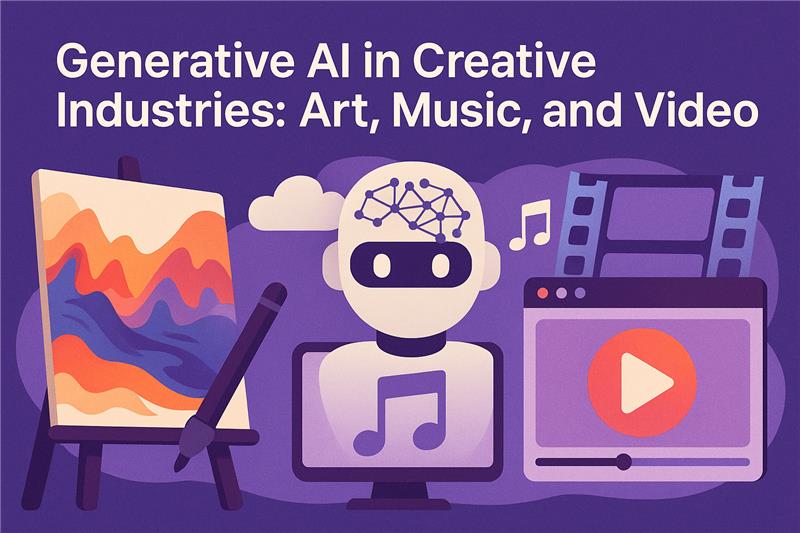
Generative AI is revolutionizing how creative content is conceived, produced, and consumed across industries. Powered by advanced machine learning models—especially those trained on vast datasets of art, sound, and video—generative AI is now capable of mimicking human creativity and even producing entirely novel outputs.
In the creative sectors like visual art, music, and video production, generative AI serves not just as a tool, but as a co-creator. From automating repetitive tasks to offering fresh perspectives, it is enabling artists, musicians, and filmmakers to break traditional boundaries. As creative processes evolve, AI is offering both efficiency and experimentation, allowing individuals and businesses to create high-quality content faster and at lower cost.
This article dives into how generative AI is being used across three major creative areas: visual art, music, and video. We’ll explore real-world applications, tools, benefits, and challenges, as well as the future potential of AI-human collaboration in the creative world.
Generative AI in Visual Art
Generative AI is bringing a paradigm shift to the world of visual art. With the power of machine learning, AI can now create original images, illustrations, paintings, and designs—often in seconds. These systems are trained on massive datasets containing thousands or even millions of visual samples, enabling them to learn patterns, textures, colors, and composition techniques used by human artists.
This technology is not meant to replace artists but to empower them. By using AI tools, creators can generate multiple design concepts, experiment with different styles, and overcome creative blocks—all while saving time and resources. From professional designers and illustrators to hobbyists and entrepreneurs, many are turning to AI to enhance creativity and accelerate production.
Text-to-Image Tools
- Natural Language Prompts: Tools like DALL·E, Midjourney, and Stable Diffusion allow users to input simple text descriptions and generate highly detailed and contextually relevant images. For example, typing “a futuristic cityscape at night in cyberpunk style” can yield complex visuals without any design software.
- Creative Versatility: These tools can produce artwork in a range of styles—watercolor, digital, abstract, or realistic. Artists can generate dozens of variations of a single idea, selecting or combining the best results for their projects.
Style Transfer and Image Enhancement
- AI Style Transfer: Artists can merge two images or apply the visual style of one painting to another. For instance, a photograph can be transformed to resemble the brushwork of Van Gogh or the structure of Cubist art.
- Super-Resolution and Image Cleanup: AI can upscale low-resolution images while preserving quality. It can also remove artifacts, sharpen blurry visuals, and automatically correct lighting and color balance—tasks that traditionally require time-consuming manual effort.
Applications in Visual Industries
- Marketing and Advertising: Agencies can create ad banners, social media visuals, and campaign mockups faster than ever. AI-generated imagery is now part of many real-time marketing workflows.
- Gaming and Animation: Concept artists use AI to develop character designs, environments, and textures. This accelerates early-stage production and helps teams visualize game worlds more efficiently.
- Publishing and Illustration: Authors and content creators use AI tools to create book covers, editorial illustrations, and graphic novel panels without needing a full design team.
Generative AI in Music
Generative AI is redefining the way music is composed, produced, and experienced. With the ability to analyze and mimic complex musical patterns, AI models can now create melodies, harmonies, and rhythms that sound surprisingly human. These tools are not just limited to background music or simple loops—they are capable of composing full-length tracks, aiding musicians in their workflow, and even customizing music for brands or individuals.
What was once a task requiring years of training and expensive equipment is now more accessible, thanks to intuitive platforms powered by AI. Composers, DJs, indie artists, and even developers are embracing this technology to accelerate production, unlock new styles, and reduce creative friction.
AI-Based Music Composition
- Automated Composition: Tools like AIVA, Amper Music, and MuseNet can generate original musical pieces in various genres including classical, pop, jazz, and electronic. These tools analyze historical compositions to understand structure and style, producing results that often surprise even seasoned musicians.
- Customized Output: Users can set mood, tempo, instruments, and structure. Whether it’s a soothing piano tune or a fast-paced EDM beat, AI can tailor compositions to specific needs in seconds.
Assistance for Producers and Artists
- Idea Generation: When musicians face creative block, AI can help by suggesting chords, generating melodies, or offering alternative arrangements. This is particularly helpful in early-stage brainstorming sessions.
- Virtual Co-Creation: Some artists use AI as a collaborative partner, letting it suggest modifications or enhancements to raw ideas. It functions almost like a digital studio assistant that’s always ready to improvise or refine content.
Applications in Music Production
- Content Creation: AI-generated music is widely used in YouTube videos, podcasts, and mobile apps where budget constraints or licensing issues make original compositions hard to obtain.
- Soundtrack and Gaming: Video game developers and filmmakers use generative AI to build dynamic soundtracks that evolve with the user’s interaction or mood of a scene, creating deeply immersive experiences.
Generative AI in Video & Animation
Generative AI is making a significant impact on video production and animation, enabling creators to produce high-quality visual content faster and with fewer resources. Whether it’s generating video from text prompts, animating static images, or enhancing post-production effects, AI is automating many labor-intensive steps traditionally handled by large teams and costly equipment.
As demand for short-form video content surges on platforms like YouTube, Instagram, and TikTok, AI is proving especially useful for creators, marketers, educators, and storytellers who need compelling visuals quickly and affordably.
Text-to-Video and Image-to-Video Tools
- Text-Based Video Generation: Platforms like Runway, Pika, and Synthesia can create short video clips using only text descriptions. Users simply enter a prompt like “sunrise over mountains with flying birds,” and the system renders a realistic animation within minutes.
- Image Animation: Tools can animate static images, such as portraits or illustrations, turning them into expressive, moving characters for use in social media, ads, or education.
Storyboarding and Animation Support
- AI-Powered Storyboarding: AI tools can take a script or plot outline and automatically generate visual storyboards. This helps filmmakers and marketers visualize scenes before investing in full production.
- Assisted Animation: In animation workflows, AI helps by interpolating frames, syncing voiceovers with character lip movement, and adding motion effects—reducing the need for frame-by-frame animation.
Editing and CGI Enhancement
- Smart Editing Tools: AI now assists in cutting scenes, correcting lighting, adjusting colors, and even removing background noise in audio—all of which streamline the editing process for creators and editors.
- Visual Effects Automation: Complex CGI effects like smoke, fire, explosions, or particle movements can be generated with AI, removing the need for expensive simulations or large rendering farms.
Benefits of Generative AI in Creative Fields
Generative AI is unlocking new possibilities in the creative world. It enhances productivity, reduces costs, and opens the door for innovation. Whether you’re an independent artist or part of a large production studio, these benefits offer both practical and imaginative advantages.
Enhanced Creativity
- Idea Exploration: AI helps creators explore ideas beyond their usual scope. Artists can experiment with styles, sounds, or video concepts they may not have attempted before—offering fresh inspiration.
- Rapid Prototyping: Creators can generate multiple iterations of a design, song, or scene quickly, allowing for better creative decision-making and refinement.
Cost Efficiency
- Lower Production Costs: With AI automating key parts of the creative workflow, there’s less need for expensive tools or large teams, making production more accessible.
- Time-Saving: From storyboard generation to audio mastering, tasks that used to take hours or days can now be done in minutes with minimal input.
Accessibility for All
- Tools for Non-Experts: You don’t need to be a trained musician, designer, or animator to create compelling content. AI tools simplify processes so anyone can contribute creatively.
- Global Collaboration: Cloud-based generative AI tools allow artists from different parts of the world to collaborate in real-time, eliminating technical or financial barriers.
Customization at Scale
- Personalized Content: Generative AI makes it possible to create highly personalized content—music, images, or video—tailored to a specific brand, audience, or individual user.
- Dynamic Media: Marketers and developers can use AI to generate content that adapts in real-time, such as custom soundtracks or visuals based on user behavior.
Challenges and Ethical Concerns
While generative AI offers groundbreaking opportunities, it also brings challenges that creators and organizations must address. These concerns span legal, ethical, and technical areas, especially as AI-generated content becomes harder to distinguish from human-made work.
Intellectual Property Issues
- Originality and Ownership: One of the biggest questions is who owns AI-generated content—the user, the platform, or the AI system’s developers? Current copyright laws are still evolving and often don’t clearly address AI-produced works.
- Training Data Use: Many AI models are trained on publicly available artworks, music, or videos. This raises concerns when outputs closely mimic copyrighted content without permission or credit.
Loss of Human Creativity
- Over-Reliance on AI: There’s a growing fear that creatives may become too dependent on AI, potentially diminishing their original thinking and artistic expression.
- Generic Output Risk: While AI can generate fast results, those outputs may lack the emotional depth or cultural context that human creators bring to the table.
Bias and Representation
- Dataset Bias: AI models reflect the data they are trained on. If the training data lacks diversity, the outputs can carry gender, racial, or cultural biases—sometimes unintentionally reinforcing stereotypes.
- Ethical Curation: Ensuring fairness in output requires better-curated training datasets and responsible design of AI systems.
Deepfakes and Misinformation
- Video and Audio Manipulation: AI-generated deepfakes can convincingly alter appearances and voices, raising concerns about misinformation, fraud, and erosion of public trust.
- Content Authenticity: As AI-generated visuals and sounds become indistinguishable from real ones, creators and platforms must find ways to ensure transparency and accountability.
Future of Generative AI in the Creative Industry
The future of generative AI in creative fields looks promising, with innovations set to further blur the lines between human and machine-made art. As models become more intelligent and better trained, AI is expected to take on more complex and nuanced creative tasks—making it a true collaborator in artistic processes rather than just a tool.
From real-time interactive content to hyper-personalized experiences, the next wave of generative AI is poised to transform how we create, distribute, and enjoy creative media across the world.
Human-AI Collaboration
- Creative Synergy: Rather than replacing artists, AI is evolving into a creative partner. Future workflows will emphasize a hybrid model where human intuition and emotion meet AI’s speed and scalability.
- Tools for New Mediums: Artists will be able to express themselves through completely new mediums—like immersive VR art or AI-assisted performance art—that were previously inaccessible.
Real-Time Content Generation
- Interactive Storytelling: Games and virtual worlds will use AI to adapt storylines dynamically, responding to user input to create unique experiences every time.
- Live Audio and Visuals: AI will be able to generate music, dialogue, or visuals in real time for live performances, virtual concerts, and educational simulations.
Ethical and Regulatory Developments
- Stronger Legal Frameworks: As generative AI content becomes mainstream, governments and organizations will likely establish clear rules around ownership, usage, and attribution.
- Digital Watermarking: Future AI models may include built-in systems that tag outputs with identifiers, helping consumers and platforms verify content authenticity.
Democratization of Creativity
- Empowering Individuals: With user-friendly AI tools, anyone will be able to create professional-level content—lowering the entry barrier to creative industries.
- Wider Market Access: Artists from underserved or remote communities can now reach global audiences with the help of AI tools that streamline production and marketing.
Conclusion
Generative AI is transforming how we create, consume, and collaborate across art, music, and video. It allows individuals and businesses to break creative barriers, accelerate production timelines, and personalize content at scale. However, as this technology becomes more embedded in our workflows, it’s important to balance innovation with ethical responsibility and proper regulation.
If you’re looking to implement generative AI in your creative projects, choosing the right technology partner is crucial. Explore this curated list of top-rated Generative AI Development Company to find experienced teams that can bring your ideas to life.
 AI Innovation
Leave a comment