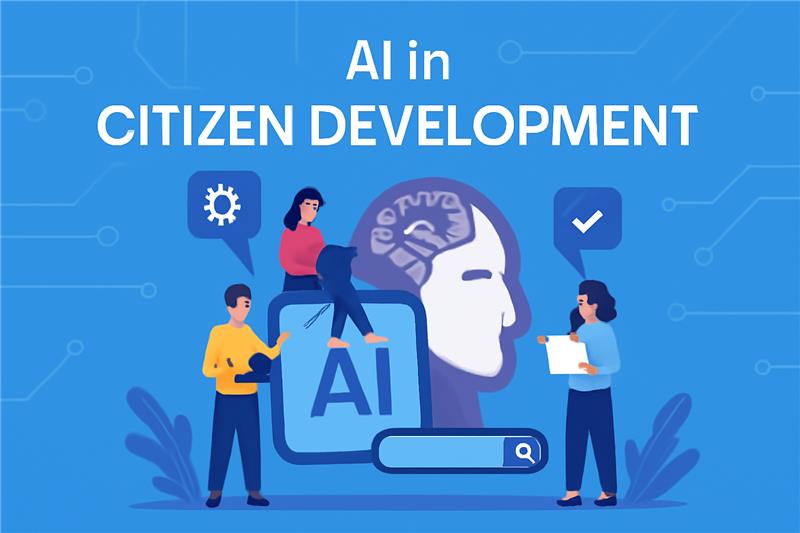
Technology is evolving at breakneck speed, and one of the biggest transformations taking place today is the fusion of Artificial Intelligence (AI) with citizen development. No longer is software creation a job reserved for seasoned developers. Thanks to low-code/no-code platforms and AI, everyday business users — or “citizen developers” — are taking charge of app development.
In this article, we’ll explore how AI is amplifying the power of citizen development, what it means for businesses, and why this shift is not just a trend — it’s a strategic move you can’t afford to miss.
What is Citizen Development?
Citizen development is the practice of empowering non-technical employees to create applications using visual, no-code or low-code platforms. These platforms eliminate the need for traditional programming skills by allowing users to design workflows, data models, and interfaces through drag-and-drop functionality.
But where it truly becomes revolutionary is when AI enters the picture. AI enables these platforms to become intelligent assistants—automating logic, understanding user intent, suggesting optimizations, and catching errors before they become problems. With AI-powered tools, citizen developers don’t just build apps — they build smart, adaptive solutions.
This approach not only reduces dependency on IT departments but also accelerates innovation. It lets people closest to the problem — whether they’re in marketing, HR, operations, or finance — quickly create the solutions they need, without waiting weeks or months for IT teams to catch up.
Key AI Capabilities in Citizen Development
AI doesn’t just speed up citizen development — it fundamentally enhances the way apps are built and used. By integrating AI into no-code and low-code platforms, these tools become intuitive, error-resistant, and more aligned with user intent. Let’s explore the core AI features transforming citizen development today.
AI-Powered Workflow Automation
AI streamlines complex business processes by automating repetitive and time-consuming tasks. It analyzes how workflows typically function and makes real-time decisions about the next steps. For example, an AI system can auto-assign tasks based on employee workload or send reminders for approvals without human intervention.
- Smart Triggers: AI automatically detects events (like form submission or data update) and initiates follow-up actions based on conditions.
- Adaptive Routing: Workflows can reroute based on real-time inputs — such as who’s available, or how urgent a task is.
- Process Suggestions: AI observes how workflows are used and recommends optimizations to reduce delays or improve consistency.
Smart Error Detection and Debugging
One of the major challenges for non-technical users is identifying and fixing errors in logic or functionality. AI makes this easy. It monitors workflows for inconsistencies, missing conditions, or faulty data flows and provides suggestions in plain language.
- Real-Time Validation: AI checks inputs, logic branches, and conditions while a workflow is being built to prevent invalid configurations.
- Self-Healing Flows: In some platforms, AI can auto-fix minor issues such as empty fields, loop errors, or broken links between modules.
- Human-Friendly Alerts: Instead of cryptic error messages, users receive clear feedback about what went wrong and how to fix it.
AI Chatbots and Virtual Assistants
AI assistants and chatbots now come built into many no-code tools. These virtual helpers guide users through the app-building journey by offering real-time support, answers, and even pre-built templates based on context.
- Conversational Help: Users can ask questions in natural language and get step-by-step assistance on configuring logic or forms.
- Template Recommendations: Based on the user’s business function (like HR or finance), the AI can suggest templates that fit their needs.
- Voice-Enabled Interactions: In some platforms, users can describe their app idea verbally, and the assistant converts it into a draft flow.
AI Data Insights
Beyond building apps, AI plays a crucial role in monitoring and improving them after launch. By analyzing usage patterns, process bottlenecks, and success rates, AI delivers actionable insights to citizen developers.
- Usage Analytics: Know who is using the app, how often, and where users drop off or face delays.
- Performance Scoring: AI assigns quality scores based on response time, completion rate, and error frequency.
- Optimization Tips: It provides specific advice to tweak steps, fields, or automation to improve outcomes.
Top Benefits of Integrating AI
Combining AI with citizen development offers a wide array of benefits for both business users and IT departments. It empowers organizations to innovate faster, operate more efficiently, and achieve better outcomes without overburdening technical teams. Let’s break down the key advantages of this powerful combination.
Efficiency and Speed
AI shortens the development cycle by automating many of the tedious steps involved in building applications. Instead of spending days writing code or configuring complex logic, users can complete tasks in minutes using smart suggestions and pre-built components. AI also reduces back-and-forths between business teams and IT by helping users get things right the first time.
Accuracy and Quality
AI helps eliminate common human errors that may arise during app creation. It performs checks on logic, data flow, and user input to ensure everything works as expected. This results in higher-quality applications that are more stable, secure, and user-friendly from day one. AI also ensures that applications stay compliant with business rules and standards.
Scalability
As organizations grow, their digital needs expand — more users, more processes, more complexity. AI makes it easier to scale applications without increasing the workload. It adapts workflows based on real-time usage patterns and automates maintenance tasks. Whether you’re supporting 10 users or 10,000, AI ensures the app performs smoothly without needing constant IT intervention.
Cost Savings
Building applications through traditional methods often involves high labor costs, long project timelines, and expensive software infrastructure. With AI-enhanced citizen development, companies drastically reduce the need for specialized developers. Business users can build tools themselves, which slashes costs and minimizes delays, all while freeing up IT for more strategic initiatives.
Strategic IT Focus
IT teams are frequently overwhelmed by requests for small tools or process updates. AI in citizen development shifts this burden. Business users take care of routine app creation, while IT can focus on larger goals — like innovation, data security, and enterprise architecture. This creates a healthy collaboration where both sides focus on what they do best.
Advanced AI Trends in Citizen Development
As AI technology matures, its role in citizen development is going far beyond basic automation. Emerging capabilities like generative AI, AI agents, and natural language interfaces are taking user empowerment to an entirely new level. These trends are reshaping how applications are created, managed, and evolved — with minimal technical input.
AI Agents as Co-Developers
One of the most exciting advancements is the rise of autonomous AI agents that act like digital co-developers. These agents can take instructions from users, perform complex app-building tasks, and even update workflows automatically based on performance data. They’re more than tools — they act like collaborators that learn, adapt, and optimize in real time.
- Autonomous Execution: Agents can build app modules or configure logic independently from user prompts.
- Performance Learning: They analyze app usage and refine logic to improve outcomes continuously.
- Smart Maintenance: Agents identify outdated logic or inefficient paths and make recommendations — or act on them automatically.
Natural Language Interfaces and Generative AI
Generative AI, especially large language models (LLMs), is radically simplifying how users interact with development platforms. Instead of navigating menus and logic trees, users can just describe what they want in plain English. The AI understands the intent, interprets context, and generates full workflows or application screens in seconds.
- Text-to-App Generation: Users write prompts like “create a leave request system,” and the AI assembles the key components instantly.
- Adaptive Responses: As users refine their input, the AI updates the app structure on the fly, making iteration seamless.
- Low Friction Onboarding: First-time users can build useful apps without needing to learn platform mechanics.
Unstructured Data Handling
Another frontier is AI’s ability to process unstructured data — such as PDFs, emails, voice commands, and handwritten forms. In traditional systems, this type of data would require manual entry or complex integrations. But now, AI can understand and convert it into structured inputs that feed directly into workflows.
- OCR (Optical Character Recognition): AI scans documents, receipts, or photos and extracts usable text and numbers.
- NLP (Natural Language Processing): Emails and messages are analyzed for meaning and routed to the right workflows automatically.
- Multi-Source Integration: AI combines data from varied formats into a single coherent dataset for apps to use.
Real-World Use Cases
AI-driven citizen development is already reshaping industries. From finance and healthcare to retail and HR, businesses are using low-code tools powered by AI to build solutions faster, more accurately, and with fewer resources. Below are real-world examples that showcase the impact across different sectors.
Finance and Banking
Financial institutions often need custom tools for internal approvals, client onboarding, and compliance tracking. With AI-powered citizen development, non-technical teams in banks can now create these solutions independently. For example, AI can automate risk assessment workflows or analyze transaction patterns to flag suspicious activity — all without IT involvement.
- Loan Application Processing: AI guides staff through building workflows to review, verify, and approve loans faster.
- Regulatory Reporting: Data from multiple systems can be consolidated and auto-formatted for audit and compliance.
Healthcare and Life Sciences
Hospitals and research organizations use citizen development platforms to manage patient records, appointment scheduling, and lab workflows. AI enables doctors and staff to build applications that adapt to patient needs and automate repetitive clinical tasks like updating records or sending follow-ups.
- Patient Intake Forms: AI creates smart forms that auto-adjust based on symptoms or history.
- Compliance Workflows: Tracks consent, testing, and documentation — reducing human errors and delays.
Retail and E-Commerce
Retailers often need to respond quickly to market shifts, promotions, and customer behavior. AI-driven apps created by marketing or operations teams can automate discount campaigns, inventory restocks, or customer feedback loops — without coding. These agile tools help teams stay ahead of consumer demand.
- Promotional Workflows: AI auto-generates sales campaign apps based on inventory and user segments.
- Customer Service Dashboards: Smart dashboards help resolve complaints by analyzing common issues in real time.
Human Resources (HR)
HR teams frequently use AI-enabled citizen development to streamline hiring, onboarding, and performance tracking. They can design systems that score resumes, schedule interviews, and monitor employee engagement using sentiment analysis — all without developer support.
- Resume Screening Tools: AI sorts candidates based on job match and flags top talent instantly.
- Onboarding Flows: New hire checklists are dynamically customized based on department and location.
Challenges and Considerations
While AI in citizen development offers impressive benefits, it also comes with challenges that organizations must manage carefully. Without proper oversight, rapid development can lead to issues like data privacy risks, lack of governance, and low-quality apps. Below are the key areas that need thoughtful planning and strategy.
Data Privacy and Security
Citizen-developed apps often deal with sensitive business or customer data. When AI automates processes, there’s a risk of exposing information to unverified sources or third-party models. Companies must ensure that apps follow strict data protection policies, including encryption, access control, and secure hosting.
- Compliance Checks: All apps must comply with laws like GDPR, HIPAA, or internal data policies.
- Data Minimization: Limit the amount of data AI models access to only what’s needed for the workflow.
Governance and Oversight
Without proper governance, citizen development can lead to “shadow IT” — where unmonitored apps create security holes or operational confusion. Organizations need clear policies and a framework for reviewing, approving, and managing apps built by citizen developers, especially when AI is involved.
- Platform Controls: Use platforms that allow IT to monitor, approve, and update user-built apps centrally.
- Audit Trails: Ensure every change or data access event is logged and reviewable by admins.
Bias and Inaccuracy in AI Models
AI systems learn from existing data — and if that data contains biases or errors, the AI may reinforce them. In citizen development, this could lead to flawed decision-making in apps related to hiring, finance, or customer interaction. Continuous monitoring and testing of AI-driven logic is essential.
- Diverse Data Sets: Train AI features on inclusive, well-balanced data to reduce unintended bias.
- Human Oversight: Use AI to assist — not replace — critical thinking and decision-making.
Platform Limitations
Not all no-code platforms are built equally. Some may offer only basic AI features, while others may lack integration support or scalability. Businesses need to choose their platforms wisely, based on current needs and future goals, especially if they plan to scale AI usage across departments.
- Feature Evaluation: Assess AI capabilities like NLP, automation, analytics, and integration before committing.
- Vendor Reliability: Select providers with proven security, compliance, and customer support track records.
Conclusion
AI in citizen development is not just a passing trend — it’s a strategic advantage that organizations can’t afford to ignore. As tools become smarter and more user-friendly, business teams are now empowered to solve problems, innovate processes, and build solutions at a scale and speed that was previously impossible. This shift reduces the burden on IT while accelerating digital transformation across every department.
For organizations ready to take the next step, partnering with the right experts can make a significant difference. Explore top-rated AI Development Companies to unlock the full potential of AI in your citizen development strategy.
 AI Innovation
Leave a comment