Author: AIInnovation

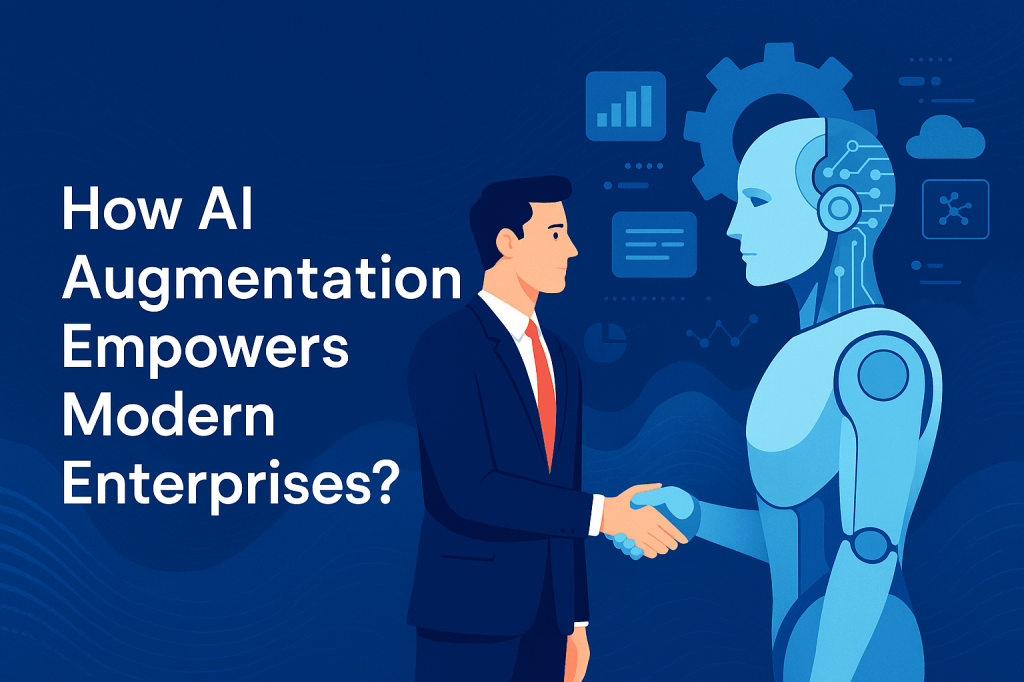
  • How AI Augmentation Empowers Modern Enterprises?

    How AI Augmentation Empowers Modern Enterprises?

    Artificial Intelligence has moved far beyond simple automation. Modern businesses no longer use AI just to replace repetitive tasks. Instead, they are embracing a new approach called AI augmentation, where AI works alongside humans as a powerful digital partner. Rather than taking over jobs, it enhances human skills, improves decision-making, and opens new opportunities for innovation.

    In today’s competitive market, enterprises face overwhelming data, rapidly changing customer demands, and increasing operational complexity. AI augmentation helps them tackle these challenges without removing the human element. It combines the speed and precision of machines with the creativity, empathy, and strategic thinking of humans.

    Let’s understand what AI augmentation is, how it works, and why it is becoming essential for enterprises that want to stay ahead.

    What is AI Augmentation?

    AI augmentation refers to the practice of enhancing human intelligence and capabilities with the help of AI technologies. Instead of replacing employees, AI acts as a collaborative assistant. It processes massive amounts of information, finds patterns, and gives recommendations, while humans make the final decisions.

    For example, a customer service agent can use an AI chatbot to handle routine questions, while focusing on complex issues that require empathy. A business analyst can rely on AI-generated data insights but still apply human judgment before making a strategic move. This combination makes work faster, smarter, and more effective.

    The key difference between AI augmentation and full automation is human control. Automation removes human intervention completely, but augmentation enhances human roles by reducing workload and improving outcomes.

    How Does AI Augmentation Work?

    AI augmentation works by integrating advanced AI tools into business workflows. These tools:

    • Analyze complex data: AI scans structured and unstructured data to extract meaningful insights.
    • Predict outcomes: Machine learning models forecast trends, risks, and opportunities for better decision-making.
    • Assist in real time: AI systems suggest actions or solutions instantly during ongoing processes.
    • Learn continuously: Over time, AI improves its accuracy through user feedback and new data.

    This process keeps humans in charge while giving them the superpower of data-driven intelligence.

    Core Characteristics of AI Augmentation

    AI augmentation is not just about adding smart tools to your business. It’s about creating a balanced partnership between humans and machines. For enterprises, this means building a system where technology amplifies human strengths while still relying on human judgment. Here are the core characteristics that define AI augmentation:

    Human-in-the-Loop

    One of the most important aspects of AI augmentation is keeping humans involved. Unlike full automation, where machines operate independently, augmented systems always include human oversight. AI can provide recommendations, detect errors, or automate routine tasks. But the final decision or action often remains in the hands of humans. This approach improves trust and reduces risks caused by blind automation.

    Contextual Awareness

    AI augmentation is designed to understand the context in which it operates. For example, it doesn’t just analyze raw data—it considers business goals, customer preferences, and external market factors. This helps the system provide more accurate insights. A sales forecasting tool, for instance, might adjust predictions based on economic changes or seasonal demand rather than relying on historical data alone.

    Explainability and Trust

    Enterprises need to trust the decisions suggested by AI. That’s why augmented AI solutions focus on transparency. They use Explainable AI (XAI) techniques to show how and why a recommendation was made. For example, if an AI model suggests a pricing strategy, it will also explain which data points influenced its decision. This transparency builds confidence among employees and leadership teams.

    Interactive Interfaces

    AI augmentation is effective only when it is easy to use. Augmented systems often come with interactive dashboards and visual tools that allow employees to communicate with AI seamlessly. For instance, a manager can ask a virtual assistant for performance insights and receive a clear visual report instantly. This makes AI accessible to both technical and non-technical users.

    Continuous Learning

    AI augmentation is not static. It evolves continuously as it learns from new data and user feedback. Over time, the system becomes more intelligent and better aligned with the business’s needs. For example, a recruitment AI might learn to better predict cultural fit as it reviews more successful hiring cases over time.

    Multi-Modal Fusion

    Modern AI augmentation combines different types of data for deeper insights. It can process text, images, videos, audio, and numerical data all at once. For example, a healthcare AI might analyze patient records, lab reports, and medical imaging together to assist doctors in diagnosis. This multi-modal approach makes AI augmentation more powerful and versatile.

    These core characteristics ensure that AI augmentation remains a supportive partner rather than a replacement for human intelligence. It gives enterprises a way to scale knowledge, improve performance, and make better decisions without losing the human touch.

    Why Do Modern Enterprises Need AI Augmentation?

    Enterprises today are operating in a highly dynamic environment. They face massive data flows, unpredictable market shifts, increasing competition, and growing customer expectations. Relying only on human capabilities is no longer enough. At the same time, fully automating processes may remove the creativity and ethical reasoning that humans bring. This is where AI augmentation becomes critical. It provides the perfect balance between human expertise and machine intelligence.

    Here are some key reasons why modern enterprises must embrace AI augmentation:

    Handling Complexity

    Businesses deal with large volumes of complex data every day. Analyzing this manually is slow and prone to errors. AI augmentation can process massive datasets in seconds, identify hidden patterns, and offer meaningful insights. For example, a financial firm can use AI to detect fraudulent transactions from millions of records. However, humans still interpret the final results, ensuring the decisions are accurate and ethical. This combination helps enterprises manage complexity effectively.

    Scalable Personalization

    Customers now expect personalized experiences at every touchpoint. AI augmentation makes it possible to deliver tailored services at scale. For instance, AI can analyze customer buying history, social media interactions, and preferences to suggest the best product or service. Meanwhile, marketing teams add the human touch by crafting creative campaigns based on these insights. This hybrid approach improves customer satisfaction and brand loyalty.

    Cost-Efficient ROI

    Unlike full automation projects that can be expensive and risky, AI augmentation is more cost-effective. It can be implemented step by step, focusing on critical areas where AI can support employees. This approach reduces operational costs, improves productivity, and delivers faster returns on investment. For example, augmented AI tools in customer service can lower support costs while improving response times, without removing the need for human agents.

    Operationalized AI

    AI augmentation seamlessly integrates into everyday workflows. It doesn’t require employees to change the way they work entirely. Instead, it acts as a smart assistant that provides recommendations and insights in real time. A sales team, for example, can receive AI-driven lead scoring directly inside their CRM system. This integration makes AI practical and easy to adopt across different departments.

    Faster Decision-Making

    In highly competitive industries, timing is everything. AI augmentation enables businesses to make faster and smarter decisions. It continuously monitors data, predicts possible outcomes, and alerts decision-makers about risks or opportunities. Humans then take immediate, well-informed actions. This helps enterprises stay ahead of competitors and respond quickly to market changes.

    Empowering Human Creativity

    When routine and data-heavy tasks are handled by AI, employees gain more time to focus on creative and strategic work. For example, designers can use AI-generated ideas as a starting point and then refine them with their creative skills. Similarly, business leaders can spend less time crunching numbers and more time on innovation and long-term strategy. This human-AI collaboration unlocks new levels of productivity and innovation.

    In short, AI augmentation helps enterprises work smarter, serve customers better, and adapt quickly to market changes. It bridges the gap between technology and human expertise, enabling organizations to grow without losing their unique human value.

    How AI Augmentation Transforms Key Business Areas

    AI augmentation is not limited to a single department. It has the potential to enhance multiple areas of an enterprise, from customer-facing operations to internal workflows. By combining machine efficiency with human expertise, it creates new opportunities for innovation and growth. Let’s explore how AI augmentation is reshaping key business functions.

    Customer Experience

    Delivering a seamless and personalized customer experience is now a top priority for enterprises. AI augmentation helps in several ways. AI chatbots can handle routine inquiries instantly, reducing wait times for customers. At the same time, human agents can step in for complex or sensitive issues. AI also analyzes customer feedback, behavior, and preferences, enabling businesses to create hyper-personalized offers and improve satisfaction rates. For example, an AI-augmented support team can proactively reach out to customers before they face a problem, creating a truly customer-centric experience.

    Decision-Making & Strategy

    Making strategic business decisions requires accurate insights. AI augmentation empowers leaders with real-time data analysis and predictive analytics. For example, a retail business can use AI to forecast demand, optimize inventory, and avoid stock shortages. Executives still use their judgment to align these insights with long-term goals. This mix of machine-driven data intelligence and human strategic thinking reduces risks and supports smarter decisions across the enterprise.

    Employee Productivity

    Employees often spend too much time on repetitive tasks such as data entry, report generation, or scheduling. AI augmentation automates these routine activities, freeing up employees to focus on meaningful work. For example, AI can create a draft report, while the employee only needs to review and finalize it. Augmented tools can also provide real-time suggestions, improving accuracy and reducing errors. As a result, employees become more productive and engaged in tasks that truly add value.

    Data Analysis and Insights

    Enterprises are generating enormous amounts of data every day. Without AI, analyzing such large datasets is time-consuming and overwhelming. AI augmentation makes it easier by filtering, organizing, and analyzing data at scale. For instance, an AI-powered analytics platform can highlight key trends, anomalies, and opportunities hidden in raw data. Human analysts then interpret these findings and make strategic decisions. This collaboration between AI and humans results in faster, more accurate insights.

    Sales and Marketing

    In sales and marketing, AI augmentation enhances customer targeting and campaign effectiveness. AI can segment audiences based on their behavior, predict which leads are more likely to convert, and suggest the best messaging for each segment. Marketing teams can then use these insights to craft creative campaigns that resonate with the audience. In sales, AI can prioritize leads for follow-up, saving time and increasing the chances of closing deals. This hybrid approach maximizes both efficiency and creativity in driving revenue growth.

    Innovation and R&D

    Innovation often requires analyzing vast information from different sources, spotting trends, and generating new ideas. AI augmentation speeds up this process. For example, in pharmaceuticals, AI can analyze millions of research papers and clinical trial results to suggest new drug formulations. Human scientists then validate these findings and innovate further. This accelerates research and helps enterprises stay ahead of competitors in developing new products and services.

    By transforming these core business areas, AI augmentation ensures that enterprises become more agile, customer-focused, and data-driven while still retaining the human values that drive creativity and trust.

    The Future of AI Augmentation in Enterprises

    The future of enterprises will be shaped by a deeper collaboration between humans and AI. As AI technologies evolve, they will become even more intelligent, adaptive, and easier to integrate into daily workflows. But instead of replacing people, the future trend points toward an amplified partnership. Humans will focus on high-value creative and strategic tasks, while AI will take care of data-heavy, repetitive, and analytical work.

    Here’s what we can expect in the future of AI augmentation:

    Deeper Integration with Enterprise Systems

    AI augmentation will be seamlessly embedded into enterprise platforms like CRMs, ERPs, and collaboration tools. Employees won’t have to switch between different applications. Instead, AI assistants will work within the tools they already use, providing real-time insights and recommendations. This will make AI support more accessible and intuitive for everyone in the organization, from frontline workers to executives.

    Advanced Personalization

    Future AI systems will go beyond basic personalization. They will understand not only customer behavior but also emotions and intent. This means businesses will deliver experiences that feel more human-like. For example, AI could detect when a customer is frustrated and alert a human agent to step in with empathy. This emotional intelligence layer will redefine how enterprises engage with their audiences.

    Autonomous yet Guided AI

    While AI will become more autonomous, human oversight will remain crucial. We will see hybrid decision-making models where AI can initiate actions but still requires final approval from humans for critical decisions. This approach will maintain ethical standards and ensure that AI remains aligned with organizational values.

    Continuous Learning and Adaptation

    AI augmentation will not remain static. Future systems will continuously learn from real-world feedback, evolving to become more accurate and reliable over time. For instance, AI tools used in healthcare will improve diagnostic accuracy with each new case, while in finance, they’ll become better at predicting market shifts based on live data. This self-improving capability will keep enterprises ahead of rapid market changes.

    Augmented Workforce

    The workforce of the future will rely heavily on augmented intelligence. Employees will use AI-driven tools as “digital co-workers” that help them brainstorm ideas, find relevant information, and speed up execution. Job roles will shift from task-oriented to value-oriented, with humans focusing on creativity, empathy, and leadership while AI handles execution-heavy tasks. This will create a more empowered and productive workforce.

    Ethical and Responsible AI Practices

    As AI augmentation becomes more widespread, enterprises will need strong governance frameworks to ensure ethical use. Transparency, data privacy, and fairness will be key priorities. Companies that invest in responsible AI will build more trust with customers and employees, securing a competitive advantage in the long run.

    Overall, the future of AI augmentation will lead to enterprises that are smarter, more adaptable, and more human-centric. It will enable organizations to innovate faster, respond quickly to challenges, and create better experiences for customers and employees alike.

    Conclusion

    AI augmentation is transforming the way modern enterprises operate. It doesn’t aim to replace people but instead enhances human intelligence, creativity, and decision-making. By leveraging AI to handle complex data analysis, repetitive tasks, and predictive insights, businesses can focus on delivering higher value to customers and driving innovation. This human-AI collaboration creates smarter, more agile organizations that can stay ahead in today’s competitive markets.

    From improving customer experience to boosting employee productivity and accelerating innovation, AI augmentation touches every aspect of a business. And as technology evolves, its impact will only grow deeper—making enterprises more efficient, ethical, and human-centric at the same time.

    If you’re looking to harness the power of AI for your enterprise, partnering with the right experts is crucial. Explore the best solutions with a Top AI Development Company and take the first step toward building an augmented future for your organization.
  • AWS Generative AI Solutions: How it Can Help You Build Powerful Applications?

    AWS Generative AI Solutions: How it Can Help You Build Powerful Applications?

    Generative AI has emerged as one of the most disruptive technologies of the decade. Unlike traditional AI models that simply classify or predict, generative AI can create entirely new content. It can write human-like text, design images, generate code, compose music, and even simulate real conversations. This makes it a game-changer for businesses looking to innovate faster.

    However, building and training generative AI models from scratch requires massive amounts of data, specialized talent, and expensive computational resources. For many organizations, this is a major roadblock. That’s where Amazon Web Services (AWS) steps in. AWS offers a wide range of generative AI solutions that allow developers and businesses to access cutting-edge AI models without worrying about infrastructure or complex model training.

    With AWS Generative AI Solutions, you can:

    • Leverage Pre-Trained Models: Access powerful foundation models created by leading AI companies.
    • Reduce Development Complexity: Focus on application logic instead of managing machine learning pipelines.
    • Scale Effortlessly: Use AWS cloud infrastructure to handle any workload, from small experiments to enterprise-grade deployments.
    • Accelerate Innovation: Rapidly prototype and launch generative AI applications with minimal upfront cost.

    In the following sections, we’ll explore what AWS Generative AI Solutions are, how they work, the core tools available, and real-world scenarios where they can transform your business.

    What Are AWS Generative AI Solutions?

    AWS Generative AI Solutions are a set of cloud-based services, tools, and APIs that enable businesses to build intelligent applications capable of creating new content. Instead of requiring you to train a model from scratch, AWS connects you to high-quality foundation models hosted on its cloud infrastructure.

    These foundation models are pre-trained on massive datasets and optimized for a variety of tasks such as text generation, summarization, image creation, conversational AI, and personalization. With AWS, you can interact with these models through simple APIs, fine-tune them for your business needs, and deploy them at scale without worrying about the underlying infrastructure.

    In simpler terms, AWS takes care of the heavy lifting—like training, optimizing, and hosting large models—so you can focus on building applications that deliver value to your customers.

    Why Are AWS Generative AI Solutions Important?

    Generative AI has a wide range of potential, but the barrier to entry has traditionally been high. AWS lowers this barrier by:

    • Making AI Accessible: Even small businesses without dedicated AI teams can now integrate advanced AI capabilities.
    • Reducing Time-to-Market: Pre-trained models allow you to skip lengthy model training phases.
    • Ensuring Cost Efficiency: Pay-as-you-go pricing means you only pay for what you use, avoiding large upfront investments.
    • Providing Scalability: As your business grows, AWS automatically scales your AI workloads without downtime.

    By combining cutting-edge AI models with the scalability of the cloud, AWS democratizes access to generative AI, enabling innovation across industries like e-commerce, healthcare, education, media, and more.

    How Does AWS Generative AI Work?

    AWS makes the entire generative AI workflow simple and structured, even for businesses without deep machine learning expertise. Instead of starting from scratch, you follow a clear process that takes you from raw data to an AI-enabled application. The workflow generally involves four key steps:

    • Step 1: Prepare and organize your data
    • Step 2: Select the right pre-trained foundation model
    • Step 3: Fine-tune the model to match your specific needs
    • Step 4: Integrate the AI into your applications or workflows

    Let’s explore each step in detail with practical examples.

    Step 1: Data Preparation

    Data is the heart of any AI system. The quality of the data you use directly affects the accuracy and usefulness of the model’s output. In AWS, you can store, clean, and organize your data using services like Amazon S3 for storage and AWS Glue for data integration.

    For example, if you’re a retailer building a generative AI-powered product recommendation engine, you might collect:

    • Customer Data: Purchase history, browsing patterns, and demographics
    • Product Information: Descriptions, images, categories, and reviews
    • Interaction Logs: Previous chatbot conversations or customer support tickets

    Before feeding this data into an AI model, AWS helps you clean and structure it properly. Well-prepared data ensures the model understands your domain and produces meaningful outputs.

    Step 2: Model Selection

    Once your data is ready, the next step is selecting the right foundation model. AWS connects you to a library of powerful models through services like Amazon Bedrock. These models are built and hosted by leading AI providers such as Anthropic, AI21 Labs, Stability AI, and Cohere.

    For instance:

    • Text Generation: Choose models like Claude (Anthropic) for chatbots, summarization, or content creation.
    • Image Generation: Use Stability AI’s Stable Diffusion models to create realistic visuals.
    • Code Generation: Pick a model trained for software development to automate coding tasks.

    The beauty of AWS is that you don’t need to train these models yourself. You simply select one that fits your use case and start using it through an API call. This dramatically reduces the time needed to prototype and test ideas.

    Step 3: Fine-Tuning

    Pre-trained models are powerful, but they are designed to be general-purpose. To make them truly effective for your business, you can fine-tune them with domain-specific data. Fine-tuning adjusts the model’s weights or parameters so it understands your industry better.

    For example:

    • Healthcare: Fine-tune the model with medical documents to improve diagnosis recommendations.
    • Finance: Train it with historical financial reports to improve investment insights.
    • Retail: Use product-specific language and customer sentiment data to make more personalized suggestions.

    AWS services like Amazon SageMaker make fine-tuning easier by providing managed training environments. You don’t need specialized infrastructure or deep ML expertise—just provide your curated data, and SageMaker handles the rest.

    Step 4: Application Integration

    The final step is embedding the AI capabilities into your application. AWS offers multiple ways to integrate models into your workflows:

    • APIs: Call the model’s API from your web or mobile app to get AI-generated responses.
    • SDKs: Use AWS SDKs for different programming languages to easily connect your backend to the AI services.
    • Serverless Integration: Combine AWS Lambda and Bedrock for a scalable, event-driven AI pipeline.

    For example, an e-commerce platform can integrate a generative AI model into its product page to generate dynamic descriptions, personalized recommendations, or even answer customer questions in real-time through a chatbot interface.

    By following these four steps, businesses can go from raw data to a fully functional generative AI solution without worrying about complex infrastructure or model training processes. AWS makes the entire lifecycle streamlined and accessible.

    Key AWS Tools for Generative AI

    AWS offers a rich ecosystem of tools and services to support the entire lifecycle of generative AI applications. These tools cover everything from accessing powerful foundation models to fine-tuning, scaling, and managing AI workloads. By combining these services, you can build highly customized and scalable solutions without the burden of managing heavy infrastructure.

    Let’s explore the most important AWS tools that power generative AI development and how they can help you create intelligent, business-ready applications.

    Amazon Q

    Amazon Q is a conversational AI assistant designed to improve productivity for both business users and developers. It can understand natural language queries, retrieve insights from large documents, and even help with code-related tasks.

    For example, a software team can use Amazon Q to:

    • Answer Technical Questions: Ask natural language questions about code, APIs, or system documentation.
    • Summarize Documents: Quickly extract key insights from long reports, manuals, or research papers.
    • Automate Workflows: Integrate with business tools like Slack or Microsoft Teams to provide real-time answers.

    In a customer service setting, Amazon Q can act as a virtual assistant, helping support teams respond to complex queries faster and more accurately. It reduces the need for manual searching, freeing employees to focus on higher-value work.

    Amazon Bedrock

    Amazon Bedrock is the easiest way to build and scale generative AI applications without managing servers or training models. It provides API-based access to a variety of high-performing foundation models from providers like Anthropic, AI21 Labs, Stability AI, and Cohere.

    With Bedrock, you can:

    • Build Chatbots: Create AI-driven conversational experiences without worrying about model training or hosting.
    • Generate Content: Produce blogs, product descriptions, marketing copy, or summaries automatically.
    • Perform Semantic Search: Enable intelligent document search that understands context and meaning.

    The key advantage of Bedrock is that it’s completely serverless. You don’t need to deploy any infrastructure or manage scaling—AWS handles everything. This lets businesses experiment with generative AI quickly, without upfront complexity.

    Amazon SageMaker

    Amazon SageMaker is a fully managed machine learning platform that simplifies building, training, fine-tuning, and deploying custom AI models. While Bedrock focuses on ready-to-use models, SageMaker is for teams that want more control and customization.

    For example:

    • Fine-Tuning Models: Use your domain-specific data to improve a general-purpose model’s accuracy.
    • Experimenting with Models: Try multiple architectures, hyperparameters, or training datasets.
    • Production Deployment: Host trained models with scalable inference endpoints.

    Imagine a healthcare provider fine-tuning a model with patient health records to improve diagnostic recommendations, or a legal firm training a model with contracts to assist with document review. SageMaker provides the flexibility to customize models deeply while still using AWS-managed infrastructure.

    AI Infrastructure

    Generative AI models require massive computational power, especially during training and inference for large workloads. AWS provides specialized AI infrastructure including GPU-accelerated instances, high-speed networking, and distributed storage to meet these demands.

    Some key components include:

    • Amazon EC2 P4 and P5 Instances: GPU-powered instances optimized for deep learning workloads.
    • AWS Trainium & Inferentia Chips: Custom silicon designed for efficient training and inference.
    • Elastic Load Balancing: Automatically manages traffic distribution for AI workloads at scale.

    This infrastructure ensures that even the most complex AI applications can run smoothly, whether you’re serving millions of API requests per day or training a custom large language model.

    Data Foundation

    High-quality data is essential for meaningful AI outputs. AWS offers a robust data foundation with services that help you collect, clean, store, and manage data securely. These include:

    • Amazon S3: Secure, scalable object storage for large datasets.
    • AWS Glue: ETL (extract, transform, load) service for data cleaning and integration.
    • Amazon Athena: Interactive SQL queries on data stored in S3, making analysis easier.

    For example, an e-commerce company could store years of customer purchase data in S3, clean it with AWS Glue, and then use it to fine-tune a generative AI model that personalizes recommendations. AWS ensures your data is always encrypted, protected, and compliant with global regulations.

    Together, these AWS tools create a powerful ecosystem where businesses can build, scale, and manage generative AI applications with minimal effort. Whether you need a simple chatbot or a fully customized AI-powered platform, AWS has a tool that fits your needs.

    Real-World Use Cases of AWS Generative AI

    Generative AI is not just a futuristic concept—it is already transforming industries by automating tasks, improving customer experiences, and unlocking new business opportunities. With AWS Generative AI Solutions, organizations across multiple sectors can implement AI-driven innovations without investing heavily in complex infrastructure or AI research.

    Here are some practical use cases across different industries where AWS Generative AI is making a measurable impact.

    Healthcare

    In healthcare, generative AI is enhancing patient care, speeding up research, and reducing the administrative burden on medical staff. AWS helps healthcare organizations securely handle sensitive data while leveraging powerful AI models.

    Some examples include:

    • Medical Report Summarization: AI can quickly summarize patient histories, lab results, and radiology reports to assist doctors in diagnosis.
    • Drug Discovery: Researchers can use generative models to simulate molecular structures, accelerating the discovery of new treatments.
    • Virtual Health Assistants: Chatbots can answer basic medical queries, schedule appointments, and provide medication reminders.

    For instance, a hospital could integrate Amazon Bedrock to create a secure chatbot that explains medical conditions in simple language, improving patient engagement. At the same time, researchers can use SageMaker to fine-tune models on proprietary medical datasets, ensuring AI recommendations align with their specialized field.

    Retail & E-Commerce

    Retail and e-commerce businesses are leveraging AWS Generative AI to enhance the shopping experience, drive personalization, and optimize marketing efforts.

    Some real-world applications include:

    • Product Descriptions: Automatically generate SEO-friendly product titles and descriptions at scale.
    • Personalized Recommendations: Suggest products based on user browsing and purchase history.
    • AI-Powered Customer Service: Chatbots answer customer queries, reducing response time and improving satisfaction.

    For example, an online store can use Amazon Q to instantly retrieve product information for customers, while Bedrock can generate dynamic descriptions for new items. This saves time for merchants and provides shoppers with more engaging content.

    Finance

    The finance industry relies on accurate data analysis and timely insights. AWS Generative AI can process large volumes of data, helping financial institutions improve decision-making and compliance.

    Common use cases include:

    • Financial Report Analysis: AI models summarize lengthy quarterly reports for faster understanding.
    • Fraud Detection: Generative models simulate unusual transaction patterns to identify potential fraud.
    • Customer Support: AI assistants help customers with account queries, loan details, and investment advice.

    For example, a bank could fine-tune a generative model using SageMaker to analyze client investment portfolios and produce simplified reports for customers. It can also integrate AI chatbots for round-the-clock assistance with complex financial queries.

    Media & Entertainment

    In the media and entertainment industry, content creation is one of the biggest challenges. AWS Generative AI helps automate and enhance creative processes, allowing businesses to produce more engaging material in less time.

    Examples include:

    • Content Generation: Automatically create blog posts, scripts, or social media captions for marketing campaigns.
    • Video & Image Creation: Use AI models like Stable Diffusion to generate high-quality visuals and concept art.
    • Personalized Streaming Experiences: AI recommends movies, music, or shows tailored to individual preferences.

    A streaming platform, for instance, could integrate AWS Bedrock to dynamically generate personalized movie recommendations for users. A gaming company might use generative AI to create realistic in-game characters, dialogue, and immersive environments faster than ever before.

    Other Emerging Use Cases

    Apart from these major industries, AWS Generative AI is also being applied in:

    • Education: AI tutors that create personalized learning materials for students.
    • Legal Services: Contract analysis and automated summarization of legal documents.
    • Manufacturing: Generating design prototypes and simulating production workflows.

    The flexibility of AWS services makes it possible to adapt generative AI solutions to virtually any industry, enabling both small businesses and large enterprises to innovate faster and stay competitive.

    Benefits of AWS Generative AI Solutions

    Choosing AWS for generative AI development brings a wide range of business and technical advantages. It allows companies to experiment with cutting-edge AI models while maintaining security, scalability, and cost control. Whether you’re a startup or a large enterprise, AWS provides the tools to build AI-powered applications faster and with less complexity.

    Here are the key benefits of using AWS Generative AI solutions:

    Scalability and Performance

    AWS is designed to scale on demand, ensuring that your AI applications can handle any level of workload. Generative AI models often require significant computational resources, especially during peak usage times. With AWS, you can instantly scale your infrastructure up or down without worrying about hardware limitations.

    For example:

    • Global Reach: Deploy AI services in multiple AWS regions to serve users worldwide with low latency.
    • Auto-Scaling: Automatically adjust compute resources to handle sudden spikes in demand, like during product launches or campaigns.
    • Optimized Hardware: Access GPU-powered instances and custom AI chips like AWS Trainium for faster model inference.

    This flexibility means you can serve millions of API requests or generate complex AI outputs without delays, ensuring a smooth experience for your users.

    Cost Efficiency

    Building and maintaining AI infrastructure from scratch can be extremely expensive. AWS eliminates this burden by offering a pay-as-you-go pricing model. You only pay for the resources you use, which helps control costs, especially for experimental or seasonal workloads.

    Some cost-saving advantages include:

    • No Upfront Investment: Avoid buying costly servers, GPUs, or data center infrastructure.
    • On-Demand Usage: Run generative AI models only when needed, reducing idle costs.
    • Serverless Options: Services like Amazon Bedrock handle all infrastructure, so you don’t pay for unused capacity.

    For a startup, this means you can prototype and launch generative AI solutions quickly without committing to high fixed costs. Large enterprises can also scale resources intelligently, optimizing operational budgets.

    Enterprise-Grade Security and Compliance

    AI applications often handle sensitive data, making security and compliance critical. AWS provides a secure cloud environment with enterprise-grade encryption, identity management, and compliance certifications.

    Key security benefits include:

    • End-to-End Encryption: Your data remains encrypted at rest and in transit.
    • Access Control: Fine-grained permissions through AWS Identity and Access Management (IAM).
    • Compliance Ready: AWS meets global regulatory standards like HIPAA, GDPR, and SOC for industries like healthcare and finance.

    This means a hospital using AWS for generative AI can process medical records securely, or a bank can safely analyze financial data while meeting strict compliance requirements.

    Faster Time-to-Market

    Instead of spending months building and training AI models, AWS lets you start with pre-trained foundation models. You can integrate them directly into your applications through simple API calls, dramatically reducing development time.

    For example:

    • Pre-Trained Models: Use models from Anthropic, AI21 Labs, or Stability AI without extra training.
    • Rapid Prototyping: Quickly test ideas and iterate on AI features before full deployment.
    • Managed Services: Offload complex infrastructure and model management tasks to AWS.

    A retail company can launch an AI-powered product recommendation engine in weeks instead of months. A media company can generate dynamic marketing content on the fly without hiring a large AI team.

    Flexibility and Innovation

    AWS doesn’t lock you into a single AI model or framework. You can choose from multiple models, fine-tune them, or even bring your own models. This flexibility encourages innovation by letting businesses experiment with different approaches.

    Some ways AWS supports innovation include:

    • Choice of Models: Access text, image, and code generation models from multiple providers.
    • Fine-Tuning Options: Tailor models to your domain-specific data for better accuracy.
    • Integration with Other AWS Services: Combine AI with analytics, databases, or IoT solutions for advanced applications.

    For instance, an automotive company can integrate generative AI with IoT data from vehicles to create smarter predictive maintenance solutions. A fintech startup can combine AI with real-time analytics for personalized financial planning tools.

    Overall, AWS Generative AI solutions remove the traditional barriers to adopting AI. You get access to world-class technology, enterprise-grade security, and the ability to innovate at your own pace—all without managing heavy infrastructure.

    Conclusion

    AWS Generative AI Solutions are transforming the way businesses build intelligent applications. From pre-trained foundation models to enterprise-grade security and scalable infrastructure, AWS provides everything you need to create AI-driven products and services without heavy upfront investment. Whether you want to launch a simple AI chatbot, automate content creation, or fine-tune advanced models for specialized use cases, AWS has a solution that fits your needs.

    By leveraging tools like Amazon Bedrock, SageMaker, and Amazon Q, companies can reduce development time, cut costs, and bring innovative AI-powered experiences to market faster. The flexibility to choose different models, customize them with your own data, and integrate seamlessly with other AWS services makes it easy to adopt generative AI at any scale.

    However, building production-ready AI applications still requires expertise in AI strategy, integration, and user experience. If you’re looking for professional support to implement these solutions effectively, partnering with experienced Generative AI Development Companies can help you maximize the value of AWS services. These experts can guide you through the entire journey, from proof-of-concept to enterprise-grade deployment.

    In today’s competitive digital landscape, businesses that embrace generative AI will unlock new opportunities for innovation, personalization, and automation. With AWS, you can confidently build powerful AI solutions that scale with your ambitions.

  • AI in Citizen Development: The Tech Shift You Can’t Afford to Miss

    AI in Citizen Development: The Tech Shift You Can’t Afford to Miss

    Technology is evolving at breakneck speed, and one of the biggest transformations taking place today is the fusion of Artificial Intelligence (AI) with citizen development. No longer is software creation a job reserved for seasoned developers. Thanks to low-code/no-code platforms and AI, everyday business users — or “citizen developers” — are taking charge of app development.

    In this article, we’ll explore how AI is amplifying the power of citizen development, what it means for businesses, and why this shift is not just a trend — it’s a strategic move you can’t afford to miss.

    What is Citizen Development?

    Citizen development is the practice of empowering non-technical employees to create applications using visual, no-code or low-code platforms. These platforms eliminate the need for traditional programming skills by allowing users to design workflows, data models, and interfaces through drag-and-drop functionality.

    But where it truly becomes revolutionary is when AI enters the picture. AI enables these platforms to become intelligent assistants—automating logic, understanding user intent, suggesting optimizations, and catching errors before they become problems. With AI-powered tools, citizen developers don’t just build apps — they build smart, adaptive solutions.

    This approach not only reduces dependency on IT departments but also accelerates innovation. It lets people closest to the problem — whether they’re in marketing, HR, operations, or finance — quickly create the solutions they need, without waiting weeks or months for IT teams to catch up.

    Key AI Capabilities in Citizen Development

    AI doesn’t just speed up citizen development — it fundamentally enhances the way apps are built and used. By integrating AI into no-code and low-code platforms, these tools become intuitive, error-resistant, and more aligned with user intent. Let’s explore the core AI features transforming citizen development today.

    AI-Powered Workflow Automation

    AI streamlines complex business processes by automating repetitive and time-consuming tasks. It analyzes how workflows typically function and makes real-time decisions about the next steps. For example, an AI system can auto-assign tasks based on employee workload or send reminders for approvals without human intervention.

    • Smart Triggers: AI automatically detects events (like form submission or data update) and initiates follow-up actions based on conditions.
    • Adaptive Routing: Workflows can reroute based on real-time inputs — such as who’s available, or how urgent a task is.
    • Process Suggestions: AI observes how workflows are used and recommends optimizations to reduce delays or improve consistency.

    Smart Error Detection and Debugging

    One of the major challenges for non-technical users is identifying and fixing errors in logic or functionality. AI makes this easy. It monitors workflows for inconsistencies, missing conditions, or faulty data flows and provides suggestions in plain language.

    • Real-Time Validation: AI checks inputs, logic branches, and conditions while a workflow is being built to prevent invalid configurations.
    • Self-Healing Flows: In some platforms, AI can auto-fix minor issues such as empty fields, loop errors, or broken links between modules.
    • Human-Friendly Alerts: Instead of cryptic error messages, users receive clear feedback about what went wrong and how to fix it.

    AI Chatbots and Virtual Assistants

    AI assistants and chatbots now come built into many no-code tools. These virtual helpers guide users through the app-building journey by offering real-time support, answers, and even pre-built templates based on context.

    • Conversational Help: Users can ask questions in natural language and get step-by-step assistance on configuring logic or forms.
    • Template Recommendations: Based on the user’s business function (like HR or finance), the AI can suggest templates that fit their needs.
    • Voice-Enabled Interactions: In some platforms, users can describe their app idea verbally, and the assistant converts it into a draft flow.

    AI Data Insights

    Beyond building apps, AI plays a crucial role in monitoring and improving them after launch. By analyzing usage patterns, process bottlenecks, and success rates, AI delivers actionable insights to citizen developers.

    • Usage Analytics: Know who is using the app, how often, and where users drop off or face delays.
    • Performance Scoring: AI assigns quality scores based on response time, completion rate, and error frequency.
    • Optimization Tips: It provides specific advice to tweak steps, fields, or automation to improve outcomes.

    Top Benefits of Integrating AI

    Combining AI with citizen development offers a wide array of benefits for both business users and IT departments. It empowers organizations to innovate faster, operate more efficiently, and achieve better outcomes without overburdening technical teams. Let’s break down the key advantages of this powerful combination.

    Efficiency and Speed

    AI shortens the development cycle by automating many of the tedious steps involved in building applications. Instead of spending days writing code or configuring complex logic, users can complete tasks in minutes using smart suggestions and pre-built components. AI also reduces back-and-forths between business teams and IT by helping users get things right the first time.

    Accuracy and Quality

    AI helps eliminate common human errors that may arise during app creation. It performs checks on logic, data flow, and user input to ensure everything works as expected. This results in higher-quality applications that are more stable, secure, and user-friendly from day one. AI also ensures that applications stay compliant with business rules and standards.

    Scalability

    As organizations grow, their digital needs expand — more users, more processes, more complexity. AI makes it easier to scale applications without increasing the workload. It adapts workflows based on real-time usage patterns and automates maintenance tasks. Whether you’re supporting 10 users or 10,000, AI ensures the app performs smoothly without needing constant IT intervention.

    Cost Savings

    Building applications through traditional methods often involves high labor costs, long project timelines, and expensive software infrastructure. With AI-enhanced citizen development, companies drastically reduce the need for specialized developers. Business users can build tools themselves, which slashes costs and minimizes delays, all while freeing up IT for more strategic initiatives.

    Strategic IT Focus

    IT teams are frequently overwhelmed by requests for small tools or process updates. AI in citizen development shifts this burden. Business users take care of routine app creation, while IT can focus on larger goals — like innovation, data security, and enterprise architecture. This creates a healthy collaboration where both sides focus on what they do best.

    Advanced AI Trends in Citizen Development

    As AI technology matures, its role in citizen development is going far beyond basic automation. Emerging capabilities like generative AI, AI agents, and natural language interfaces are taking user empowerment to an entirely new level. These trends are reshaping how applications are created, managed, and evolved — with minimal technical input.

    AI Agents as Co-Developers

    One of the most exciting advancements is the rise of autonomous AI agents that act like digital co-developers. These agents can take instructions from users, perform complex app-building tasks, and even update workflows automatically based on performance data. They’re more than tools — they act like collaborators that learn, adapt, and optimize in real time.

    • Autonomous Execution: Agents can build app modules or configure logic independently from user prompts.
    • Performance Learning: They analyze app usage and refine logic to improve outcomes continuously.
    • Smart Maintenance: Agents identify outdated logic or inefficient paths and make recommendations — or act on them automatically.

    Natural Language Interfaces and Generative AI

    Generative AI, especially large language models (LLMs), is radically simplifying how users interact with development platforms. Instead of navigating menus and logic trees, users can just describe what they want in plain English. The AI understands the intent, interprets context, and generates full workflows or application screens in seconds.

    • Text-to-App Generation: Users write prompts like “create a leave request system,” and the AI assembles the key components instantly.
    • Adaptive Responses: As users refine their input, the AI updates the app structure on the fly, making iteration seamless.
    • Low Friction Onboarding: First-time users can build useful apps without needing to learn platform mechanics.

    Unstructured Data Handling

    Another frontier is AI’s ability to process unstructured data — such as PDFs, emails, voice commands, and handwritten forms. In traditional systems, this type of data would require manual entry or complex integrations. But now, AI can understand and convert it into structured inputs that feed directly into workflows.

    • OCR (Optical Character Recognition): AI scans documents, receipts, or photos and extracts usable text and numbers.
    • NLP (Natural Language Processing): Emails and messages are analyzed for meaning and routed to the right workflows automatically.
    • Multi-Source Integration: AI combines data from varied formats into a single coherent dataset for apps to use.

    Real-World Use Cases

    AI-driven citizen development is already reshaping industries. From finance and healthcare to retail and HR, businesses are using low-code tools powered by AI to build solutions faster, more accurately, and with fewer resources. Below are real-world examples that showcase the impact across different sectors.

    Finance and Banking

    Financial institutions often need custom tools for internal approvals, client onboarding, and compliance tracking. With AI-powered citizen development, non-technical teams in banks can now create these solutions independently. For example, AI can automate risk assessment workflows or analyze transaction patterns to flag suspicious activity — all without IT involvement.

    • Loan Application Processing: AI guides staff through building workflows to review, verify, and approve loans faster.
    • Regulatory Reporting: Data from multiple systems can be consolidated and auto-formatted for audit and compliance.

    Healthcare and Life Sciences

    Hospitals and research organizations use citizen development platforms to manage patient records, appointment scheduling, and lab workflows. AI enables doctors and staff to build applications that adapt to patient needs and automate repetitive clinical tasks like updating records or sending follow-ups.

    • Patient Intake Forms: AI creates smart forms that auto-adjust based on symptoms or history.
    • Compliance Workflows: Tracks consent, testing, and documentation — reducing human errors and delays.

    Retail and E-Commerce

    Retailers often need to respond quickly to market shifts, promotions, and customer behavior. AI-driven apps created by marketing or operations teams can automate discount campaigns, inventory restocks, or customer feedback loops — without coding. These agile tools help teams stay ahead of consumer demand.

    • Promotional Workflows: AI auto-generates sales campaign apps based on inventory and user segments.
    • Customer Service Dashboards: Smart dashboards help resolve complaints by analyzing common issues in real time.

    Human Resources (HR)

    HR teams frequently use AI-enabled citizen development to streamline hiring, onboarding, and performance tracking. They can design systems that score resumes, schedule interviews, and monitor employee engagement using sentiment analysis — all without developer support.

    • Resume Screening Tools: AI sorts candidates based on job match and flags top talent instantly.
    • Onboarding Flows: New hire checklists are dynamically customized based on department and location.

    Challenges and Considerations

    While AI in citizen development offers impressive benefits, it also comes with challenges that organizations must manage carefully. Without proper oversight, rapid development can lead to issues like data privacy risks, lack of governance, and low-quality apps. Below are the key areas that need thoughtful planning and strategy.

    Data Privacy and Security

    Citizen-developed apps often deal with sensitive business or customer data. When AI automates processes, there’s a risk of exposing information to unverified sources or third-party models. Companies must ensure that apps follow strict data protection policies, including encryption, access control, and secure hosting.

    • Compliance Checks: All apps must comply with laws like GDPR, HIPAA, or internal data policies.
    • Data Minimization: Limit the amount of data AI models access to only what’s needed for the workflow.

    Governance and Oversight

    Without proper governance, citizen development can lead to “shadow IT” — where unmonitored apps create security holes or operational confusion. Organizations need clear policies and a framework for reviewing, approving, and managing apps built by citizen developers, especially when AI is involved.

    • Platform Controls: Use platforms that allow IT to monitor, approve, and update user-built apps centrally.
    • Audit Trails: Ensure every change or data access event is logged and reviewable by admins.

    Bias and Inaccuracy in AI Models

    AI systems learn from existing data — and if that data contains biases or errors, the AI may reinforce them. In citizen development, this could lead to flawed decision-making in apps related to hiring, finance, or customer interaction. Continuous monitoring and testing of AI-driven logic is essential.

    • Diverse Data Sets: Train AI features on inclusive, well-balanced data to reduce unintended bias.
    • Human Oversight: Use AI to assist — not replace — critical thinking and decision-making.

    Platform Limitations

    Not all no-code platforms are built equally. Some may offer only basic AI features, while others may lack integration support or scalability. Businesses need to choose their platforms wisely, based on current needs and future goals, especially if they plan to scale AI usage across departments.

    • Feature Evaluation: Assess AI capabilities like NLP, automation, analytics, and integration before committing.
    • Vendor Reliability: Select providers with proven security, compliance, and customer support track records.

    Conclusion

    AI in citizen development is not just a passing trend — it’s a strategic advantage that organizations can’t afford to ignore. As tools become smarter and more user-friendly, business teams are now empowered to solve problems, innovate processes, and build solutions at a scale and speed that was previously impossible. This shift reduces the burden on IT while accelerating digital transformation across every department.

    For organizations ready to take the next step, partnering with the right experts can make a significant difference. Explore top-rated AI Development Companies to unlock the full potential of AI in your citizen development strategy.

  • Generative AI in Creative Industries: Art, Music, and Video

    Generative AI in Creative Industries: Art, Music, and Video

    Generative AI is revolutionizing how creative content is conceived, produced, and consumed across industries. Powered by advanced machine learning models—especially those trained on vast datasets of art, sound, and video—generative AI is now capable of mimicking human creativity and even producing entirely novel outputs.

    In the creative sectors like visual art, music, and video production, generative AI serves not just as a tool, but as a co-creator. From automating repetitive tasks to offering fresh perspectives, it is enabling artists, musicians, and filmmakers to break traditional boundaries. As creative processes evolve, AI is offering both efficiency and experimentation, allowing individuals and businesses to create high-quality content faster and at lower cost.

    This article dives into how generative AI is being used across three major creative areas: visual art, music, and video. We’ll explore real-world applications, tools, benefits, and challenges, as well as the future potential of AI-human collaboration in the creative world.

    Generative AI in Visual Art

    Generative AI is bringing a paradigm shift to the world of visual art. With the power of machine learning, AI can now create original images, illustrations, paintings, and designs—often in seconds. These systems are trained on massive datasets containing thousands or even millions of visual samples, enabling them to learn patterns, textures, colors, and composition techniques used by human artists.

    This technology is not meant to replace artists but to empower them. By using AI tools, creators can generate multiple design concepts, experiment with different styles, and overcome creative blocks—all while saving time and resources. From professional designers and illustrators to hobbyists and entrepreneurs, many are turning to AI to enhance creativity and accelerate production.

    Text-to-Image Tools

    • Natural Language Prompts: Tools like DALL·E, Midjourney, and Stable Diffusion allow users to input simple text descriptions and generate highly detailed and contextually relevant images. For example, typing “a futuristic cityscape at night in cyberpunk style” can yield complex visuals without any design software.
    • Creative Versatility: These tools can produce artwork in a range of styles—watercolor, digital, abstract, or realistic. Artists can generate dozens of variations of a single idea, selecting or combining the best results for their projects.

    Style Transfer and Image Enhancement

    • AI Style Transfer: Artists can merge two images or apply the visual style of one painting to another. For instance, a photograph can be transformed to resemble the brushwork of Van Gogh or the structure of Cubist art.
    • Super-Resolution and Image Cleanup: AI can upscale low-resolution images while preserving quality. It can also remove artifacts, sharpen blurry visuals, and automatically correct lighting and color balance—tasks that traditionally require time-consuming manual effort.

    Applications in Visual Industries

    • Marketing and Advertising: Agencies can create ad banners, social media visuals, and campaign mockups faster than ever. AI-generated imagery is now part of many real-time marketing workflows.
    • Gaming and Animation: Concept artists use AI to develop character designs, environments, and textures. This accelerates early-stage production and helps teams visualize game worlds more efficiently.
    • Publishing and Illustration: Authors and content creators use AI tools to create book covers, editorial illustrations, and graphic novel panels without needing a full design team.

    Generative AI in Music

    Generative AI is redefining the way music is composed, produced, and experienced. With the ability to analyze and mimic complex musical patterns, AI models can now create melodies, harmonies, and rhythms that sound surprisingly human. These tools are not just limited to background music or simple loops—they are capable of composing full-length tracks, aiding musicians in their workflow, and even customizing music for brands or individuals.

    What was once a task requiring years of training and expensive equipment is now more accessible, thanks to intuitive platforms powered by AI. Composers, DJs, indie artists, and even developers are embracing this technology to accelerate production, unlock new styles, and reduce creative friction.

    AI-Based Music Composition

    • Automated Composition: Tools like AIVA, Amper Music, and MuseNet can generate original musical pieces in various genres including classical, pop, jazz, and electronic. These tools analyze historical compositions to understand structure and style, producing results that often surprise even seasoned musicians.
    • Customized Output: Users can set mood, tempo, instruments, and structure. Whether it’s a soothing piano tune or a fast-paced EDM beat, AI can tailor compositions to specific needs in seconds.

    Assistance for Producers and Artists

    • Idea Generation: When musicians face creative block, AI can help by suggesting chords, generating melodies, or offering alternative arrangements. This is particularly helpful in early-stage brainstorming sessions.
    • Virtual Co-Creation: Some artists use AI as a collaborative partner, letting it suggest modifications or enhancements to raw ideas. It functions almost like a digital studio assistant that’s always ready to improvise or refine content.

    Applications in Music Production

    • Content Creation: AI-generated music is widely used in YouTube videos, podcasts, and mobile apps where budget constraints or licensing issues make original compositions hard to obtain.
    • Soundtrack and Gaming: Video game developers and filmmakers use generative AI to build dynamic soundtracks that evolve with the user’s interaction or mood of a scene, creating deeply immersive experiences.

    Generative AI in Video & Animation

    Generative AI is making a significant impact on video production and animation, enabling creators to produce high-quality visual content faster and with fewer resources. Whether it’s generating video from text prompts, animating static images, or enhancing post-production effects, AI is automating many labor-intensive steps traditionally handled by large teams and costly equipment.

    As demand for short-form video content surges on platforms like YouTube, Instagram, and TikTok, AI is proving especially useful for creators, marketers, educators, and storytellers who need compelling visuals quickly and affordably.

    Text-to-Video and Image-to-Video Tools

    • Text-Based Video Generation: Platforms like Runway, Pika, and Synthesia can create short video clips using only text descriptions. Users simply enter a prompt like “sunrise over mountains with flying birds,” and the system renders a realistic animation within minutes.
    • Image Animation: Tools can animate static images, such as portraits or illustrations, turning them into expressive, moving characters for use in social media, ads, or education.

    Storyboarding and Animation Support

    • AI-Powered Storyboarding: AI tools can take a script or plot outline and automatically generate visual storyboards. This helps filmmakers and marketers visualize scenes before investing in full production.
    • Assisted Animation: In animation workflows, AI helps by interpolating frames, syncing voiceovers with character lip movement, and adding motion effects—reducing the need for frame-by-frame animation.

    Editing and CGI Enhancement

    • Smart Editing Tools: AI now assists in cutting scenes, correcting lighting, adjusting colors, and even removing background noise in audio—all of which streamline the editing process for creators and editors.
    • Visual Effects Automation: Complex CGI effects like smoke, fire, explosions, or particle movements can be generated with AI, removing the need for expensive simulations or large rendering farms.

    Benefits of Generative AI in Creative Fields

    Generative AI is unlocking new possibilities in the creative world. It enhances productivity, reduces costs, and opens the door for innovation. Whether you’re an independent artist or part of a large production studio, these benefits offer both practical and imaginative advantages.

    Enhanced Creativity

    • Idea Exploration: AI helps creators explore ideas beyond their usual scope. Artists can experiment with styles, sounds, or video concepts they may not have attempted before—offering fresh inspiration.
    • Rapid Prototyping: Creators can generate multiple iterations of a design, song, or scene quickly, allowing for better creative decision-making and refinement.

    Cost Efficiency

    • Lower Production Costs: With AI automating key parts of the creative workflow, there’s less need for expensive tools or large teams, making production more accessible.
    • Time-Saving: From storyboard generation to audio mastering, tasks that used to take hours or days can now be done in minutes with minimal input.

    Accessibility for All

    • Tools for Non-Experts: You don’t need to be a trained musician, designer, or animator to create compelling content. AI tools simplify processes so anyone can contribute creatively.
    • Global Collaboration: Cloud-based generative AI tools allow artists from different parts of the world to collaborate in real-time, eliminating technical or financial barriers.

    Customization at Scale

    • Personalized Content: Generative AI makes it possible to create highly personalized content—music, images, or video—tailored to a specific brand, audience, or individual user.
    • Dynamic Media: Marketers and developers can use AI to generate content that adapts in real-time, such as custom soundtracks or visuals based on user behavior.

    Challenges and Ethical Concerns

    While generative AI offers groundbreaking opportunities, it also brings challenges that creators and organizations must address. These concerns span legal, ethical, and technical areas, especially as AI-generated content becomes harder to distinguish from human-made work.

    Intellectual Property Issues

    • Originality and Ownership: One of the biggest questions is who owns AI-generated content—the user, the platform, or the AI system’s developers? Current copyright laws are still evolving and often don’t clearly address AI-produced works.
    • Training Data Use: Many AI models are trained on publicly available artworks, music, or videos. This raises concerns when outputs closely mimic copyrighted content without permission or credit.

    Loss of Human Creativity

    • Over-Reliance on AI: There’s a growing fear that creatives may become too dependent on AI, potentially diminishing their original thinking and artistic expression.
    • Generic Output Risk: While AI can generate fast results, those outputs may lack the emotional depth or cultural context that human creators bring to the table.

    Bias and Representation

    • Dataset Bias: AI models reflect the data they are trained on. If the training data lacks diversity, the outputs can carry gender, racial, or cultural biases—sometimes unintentionally reinforcing stereotypes.
    • Ethical Curation: Ensuring fairness in output requires better-curated training datasets and responsible design of AI systems.

    Deepfakes and Misinformation

    • Video and Audio Manipulation: AI-generated deepfakes can convincingly alter appearances and voices, raising concerns about misinformation, fraud, and erosion of public trust.
    • Content Authenticity: As AI-generated visuals and sounds become indistinguishable from real ones, creators and platforms must find ways to ensure transparency and accountability.

    Future of Generative AI in the Creative Industry

    The future of generative AI in creative fields looks promising, with innovations set to further blur the lines between human and machine-made art. As models become more intelligent and better trained, AI is expected to take on more complex and nuanced creative tasks—making it a true collaborator in artistic processes rather than just a tool.

    From real-time interactive content to hyper-personalized experiences, the next wave of generative AI is poised to transform how we create, distribute, and enjoy creative media across the world.

    Human-AI Collaboration

    • Creative Synergy: Rather than replacing artists, AI is evolving into a creative partner. Future workflows will emphasize a hybrid model where human intuition and emotion meet AI’s speed and scalability.
    • Tools for New Mediums: Artists will be able to express themselves through completely new mediums—like immersive VR art or AI-assisted performance art—that were previously inaccessible.

    Real-Time Content Generation

    • Interactive Storytelling: Games and virtual worlds will use AI to adapt storylines dynamically, responding to user input to create unique experiences every time.
    • Live Audio and Visuals: AI will be able to generate music, dialogue, or visuals in real time for live performances, virtual concerts, and educational simulations.

    Ethical and Regulatory Developments

    • Stronger Legal Frameworks: As generative AI content becomes mainstream, governments and organizations will likely establish clear rules around ownership, usage, and attribution.
    • Digital Watermarking: Future AI models may include built-in systems that tag outputs with identifiers, helping consumers and platforms verify content authenticity.

    Democratization of Creativity

    • Empowering Individuals: With user-friendly AI tools, anyone will be able to create professional-level content—lowering the entry barrier to creative industries.
    • Wider Market Access: Artists from underserved or remote communities can now reach global audiences with the help of AI tools that streamline production and marketing.

    Conclusion

    Generative AI is transforming how we create, consume, and collaborate across art, music, and video. It allows individuals and businesses to break creative barriers, accelerate production timelines, and personalize content at scale. However, as this technology becomes more embedded in our workflows, it’s important to balance innovation with ethical responsibility and proper regulation.

    If you’re looking to implement generative AI in your creative projects, choosing the right technology partner is crucial. Explore this curated list of top-rated Generative AI Development Company to find experienced teams that can bring your ideas to life.

  • Top AI Programming Languages in 2025: A Comprehensive Guide

    Top AI Programming Languages in 2025: A Comprehensive Guide

    Artificial Intelligence (AI) is no longer just a futuristic concept—it’s a key driver of innovation across industries. From healthcare diagnostics to autonomous vehicles, AI is changing how we live, work, and make decisions. In 2025, the tools behind these advancements are becoming more sophisticated, and at the heart of these tools lies one major decision: which programming language to use.

    Choosing the right programming language can determine the efficiency, scalability, and long-term success of your AI solution. It affects everything from how fast you can train models to how easy it is to integrate with other systems. Some languages offer rapid development with rich libraries, while others provide better control over performance or memory usage.

    This guide is designed to help developers, data scientists, and decision-makers understand which AI programming languages are leading in 2025, what each brings to the table, and how to choose the right one based on specific project needs. Whether you’re a beginner or a seasoned developer, the right language can shape the future of your AI projects.

    Why Choosing the Right AI Language Matters

    In AI development, your choice of programming language can dramatically influence your project’s outcome. Each language brings unique strengths—some are better suited for rapid prototyping, while others are optimized for high-performance computing or statistical analysis. Making the right decision from the start can save time, reduce bugs, and enhance the scalability of your solution.

    Additionally, the language you choose affects:

    • Development Speed: Languages like Python allow you to quickly build and test models due to their clean syntax and extensive libraries.
    • Performance: When real-time responsiveness or handling massive datasets is required, low-level languages like C++ or Rust may be more suitable.
    • Community and Ecosystem: A strong community provides support, tutorials, and regular library updates, which is crucial for solving complex AI problems quickly.
    • Library Support: Frameworks such as TensorFlow, PyTorch, or Keras are not available in every language. Choosing a language with the right AI toolkit is essential.
    • Scalability and Maintenance: Languages that support modular code and large-scale deployment (like Java) are better suited for enterprise AI solutions.

    Ultimately, the “best” AI programming language isn’t universal—it’s about finding the right fit for your project type, team experience, and long-term goals. That’s why understanding the strengths and trade-offs of each option is critical before you start coding.

    Python: The Go-To Language for AI

    In 2025, Python continues to dominate the AI landscape—and for good reason. Its simplicity, versatility, and expansive ecosystem make it a top choice for both beginners and professional developers working on artificial intelligence projects. Whether you’re developing a quick prototype or scaling a deep learning application, Python offers the tools and flexibility you need.

    Why Python Remains Dominant

    Python’s clean and readable syntax significantly reduces development time. Developers can focus more on solving complex AI problems and less on debugging code syntax. This makes it especially appealing in fast-paced environments where agility is key.

    Rich Ecosystem of Libraries

    • TensorFlow: A widely-used framework for deep learning, offering tools for model training, deployment, and even mobile inference.
    • PyTorch: Gaining popularity for research and production use due to its intuitive design and dynamic computational graph support.
    • Scikit-learn: Ideal for traditional machine learning tasks such as classification, regression, and clustering.
    • Keras: A user-friendly neural network API that runs on top of TensorFlow, making it easier for newcomers to design complex models.

    Strong Community and Educational Resources

    Python boasts one of the largest developer communities in the world. This means more tutorials, extensive documentation, and faster troubleshooting support. It’s also heavily favored in academia, which contributes to a steady pipeline of AI innovations built in Python.

    Versatility Across Use Cases

    From robotics and chatbots to computer vision and natural language processing, Python can handle a wide variety of AI applications. It integrates well with other technologies like cloud services, data pipelines, and web frameworks—making it ideal for end-to-end AI solutions.

    R: Best for Data-Driven AI Projects

    R is a statistical computing language that continues to play a vital role in AI development, especially where deep data exploration, visualization, and statistical modeling are involved. In 2025, R remains the go-to language for data scientists and statisticians working on AI solutions that require precision, interpretability, and analytical depth.

    Designed for Statistical Analysis

    R was built with data analysis in mind. Unlike general-purpose languages, R excels at handling complex statistical operations and modeling techniques out of the box. From regression to time-series forecasting, it offers tools tailored to AI models that require statistical rigor.

    Powerful Data Visualization Capabilities

    • ggplot2: One of the most powerful libraries for creating advanced, customizable data visualizations.
    • shiny: Allows the creation of interactive web dashboards using only R, making it easier to present AI model outcomes to stakeholders.
    • plotly: Enables rich visual storytelling and interactive data visualizations that aid in model interpretation.

    AI and Machine Learning Libraries

    R is not just for graphs and charts—it supports various AI and ML libraries such as:

    • caret: A comprehensive toolkit for training, testing, and tuning machine learning models.
    • mlr3: A modern framework for machine learning pipelines, offering parallel processing and benchmarking tools.
    • randomForest: Provides robust implementations of ensemble learning algorithms like decision trees and forests.

    Use Cases and Industry Adoption

    R is widely used in finance, healthcare, and research. For example, it’s ideal for building credit scoring models, forecasting patient risk, or analyzing drug trial results. Its ability to explain model predictions clearly is particularly valuable in regulated industries.

    Java: Enterprise-Grade AI Development

    Java has long been a favorite for building large-scale enterprise systems—and in 2025, it’s proving to be just as relevant for AI development. Known for its stability, portability, and object-oriented nature, Java is trusted by businesses looking to integrate AI into their existing technology infrastructure.

    Why Java Works for Enterprise AI

    Java’s “write once, run anywhere” philosophy ensures consistent performance across multiple platforms, making it perfect for distributed AI systems. Whether you’re deploying on local servers, cloud platforms, or mobile devices, Java offers predictable performance and robust error handling.

    Key AI and Machine Learning Libraries

    • Deeplearning4j: A deep learning library designed for Java and Scala, supporting distributed training and big data processing using Apache Hadoop and Spark.
    • Weka: A suite of machine learning algorithms for data mining tasks, often used for quick prototyping and educational purposes.
    • MOA (Massive Online Analysis): Ideal for real-time machine learning tasks such as stream classification and regression.

    Java’s Strength in Big Data Integration

    Java integrates seamlessly with big data tools like Apache Spark, Hadoop, and Kafka, which are critical in AI systems that handle large volumes of streaming or batch data. This allows enterprises to deploy intelligent systems at scale while maintaining performance and data integrity.

    Security, Reliability, and Scalability

    Enterprises prioritize security and stability—areas where Java excels. Its mature runtime environment and strong memory management make it ideal for mission-critical AI systems, such as fraud detection engines, customer support bots, or recommendation systems used in banking, retail, and telecom industries.

    Julia: High-Performance AI and Scientific Computing

    Julia is gaining momentum in 2025 as one of the most promising languages for AI, especially in high-performance and scientific computing. Known for its speed, mathematical syntax, and ability to scale with ease, Julia bridges the gap between ease of use and raw computational power.

    Designed for Numerical and Scientific Computing

    Julia was built to handle complex mathematical operations efficiently. Its syntax resembles that of MATLAB or Python, making it intuitive for scientists and engineers. It can process large matrices, solve differential equations, and model simulations without sacrificing performance.

    Blazing-Fast Execution Speed

    Unlike Python or R, Julia compiles directly to machine code using LLVM (Low-Level Virtual Machine). This gives it near C-like performance, which is crucial for AI applications like real-time predictions, large-scale simulations, and advanced numerical modeling.

    AI and ML Ecosystem

    • Flux.jl: A flexible and powerful machine learning library native to Julia, ideal for neural networks and deep learning models.
    • MLJ.jl: A modular framework for machine learning that supports model selection, tuning, and evaluation, similar to Python’s scikit-learn.
    • CuArrays: GPU acceleration support, enabling faster training of deep models on NVIDIA GPUs.

    Use Cases in Scientific Research and Finance

    Julia is particularly popular in sectors like aerospace, climatology, and finance, where precision and computation speed are critical. From modeling stock market trends to simulating fluid dynamics, Julia allows researchers to build AI-powered systems that require both speed and accuracy.

    C++: Performance-Critical AI Applications

    When AI systems demand high-speed computation and low-level hardware control, C++ continues to be the language of choice in 2025. Its ability to offer fine-tuned performance and memory management makes it ideal for real-time AI solutions, embedded systems, and resource-intensive environments like robotics or game engines.

    Why C++ Is Still Relevant

    While newer languages offer ease of use, C++ excels where raw power is required. It allows developers to control every aspect of memory allocation and execution time—features essential in performance-heavy applications such as autonomous vehicles or real-time image processing.

    Popular AI Libraries for C++

    • Dlib: A modern C++ toolkit containing machine learning algorithms and tools for creating complex software in C++ to solve real-world problems.
    • Shark: An open-source machine learning library with methods for supervised and unsupervised learning, optimization, and kernel-based learning algorithms.
    • TensorFlow C++ API: Allows integration of TensorFlow models into C++ applications for faster model inference and deployment.

    Use Cases That Demand Speed and Efficiency

    C++ is commonly used in edge AI devices, such as drones, industrial sensors, and robotics, where latency and performance cannot be compromised. It’s also a preferred choice for AI in video games and real-time rendering, where every millisecond counts. While more complex to write than Python, C++ gives developers unparalleled control.

    JavaScript: AI in Web Applications

    JavaScript, traditionally a client-side web development language, has become increasingly relevant in AI, especially in 2025 where web-based AI applications are growing rapidly. Thanks to powerful libraries and frameworks, developers can now bring AI directly into browsers without relying on back-end servers.

    Bringing AI to the Browser

    JavaScript allows for real-time AI experiences in the browser, from chatbots and recommendation engines to face detection and language translation. It helps developers create highly interactive, AI-powered web interfaces that run efficiently without server round-trips.

    Popular AI Libraries and Tools

    • TensorFlow.js: Enables machine learning in the browser and Node.js, allowing models to be trained and run directly on the client-side.
    • Brain.js: A lightweight neural network library that makes it easy to perform basic machine learning tasks in JavaScript.
    • Synaptic: An architecture-agnostic neural network library for JavaScript, ideal for building custom networks and prototypes.

    Ideal for Interactive User Experiences

    JavaScript is widely used for front-end development, making it the perfect choice for integrating AI with user interfaces. Applications such as smart forms, voice assistants, or AI-enhanced visualizations can be powered directly in the browser—no back-end latency, no complicated deployment pipelines.

    Cross-Platform and Lightweight

    JavaScript also thrives in cross-platform environments, especially with frameworks like React Native or Electron. This enables developers to create AI-powered desktop and mobile applications using one codebase, which is both cost-effective and efficient for startups and lean AI teams.

    Rust: AI with Memory Safety and Speed

    Rust is making waves in AI development in 2025 due to its unmatched combination of performance and memory safety. As systems become more complex and demand efficient resource handling, Rust stands out by offering developers precise control over low-level operations—without sacrificing safety or developer productivity.

    Why Rust Appeals to AI Developers

    Rust provides performance close to C++ but eliminates entire categories of bugs, particularly those related to memory management. This makes it ideal for AI applications where performance, reliability, and stability are critical—such as in embedded systems, robotics, and edge devices.

    Key Libraries and Frameworks

    • tch-rs: A Rust binding for PyTorch, enabling Rust-based projects to leverage deep learning capabilities while maintaining performance and safety.
    • ndarray: A library for handling n-dimensional arrays, similar to NumPy, which is essential for numerical computation in AI workflows.
    • rustlearn: A machine learning crate that supports decision trees, logistic regression, and other supervised learning techniques.

    Use Cases and Advantages

    Rust is increasingly used in AI applications that run on constrained devices—like drones, smart sensors, or medical devices—where every byte and millisecond counts. Its memory safety guarantees help prevent crashes and undefined behavior, while its concurrency features make it well-suited for parallel processing and real-time AI tasks.

    Developer Adoption and Community Growth

    The Rust community is expanding rapidly, and its toolchain maturity is improving year by year. More AI researchers and developers are adopting Rust for mission-critical systems where Python’s performance or C++’s complexity fall short. It’s a solid choice for developers who want safety, speed, and scalability in one package.

    Other Notable Mentions

    While the languages mentioned above dominate most AI applications in 2025, a few emerging or niche options are worth noting. These languages are gaining traction in specific domains or offer innovative features that could make them more prominent in the near future.

    Go (Golang)

    Go is increasingly used for AI applications that require simplicity, speed, and concurrency. Its minimal syntax and strong performance make it ideal for backend services that need to integrate with AI models. Libraries like Gorgonia and GoLearn support basic machine learning and neural network implementations.

    Scala

    Scala continues to be popular in big data and AI ecosystems, especially when working with Apache Spark. With libraries like Breeze for numerical processing and integration with Spark MLlib, Scala is often chosen for AI models that operate over large distributed datasets.

    Swift

    Swift has emerged as a strong candidate for mobile AI development, especially on iOS. With Apple’s Core ML and Create ML frameworks, developers can build and deploy AI models directly to iPhones and iPads, offering real-time predictions and personalization features.

    MATLAB

    Still relevant in academic and industrial research, MATLAB is used in AI projects that involve signal processing, control systems, and image recognition. It provides a visual programming environment and powerful toolboxes for machine learning and deep learning applications.

    Conclusion: Choosing the Right Language for AI in 2025

    The choice of programming language in AI development isn’t just about syntax—it’s about aligning your tools with your goals. Whether you’re building high-speed robotics in C++, deploying neural networks in Python, visualizing data in R, or building interactive web-based AI with JavaScript, each language brings distinct advantages.

    As the AI landscape continues to evolve, so will the tools and platforms supporting it. Staying updated with emerging trends and technologies ensures you’re always building with the best-fit language for your use case.

    If you’re looking to accelerate your AI initiatives but aren’t sure where to begin, partnering with the right experts can make all the difference. Explore top-tier AI Consulting Companies that can guide your organization in selecting the right technologies and implementing scalable, intelligent solutions.

  • How to Build Your First ML Model with Python

    How to Build Your First ML Model with Python

    Machine learning (ML) is transforming industries by enabling computers to learn from data and make predictions or decisions without being explicitly programmed. Python has emerged as the leading language for ML because of its simplicity and rich ecosystem of libraries. If you’re new to ML, building your first model may seem intimidating. But by breaking it down into clear steps, you can grasp the process and start experimenting quickly. In this guide, we’ll take you through each essential step to build a basic machine learning model using Python — from setup to deployment and maintenance. This foundation will prepare you for more advanced projects in the future.

    Set Up Your Python Environment

    Before you start building a machine learning model, it’s important to have a proper Python environment set up. Python 3 is recommended because it supports all modern libraries and features. You’ll need to install several key libraries that make machine learning easier and more efficient.

    First, install Python from the official website or use a distribution like Anaconda, which comes bundled with many useful packages and tools. Anaconda also provides an easy way to manage environments, so you can keep different projects isolated.

    Key Python libraries you will need include:

    • NumPy: This library provides support for large, multi-dimensional arrays and matrices, along with a collection of mathematical functions. It’s fundamental for numerical computations in ML.
    • Pandas: Pandas makes data manipulation and analysis straightforward. It helps you load data, handle missing values, and organize datasets in tables (called DataFrames).
    • Matplotlib: Visualization is essential to understand data patterns. Matplotlib allows you to create graphs and charts easily.
    • scikit-learn: This is one of the most popular ML libraries. It provides simple and efficient tools for data mining, preprocessing, model building, and evaluation.

    To keep your project tidy and avoid conflicts between library versions, create a virtual environment using venv or Conda. This lets you install dependencies only for your project, without affecting the system-wide Python installation. Setting up this environment correctly is a foundational step for a smooth ML experience.

    Understand the Problem

    Before jumping into coding, it’s crucial to clearly understand the problem you want your machine learning model to solve. Machine learning is a tool to automate decision-making based on data patterns, so you need to define the exact goal.

    Start by asking yourself: What question am I trying to answer? For example, are you trying to predict whether an email is spam or not? Or maybe you want to estimate house prices based on features like size and location?

    Understanding the type of problem helps you pick the right kind of model. Machine learning problems usually fall into two broad categories:

    • Classification: The goal here is to categorize data points into discrete classes. For example, classifying images as cats or dogs, or detecting fraudulent transactions. The output is a label or category.
    • Regression: This involves predicting a continuous value. Examples include forecasting sales numbers, predicting temperatures, or estimating real estate prices.

    Defining the problem correctly ensures you choose appropriate algorithms and evaluation metrics. It also helps guide how you prepare your data and interpret the results later.

    Collect and Prepare Data

    Data is the backbone of any machine learning model. Without quality data, even the best algorithms will perform poorly. The first step is to collect a dataset relevant to your problem. You can find datasets from public sources like Kaggle, the UCI Machine Learning Repository, or create your own from business records or sensors.

    Once you have the data, load it into Python using the pandas library, which makes handling data tables easy and efficient. Start by exploring the dataset: look at its structure, types of features, and spot any missing or inconsistent values.

    Data preparation involves several important tasks:

    • Handling Missing Values: Data often has gaps. You can fill these using statistical methods like mean or median, or remove rows or columns if too many values are missing.
    • Encoding Categorical Variables: Many machine learning algorithms require numerical input. Convert categories (like “red”, “blue”, “green”) into numbers using techniques such as one-hot encoding or label encoding.
    • Feature Scaling: Features may have different units and scales, which can confuse models. Normalize or standardize features so they have similar ranges. This improves model convergence and performance.

    Thorough data cleaning and preprocessing make your dataset ready for the learning process and significantly boost the chances of building an effective model.

    Split the Data

    Splitting your dataset into training and testing sets is a critical step to evaluate how well your machine learning model will perform on new, unseen data. The training set is used to teach the model, while the testing set is used to validate its predictions.

    A common practice is to allocate around 80% of the data for training and 20% for testing. This split helps ensure the model learns enough patterns without overfitting and still has sufficient data to be evaluated fairly.

    Python’s scikit-learn library offers the convenient function train_test_split, which randomly divides the dataset while preserving the distribution of target classes. This randomness helps the model generalize better by exposing it to varied examples during training.

    Without this step, you risk building a model that performs well on the data it has seen but poorly on new data — a problem known as overfitting. Proper data splitting safeguards against this and provides a realistic measure of model effectiveness.

    Choose a Model

    Choosing the right machine learning model depends on the nature of your problem and the type of data you have. For beginners, it’s best to start with simple and well-understood algorithms before moving to complex ones. This helps you understand the basics of how models learn and make predictions.

    Here are some common models suitable for beginners:

    • Linear Regression: Ideal for regression problems where you predict continuous values. It finds a straight line that best fits the relationship between input features and the target variable.
    • Logistic Regression: Used for binary classification tasks. Despite its name, it’s a classification algorithm that estimates the probability of a data point belonging to a particular class.
    • Decision Trees: These models split the data into branches based on feature values, making decisions at each node. They work for both classification and regression and are easy to visualize.
    • Support Vector Machines (SVM): Effective for classification tasks, especially when classes are clearly separable. SVMs find the hyperplane that best separates different classes.

    As you get comfortable, you can explore ensemble methods like Random Forests or Gradient Boosting, which combine multiple models for improved accuracy.

    Train the Model

    Training your machine learning model means allowing it to learn patterns from the training data. This process adjusts the internal parameters of the model so it can make accurate predictions. In Python, training usually involves calling the .fit() method on your model object and passing in the training data features and labels.

    During training, the model iteratively improves by minimizing the difference between its predictions and the actual target values. For example, a linear regression model adjusts its line to best fit the data points.

    It’s important to monitor the training process to avoid overfitting, where the model memorizes the training data instead of learning general patterns. Overfitting leads to poor performance on new data. Techniques like cross-validation or using a validation set can help detect this issue early.

    Training time can vary depending on the model complexity and dataset size. Starting with smaller datasets helps speed up experimentation and debugging.

    Evaluate the Model

    Once your model is trained, it’s essential to evaluate how well it performs on new, unseen data. Evaluation helps you understand if the model has learned meaningful patterns or if it needs improvement. This is done by using the test dataset that was set aside earlier.

    In Python, use the model’s .predict() method to generate predictions for the test data. Then, compare these predictions against the actual target values using appropriate metrics. The choice of metrics depends on your problem type:

    • Accuracy: The proportion of correct predictions out of all predictions, mainly used for classification problems.
    • Precision, Recall, and F1-Score: These metrics provide deeper insights in classification tasks, especially when classes are imbalanced.
    • Mean Squared Error (MSE) and Root Mean Squared Error (RMSE): Common metrics for regression problems that measure the average squared difference between predicted and actual values.

    Evaluating your model guides you on whether it is ready for deployment or if it requires further tuning or more data.

    Tune Hyperparameters

    Hyperparameters are settings that control how your machine learning model learns, such as the learning rate, number of trees in a forest, or depth of a decision tree. Unlike model parameters, hyperparameters are set before training and can greatly affect performance.

    Tuning these hyperparameters helps you optimize your model’s accuracy and generalization ability. This is usually done by experimenting with different values and comparing results. Manual tuning can be time-consuming, so automated methods like Grid Search or Random Search are commonly used.

    In Python’s scikit-learn, the GridSearchCV class systematically tests combinations of hyperparameters using cross-validation. It finds the best set that maximizes model performance on validation data. Proper tuning reduces overfitting and improves predictions on new data.

    Deploy and Maintain Your Model

    After building and fine-tuning your machine learning model, the next step is deployment—making the model available for real-world use. Deployment means integrating your model into an application or system where it can receive input data and provide predictions in real time or batch mode.

    There are several ways to deploy a model, such as creating a REST API using frameworks like Flask or FastAPI, embedding it into a web app, or integrating it with cloud services like AWS or Azure. Choose the method that best fits your use case and infrastructure.

    Once deployed, it’s important to continuously monitor your model’s performance. Real-world data can change over time, causing the model to degrade. Regularly retrain the model with new data and check for accuracy drops to maintain effectiveness. This maintenance ensures your model stays reliable and delivers value.

    Conclusion

    Building your first machine learning model with Python is an exciting journey that opens doors to solving complex problems with data. By setting up the right environment, understanding your problem, preparing data carefully, choosing and training models, and evaluating them properly, you lay a strong foundation for more advanced ML projects.

    If you want expert help to develop robust Python-based machine learning solutions, consider partnering with a python development company. They bring experience, best practices, and the latest tools to accelerate your ML initiatives and deliver impactful results.

  • How LLM Development Is Reshaping the AI Industry

    How LLM Development Is Reshaping the AI Industry

    In recent years, Large Language Models (LLMs) have emerged as one of the most transformative innovations in the field of artificial intelligence. These models are designed to understand, interpret, and generate human language in a way that closely mimics real human communication. But their impact goes far beyond just text generation.

    LLMs are now driving innovation across multiple sectors, including healthcare, finance, manufacturing, and software development. Their ability to learn from massive datasets and apply that knowledge contextually is changing how we think about automation, problem-solving, and digital interaction.

    From streamlining operations to enhancing user experiences, LLMs are not only redefining AI capabilities but also reshaping the very foundation of how businesses and technologies operate. In this blog, we’ll explore how LLM development is revolutionizing the AI landscape, its technical evolution, industry use cases, economic influence, challenges, and what the future holds.

    Technological Advancements in LLMs

    LLMs have evolved dramatically over the past few years. Early language models were limited in understanding context and generating relevant responses. But today’s models are built with billions of parameters, capable of reasoning, translating, summarizing, and even coding. These advancements are the result of integrating cutting-edge techniques and architectures that go far beyond traditional machine learning.

    This section explores the key technological innovations that are pushing LLMs to new heights.

    Multimodal Capabilities

    One of the most notable advancements in modern LLMs is their ability to process multiple types of inputs beyond just text. Known as multimodal capabilities, this enables LLMs to understand and respond to images, audio, and even video. This advancement significantly broadens the use cases of AI systems, making them more aligned with real-world communication patterns.

    • Text and Image Integration: Models like GPT-4 and Gemini Pro can analyze visual data alongside textual prompts. For example, users can upload an image and ask the model to describe it, identify issues, or generate related text.
    • Audio and Speech Understanding: Some LLMs are trained to transcribe and interpret spoken words, helping in applications like virtual assistants, transcription services, and real-time translations.
    • Improved User Experience: These capabilities allow for more natural and engaging interactions, where users don’t have to rely solely on typing or reading text.

    Retrieval-Augmented Generation (RAG)

    Traditionally, LLMs rely on their training data to generate responses. However, this static knowledge base can lead to outdated or incorrect information. Retrieval-Augmented Generation (RAG) is a solution to this limitation. It allows the model to access external databases, documents, or APIs in real-time before formulating a response.

    • Dynamic Knowledge Retrieval: Instead of depending entirely on pre-trained memory, RAG lets the model “look up” relevant data from external sources when needed.
    • Real-Time Accuracy: This approach helps maintain the accuracy of responses, especially in fast-evolving fields like finance, news, or medicine.
    • Hybrid Intelligence: By blending the model’s language abilities with live information retrieval, RAG makes AI more adaptive and trustworthy.

    Reinforcement Learning Integration

    Another major leap in LLM development is the integration of reinforcement learning techniques. This involves training the model using feedback loops, where it learns from its actions and outcomes to improve future behavior. Reinforcement Learning from Human Feedback (RLHF) is a popular method used in advanced LLMs.

    • Contextual Learning: Models learn to adjust their responses based on feedback, making them more aligned with user intent.
    • Improved Decision-Making: Reinforcement learning helps the model weigh options and outcomes, which is particularly useful in multi-turn conversations or decision-based tasks.
    • Personalization: Over time, reinforcement learning can help fine-tune LLMs to better suit the preferences of specific users or industries.

    Industry Applications of LLMs

    LLMs are no longer confined to research labs or academic environments. Their real-world applications are rapidly expanding across various industries. From automating customer service to powering medical insights, LLMs are playing a pivotal role in transforming how businesses operate and deliver value.

    Below are some of the key industries where LLMs are making a significant impact.

    Healthcare

    In the healthcare sector, LLMs are streamlining clinical workflows, enhancing patient communication, and supporting diagnosis through data-driven insights. They can read and interpret clinical notes, assist in medical documentation, and even generate summaries of patient histories.

    • Clinical Decision Support: LLMs help doctors make informed decisions by analyzing patient records and suggesting possible diagnoses or treatments based on existing literature.
    • Patient Interaction: Chatbots powered by LLMs can handle appointment scheduling, answer FAQs, and provide post-treatment care instructions to patients.
    • Medical Research: LLMs can review thousands of research papers to summarize findings, uncover trends, and assist in drug discovery.

    Finance

    Financial institutions are leveraging LLMs to automate repetitive tasks, analyze unstructured data, and provide better customer service. These models are transforming everything from fraud detection to investment analysis.

    • Risk Assessment: LLMs can evaluate financial documents and assess risk profiles based on regulatory and economic data.
    • Customer Support: Intelligent chatbots handle banking queries, loan applications, and real-time transaction tracking without human intervention.
    • Market Insights: LLMs help financial analysts summarize market reports and extract key takeaways to inform investment strategies.

    Legal Industry

    In law, LLMs are used to process large volumes of legal text and simplify case preparation. Legal professionals benefit from tools that summarize contracts, extract clauses, and predict litigation outcomes using historical data.

    • Contract Analysis: LLMs identify key terms, flag unusual clauses, and highlight risks in legal documents.
    • Case Law Research: Lawyers can use LLMs to find relevant case laws, judgments, or precedents in seconds instead of hours.
    • Litigation Prediction: Advanced models can even provide probabilistic assessments of case outcomes based on historical court data.

    Customer Support

    Customer support departments are among the earliest adopters of LLMs. By automating responses and learning from user interactions, LLMs significantly reduce response times while improving service quality.

    • 24/7 Availability: LLM-powered chatbots and voice assistants ensure customers get instant help, anytime.
    • Personalized Support: These tools adapt to user history and preferences, offering customized responses.
    • Multilingual Assistance: LLMs can understand and respond in multiple languages, making support global and inclusive.

    Education

    In the education sector, LLMs are transforming how students learn and how instructors teach. From interactive tutoring to content generation, these models are redefining digital education experiences.

    • Virtual Tutors: LLMs can guide students through complex subjects, provide real-time feedback, and suggest learning paths based on performance.
    • Content Creation: Educators use LLMs to generate quizzes, summaries, study notes, and even lesson plans.
    • Language Learning: Interactive chat-based learning helps students practice new languages in a conversational format.

    Economic Impact of LLMs

    LLM development is not just revolutionizing technology—it’s reshaping economies. These models are opening new markets, transforming job roles, and significantly boosting productivity across sectors. As adoption increases, their economic footprint becomes more visible, both in terms of cost savings and value generation.

    Let’s look at how LLMs are influencing the global economy from different angles.

    Job Automation and Augmentation

    LLMs are driving a shift in the labor market. They automate repetitive and low-complexity tasks, allowing human workers to focus on more strategic responsibilities. However, instead of eliminating jobs entirely, LLMs are more commonly used to augment existing roles.

    • Automation of Routine Tasks: Tasks such as data entry, summarizing reports, and basic customer queries are now efficiently handled by LLMs.
    • Enhanced Productivity: Knowledge workers—such as analysts, marketers, and writers—can now use LLMs to generate first drafts, brainstorm ideas, or automate reports, saving hours of manual effort.
    • New Roles Emerging: With the rise of LLMs, there’s demand for prompt engineers, AI trainers, and specialists in AI ethics and compliance.

    Cost Efficiency for Businesses

    Companies that integrate LLMs into their operations often report substantial cost savings. These savings stem from automation, faster decision-making, and reduced human dependency for routine tasks. The long-term ROI can be impressive.

    • Reduced Operational Costs: AI-powered systems minimize the need for large support teams or manual data processing departments.
    • Faster Turnaround Times: Projects and deliverables that once took days can now be completed in hours, increasing output and efficiency.
    • Scalability: LLMs can handle large workloads without needing rest or expansion of infrastructure, making them highly scalable for businesses of all sizes.

    Startups and Innovation Boost

    LLMs are leveling the playing field for startups. These tools provide young companies with capabilities once available only to tech giants. Startups can now build sophisticated AI-powered applications without building entire AI departments from scratch.

    • Rapid Prototyping: Entrepreneurs can use LLMs to create MVPs (minimum viable products) faster and at lower costs.
    • Creative Disruption: Industries like education, legal tech, healthtech, and content creation are seeing a surge in AI-first startups.
    • Access to Talent: LLM APIs and no-code platforms lower the barrier to entry, allowing non-engineers to build and deploy smart applications.

    Challenges in LLM Development

    Despite their impressive capabilities, LLMs come with a range of challenges. These obstacles span ethical, technical, and operational domains. Developers and organizations must address these concerns to ensure that LLMs are used responsibly and effectively.

    Below are some of the most pressing issues currently facing LLM development.

    Data Privacy and Security

    Training LLMs requires vast amounts of data. Often, this includes sensitive personal or proprietary information. Ensuring that models don’t unintentionally memorize and leak such data is a major concern.

    • Risk of Data Leakage: If not carefully filtered, training data can include private details. LLMs may recall and reproduce this information, violating privacy laws.
    • Secure Storage: The infrastructure used for training and deployment must have robust encryption and access controls to prevent unauthorized access.
    • Regulatory Compliance: Developers must follow data protection regulations like GDPR, HIPAA, and CCPA when collecting and using data.

    Bias and Fairness

    LLMs reflect the data they are trained on. If the training data includes biases—intentional or unintentional—the model will likely replicate and amplify those biases in its outputs. This can lead to unfair treatment and harmful consequences.

    • Prejudiced Outputs: LLMs have been known to generate biased or discriminatory responses, especially around gender, race, and culture.
    • Lack of Representation: Minority groups are often underrepresented in training datasets, leading to skewed model behavior.
    • Bias Mitigation: Techniques like data balancing, bias audits, and post-training corrections are essential but still evolving.

    High Resource Requirements

    Training and deploying large LLMs require extensive computing power and financial investment. This makes it challenging for small businesses and researchers to develop and scale these models independently.

    • Energy Consumption: Training a single LLM can consume megawatt-hours of electricity, raising sustainability concerns.
    • Hardware Dependency: Specialized hardware like GPUs or TPUs is needed, which may be expensive or difficult to access.
    • Cost of Maintenance: Running LLMs at scale involves ongoing expenses for infrastructure, monitoring, and updates.

    Model Interpretability

    While LLMs produce impressively coherent outputs, understanding how they arrive at those outputs is often unclear. This lack of transparency is a major barrier to trust and accountability.

    • Black Box Nature: It’s difficult to explain why an LLM made a specific decision or generated a certain response.
    • Compliance Risks: In regulated industries like finance or healthcare, interpretability is necessary to ensure accountability.
    • Emerging Solutions: Researchers are developing tools for visualizing model attention and tracing output generation, but these are still early-stage.

    Future Trends in LLM Development

    The rapid evolution of LLMs shows no signs of slowing down. As research advances and technologies mature, we can expect several exciting trends that will shape the next generation of LLMs. These trends will focus on making models smarter, safer, more accessible, and more aligned with human goals.

    Here are some major developments likely to define the future of LLMs.

    Smaller, More Efficient Models

    One key trend is the development of smaller LLMs that maintain high performance while using fewer resources. This shift aims to make LLMs more accessible and sustainable without sacrificing output quality.

    • Edge Deployment: Compact models will be able to run directly on devices like smartphones and IoT devices, reducing latency and increasing privacy.
    • Energy Efficiency: Leaner models require less power, helping to address the environmental concerns associated with training massive LLMs.
    • Wider Adoption: Startups and small businesses can leverage these efficient models without needing cloud-based supercomputers.

    Multimodal Capabilities

    Future LLMs will not be limited to processing text alone. They will be trained to understand and generate content across various formats—images, audio, video, and code—leading to powerful multimodal AI systems.

    • Unified Understanding: These models can analyze charts, photos, speech, and written instructions simultaneously to provide richer outputs.
    • New Use Cases: Applications like visual storytelling, cross-language video transcription, and real-time language-to-image generation will become mainstream.
    • Enhanced Accessibility: Multimodal models will better serve users with disabilities by offering more interactive and inclusive experiences.

    Real-Time Learning and Personalization

    Traditionally, LLMs are trained once and then remain static. In the future, models will continuously learn and adapt in real-time, based on user interactions and updated data streams.

    • Dynamic Updates: Models will no longer require complete retraining to reflect new information—they’ll learn incrementally.
    • User-Centric AI: LLMs will adapt to individual preferences, tone, and context, offering highly personalized outputs.
    • Continuous Improvement: Feedback loops will allow LLMs to improve accuracy and relevance as they interact more with users.

    Ethical and Regulated AI Frameworks

    With the growing influence of LLMs comes the urgent need for ethical governance. Developers and regulators are working together to ensure that LLMs are built and used responsibly.

    • AI Governance Models: Frameworks will emerge to set guidelines on transparency, fairness, and accountability in LLM applications.
    • Global Standards: Countries and international organizations will collaborate to define ethical boundaries for AI usage.
    • Built-in Safeguards: Future LLMs will include mechanisms to detect harmful prompts, block unsafe outputs, and ensure content neutrality.

    Conclusion

    Large Language Models are more than just technological marvels—they’re foundational to the next era of digital transformation. From revolutionizing customer support to enabling real-time content generation, LLMs are reshaping the way businesses operate, communicate, and innovate.

    Yet, their full potential will only be realized through thoughtful development, responsible use, and continued research. Developers must address challenges like bias, data security, and scalability while keeping ethical guidelines at the forefront. At the same time, businesses need to strategically adopt LLMs to stay ahead in an increasingly AI-driven world.

    If you’re planning to integrate these advanced models into your products or services, it’s vital to partner with experts who understand both the technical and ethical dimensions of LLMs. For trusted partners in this space, explore the top LLM Development Companies who are building transformative solutions for the future.

  • How AI is Transforming DevOps Consulting Services

    How AI is Transforming DevOps Consulting Services

    In today’s digital-first world, businesses need to release software faster, with better quality, and at lower costs. This demand has led to the rise of DevOps — a development approach that brings together development and operations teams to collaborate and deliver applications more efficiently. DevOps practices ensure continuous integration, continuous deployment (CI/CD), automation, and streamlined workflows. These practices help in building a strong pipeline for rapid software delivery.

    However, as software systems grow more complex and infrastructure becomes increasingly dynamic, traditional DevOps tools and workflows are reaching their limits. Here’s where Artificial Intelligence (AI) steps in as a game-changer. AI is now revolutionizing DevOps by offering automation, intelligence, and predictability across the software delivery lifecycle.

    AI in DevOps, often referred to as AIOps (Artificial Intelligence for IT Operations), is about applying machine learning algorithms, data analytics, and intelligent automation to make development pipelines smarter and more efficient. From spotting code bugs in real-time to automatically deploying new builds with minimal downtime, AI makes DevOps smarter, faster, and more secure.

    Businesses are now realizing the power of combining AI with DevOps. The integration of AI into DevOps not only enhances speed and productivity but also introduces a proactive approach to problem-solving. With AI, organizations can predict failures before they occur, optimize resource usage, and enforce compliance automatically. These benefits translate into better user experiences, lower operational costs, and stronger digital resilience.

    Moreover, the rise of cloud computing, microservices architecture, and containerization is making AI integration even more critical. AI tools can monitor and manage complex cloud environments in real-time, something manual teams struggle to handle effectively. With platforms generating massive amounts of operational data daily, AI helps make sense of it all, providing insights and taking actions that were previously unimaginable.

    Consulting services play a pivotal role in helping organizations adopt and scale AI within DevOps. These consultants assess infrastructure, recommend suitable AI-driven tools, and create custom automation strategies. They ensure businesses gain the full benefit of AI while minimizing disruption to existing workflows.

    This blog explores how AI is transforming DevOps consulting services in real-world scenarios. We’ll cover areas like enhanced automation, predictive analytics, software quality, security, resource optimization, and more. If you’re a business leader, tech decision-maker, or DevOps engineer, understanding this transformation is crucial to staying ahead in today’s digital race.

    Enhanced Automation

    AI-driven tools automate repetitive tasks like code generation, testing, and deployment

    DevOps traditionally involves many repetitive tasks. AI-driven tools like those from Capaciteam, GitLab, and Hyperlink InfoSystem help automate code generation, perform tests, and manage deployments. These tools reduce human intervention and free up teams to focus on creative and strategic work. They also maintain consistency across different environments, reducing the risk of errors during transitions from development to production.

    For example, tools like GitHub Copilot can assist in writing code by predicting and suggesting lines of code in real-time. Similarly, AI-based testing platforms can generate and run test cases automatically, ensuring comprehensive coverage. These innovations drastically reduce the time spent on mundane tasks and accelerate time-to-market for new features.

    Reduction in manual errors and acceleration of development cycles

    Automation powered by AI reduces the chance of errors that often come from manual processes. It also speeds up development cycles by handling time-consuming tasks quickly and accurately. As a result, businesses can deliver software faster without sacrificing quality. This leads to increased customer satisfaction and improved competitive advantage in fast-moving markets.

    Furthermore, automated deployment pipelines enhanced with AI can detect anomalies or failures during releases. These systems can automatically roll back deployments or alert developers instantly, ensuring continuity and stability. The ability to trust automation at every step is critical for scaling software delivery across global teams.

    Predictive Analytics and Proactive Issue Resolution

    Utilization of AI to predict potential system failures and performance bottlenecks

    AI can analyze historical and real-time data to identify patterns that suggest possible failures. By forecasting performance issues, teams can act before they become critical. This minimizes disruption and keeps services running smoothly. These predictive insights allow companies to optimize system performance and prevent cascading failures across distributed architectures.

    AI models use techniques like time-series forecasting and anomaly detection to monitor system metrics continuously. These systems learn over time, making predictions more accurate and relevant. Proactive intervention guided by AI helps avoid costly downtime and service interruptions, which are especially crucial for industries like finance, healthcare, and e-commerce.

    Proactive maintenance and reduced downtime through early issue detection

    AI enables proactive maintenance by flagging issues early. Instead of reacting to outages, teams can prevent them. This reduces downtime and ensures a more reliable user experience, which is essential in today’s always-on digital world. Automated alerts and self-healing capabilities ensure that applications remain resilient and responsive.

    For example, AIOps tools can suggest optimal maintenance windows, predict hardware failures, and even trigger automated scaling or failover procedures. This level of insight and control makes systems more robust, allowing engineers to focus on innovation rather than firefighting technical issues.

    Improved Software Quality

    Continuous monitoring and analysis of code quality using AI algorithms

    AI can continuously scan and analyze code for issues, bugs, or inconsistencies. Platforms like community.nasscom.in and GitLab use AI to ensure that every line of code meets quality standards. This leads to cleaner, more secure code with fewer defects. Developers receive real-time feedback, enabling them to fix issues as they write code rather than during testing or post-deployment.

    Static code analysis tools powered by AI can assess coding styles, detect vulnerabilities, and ensure adherence to organizational best practices. These insights improve collaboration among developers and speed up the code review process, making software development more efficient and error-free.

    Enhanced accuracy and consistency in software delivery

    AI algorithms ensure that testing, validation, and deployment follow set patterns and best practices. This results in more consistent and accurate software releases, reducing the chances of bugs in production environments. The uniformity also simplifies compliance with regulatory standards and internal governance policies.

    By using AI for regression testing, performance benchmarking, and security validation, organizations can ensure that every release meets high-quality benchmarks. This creates a reliable delivery pipeline that enhances stakeholder confidence and end-user trust.

    Resource Optimization

    AI facilitates optimal use of infrastructure and resources

    AI systems analyze workload demands and infrastructure usage in real-time. Tools used by companies referenced by IndiaAI and Business Insider optimize cloud resources, CPU usage, and memory allocation for maximum efficiency. These systems dynamically adjust based on traffic patterns, user demand, and application health.

    Such intelligent resource allocation ensures high availability and performance during peak usage, while scaling down during idle periods to save costs. This elasticity, powered by AI, enables efficient cloud utilization and minimizes over-provisioning or underutilization.

    Efficient allocation leads to cost savings and better performance

    With smarter resource allocation, organizations can reduce infrastructure costs and avoid performance bottlenecks. This approach helps businesses scale efficiently while managing their expenses more effectively. Cost-effective scalability is a major advantage for startups and enterprises alike as they navigate evolving demands.

    Additionally, AI can provide cost forecasting and budget optimization recommendations. This ensures that teams can plan better and allocate spending where it drives the most value, whether for compute power, storage, or licensing fees.

    Security Enhancements

    Automated threat detection and response mechanisms

    AI helps in identifying threats in real-time by monitoring unusual activity across networks and applications. These tools automatically respond to threats before they escalate, keeping systems protected without delay. Security becomes proactive rather than reactive, significantly lowering breach risks.

    By leveraging machine learning and behavior analysis, AI can detect zero-day threats, phishing attempts, and insider attacks. These systems continuously learn from new attack patterns, making defenses more adaptive and robust against evolving cyber threats.

    Identification and mitigation of vulnerabilities in real-time

    AI-driven security solutions scan continuously for vulnerabilities. When issues are detected, they provide immediate feedback or apply patches. This real-time capability significantly reduces security risks in DevOps pipelines. Integrating security earlier in the development cycle, also known as DevSecOps, becomes more achievable with AI.

    For instance, AI-based scanners can detect outdated dependencies or misconfigurations in infrastructure-as-code (IaC) templates. Automated remediation suggestions streamline the patching process, helping teams address threats before they’re exploited.

    Continuous Learning and Improvement

    AI systems learn from historical data to improve future DevOps processes

    AI doesn’t just act on the present. It learns from past deployments, failures, and performance data. This allows it to refine workflows and make better decisions over time, enhancing the entire DevOps process. Continuous learning ensures that DevOps evolves based on practical insights and lessons learned.

    These feedback loops enable AI to suggest optimized build times, better testing sequences, and improved deployment strategies. The longer AI operates within a DevOps ecosystem, the more effective and intelligent it becomes, driving incremental yet meaningful improvements over time.

    Adaptive strategies for evolving development environments

    With AI, DevOps strategies become adaptive. Whether the team adopts new tools or the product scales rapidly, AI ensures that the system adjusts accordingly, maintaining performance and quality without manual reconfiguration. This agility allows businesses to innovate faster while managing operational complexity.

    AI-enabled DevOps platforms can recommend tech stack changes, integration adjustments, or process tweaks to align with evolving requirements. As a result, organizations stay ahead of the curve, ready to embrace future trends with confidence.

    The Need for AI in DevOps Consulting Services

    Growing complexity of software systems necessitates intelligent solutions

    As systems grow in complexity, traditional methods struggle to keep up. AI offers the intelligence and scalability needed to manage modern software environments. It helps consulting firms stay ahead in a competitive market. Consultants can guide organizations through AI tool selection, implementation, and performance optimization.

    Clients are increasingly seeking partners who can provide forward-looking, AI-integrated DevOps strategies. Consulting firms that build this expertise can position themselves as indispensable allies in digital transformation journeys.

    AI integration leads to faster delivery, higher quality, and reduced operational costs

    Consulting services that embrace AI can offer more value. Faster delivery times, improved quality, and reduced operational costs attract more clients and boost project success rates. AI is no longer optional—it’s essential. It empowers consultants to create more reliable roadmaps, enforce governance, and implement automation frameworks tailored to specific business goals.

    Additionally, AI enhances collaboration across cross-functional teams by providing shared dashboards, real-time data visualization, and smart recommendations. This results in smoother project execution and stronger client satisfaction.

    Consulting services must evolve to incorporate AI for competitive advantage

    Firms that adopt AI in their DevOps strategies position themselves as leaders. Clients are seeking smarter, faster, and more efficient solutions. AI delivers all three, giving consulting firms a crucial edge in the digital age. The ability to demonstrate results using AI—like reduced downtime, improved quality scores, or faster deployment rates—can significantly enhance a consultant’s credibility.

    Moreover, firms that invest in AI training and partnerships can build a robust ecosystem of services. This ensures they’re not just reacting to market shifts but actively shaping the future of DevOps consulting.

    Conclusion

    AI is not just enhancing DevOps—it’s revolutionizing it. From automation and predictive analytics to security and resource optimization, AI is driving smarter, faster, and more reliable software delivery. For consulting services, this transformation is an opportunity to innovate, stay competitive, and provide higher value to clients.

    To find reliable partners that can help you harness this transformation, explore top ai development company in usa that integrate AI into DevOps practices and drive tangible business results.

  • Is Vibe Coding the future of software development

    Is Vibe Coding the future of software development

    The world of software development is changing faster than ever. With the rise of AI, automation, and natural language processing, the way we build applications is being reimagined. One of the most revolutionary concepts emerging from this transformation is Vibe Coding. But what exactly is vibe coding, and why are developers, startups, and even large enterprises paying attention to it?

    Vibe coding is a modern development approach that allows developers and product creators to build software using natural language inputs. Rather than spending hours writing boilerplate code or configuring frameworks, developers can describe the desired functionality in plain English, and the AI handles the heavy lifting. For example, you can simply say, “Create a login screen with Google and Apple authentication, form validation, and redirect to the dashboard on success,” and watch the AI generate fully functional code.

    While it might sound futuristic, this approach is already in use. Developers are embracing tools that interpret intent and convert it into working applications. It’s about building software by communicating the desired outcomes—like expressing a vision and letting AI execute the groundwork. This doesn’t just make the process more efficient; it also makes development more inclusive.

    For non-technical founders, product managers, and designers, vibe coding opens the door to contribute more directly to the building process. This increases collaboration across departments, reduces miscommunication, and accelerates development timelines. According to the benefits of vibe coding, it can empower small teams to ship features that traditionally required large development teams.

    There’s also a major benefit for developers themselves. Instead of spending hours writing repetitive UI or backend code, they can focus on solving business problems and optimizing architecture. Vibe coding lets developers operate at a higher level of abstraction—something that’s been a goal of programming since the earliest days.

    Of course, like any emerging technology, vibe coding isn’t perfect. It’s evolving. Questions around code quality, security, and long-term maintainability still need answers. Yet the core idea—describing your intentions and letting AI turn them into real software—is undeniably compelling.

    So, is vibe coding just a temporary trend, or is it truly the future of software development? In this blog, we’ll explore how it works, its benefits, challenges, and whether it has what it takes to become a mainstream development paradigm.

    Understanding Vibe Coding

    Definition

    Vibe coding lets developers use everyday language to describe software behavior. It’s like telling an AI, “Create a user login page with social login and form validation,” and it writes the code for you. This style of coding is not about syntax or structure—it’s about intent and meaning. It allows even those unfamiliar with complex programming languages to engage in the creation process.

    The core principle is intent-driven development. This means expressing what you want the system to do, not how it should do it. Tools built around this principle translate natural language into actionable components, making coding more intuitive and less rigid.

    Origin

    The term was popularized by Andrej Karpathy, a leading AI researcher. He described it as a new layer of interaction between humans and machines. Instead of typing code line-by-line, we describe our intentions. Karpathy envisioned a world where developers act more like directors of a film—guiding an AI team that performs the actual coding.

    With the rise of large language models like GPT and Codex, the foundation for vibe coding has already been laid. The movement continues to gain traction as tools evolve and developers recognize the efficiency and accessibility it brings to the table.

    Advantages of Vibe Coding

    Accelerated Development

    Development becomes faster. Teams can ship MVPs quicker, reducing time-to-market and outpacing the competition. By simply describing features in natural language, development cycles can be reduced from weeks to days.

    This acceleration also promotes experimentation. Teams can test more ideas in less time, allowing businesses to respond quickly to user feedback and market demands. The traditional limitations of iteration cycles are being redefined by AI-powered tools.

    Accessibility

    • Low-code entry: Non-technical people can join the development process using natural language. This democratizes access to software creation and empowers stakeholders across the organization.
    • Cross-functional collaboration: Business teams can directly express needs, making the development cycle more efficient. No longer do ideas need to pass through layers of translation from business to tech teams.

    Vibe coding reduces the dependency on traditional developer bottlenecks and gives voice to those who were previously excluded from the technical creation phase.

    Enhanced Productivity

    • Focus on high-level logic: Developers can spend more time solving problems than writing boilerplate code. This allows teams to deliver smarter, more scalable solutions.
    • Reduced repetition: AI handles repetitive tasks, freeing developers to innovate. The mental load shifts from implementation to ideation, unlocking more creative and strategic thinking.

    As developers stop reinventing the wheel on every project, their time becomes more valuable and their output more impactful.

    Cost Efficiency

    • Lean teams: Small teams can now accomplish the work of many with AI augmentation. This levels the playing field for startups and smaller organizations.
    • Lower dev costs: Shorter development cycles mean lower budgets for projects. Businesses no longer need large development departments to bring ideas to life.

    Reducing overhead and labor hours leads to significant financial advantages, especially for organizations under pressure to deliver more with less.

    Challenges and Considerations

    Code Quality

    AI-generated code may not be optimized. Developers still need to review and fine-tune what the AI produces. Ensuring the maintainability and efficiency of that code remains a human task.

    Code consistency, readability, and adherence to best practices can vary. Over time, developers may need to refactor large portions of AI-generated content to align with long-term goals and performance standards.

    Security Risks

    New code generated by AI may have vulnerabilities. Without proper checks, these risks could scale quickly. Security audits and manual reviews become more important as automated systems take on more of the coding load.

    AI doesn’t inherently understand security contexts or threats, so it’s essential to integrate robust validation and scanning tools into the workflow when using vibe coding techniques.

    Overreliance on AI

    There’s a risk of developers becoming overly dependent on AI tools. Core programming knowledge may decline if not practiced regularly. Developers need to maintain their foundational skills to debug, optimize, and secure applications effectively.

    This challenge is particularly important in educational and training settings, where hands-on coding is crucial for building real-world problem-solving capabilities.

    Future Outlook

    Integration with Business Logic

    AI tools are improving their understanding of industry-specific needs. Soon, vibe coding will likely align directly with business goals, reducing translation gaps. This evolution will make development even more strategic and outcome-focused.

    Companies will benefit from a tighter loop between product ideation and software implementation, allowing faster pivots and stronger customer alignment.

    Collaborative Development

    The future is hybrid. Developers will work alongside AI like teammates—guiding, correcting, and scaling their output. This partnership model enhances efficiency while retaining the creative and critical skills of human engineers.

    Think of AI as a smart intern: helpful, fast, but still in need of supervision. Collaboration will define the success of vibe coding, not replacement.

    Mainstream Adoption

    • Startups: Small teams can use vibe coding to move fast and disrupt markets. The ability to rapidly prototype and launch makes them more competitive.
    • Enterprises: Larger companies will adopt it to stay competitive and boost productivity. By integrating vibe coding into DevOps and Agile pipelines, they can scale innovation.

    From SaaS tools to mobile apps and enterprise platforms, vibe coding is likely to find applications across the board.

    Conclusion

    Vibe coding isn’t just a concept—it’s already shaping how software is built. While there are challenges to address, its strengths in speed, collaboration, and accessibility are hard to ignore.

    To fully understand the benefits of vibe coding, it’s clear that this method represents a leap forward in developer productivity and business alignment. If the momentum continues, vibe coding may very well define the next era of software development.

  • What Is Generative AI? A Beginner’s Guide

    What Is Generative AI? A Beginner’s Guide

    Artificial Intelligence (AI) has rapidly evolved in recent years, and one of its most groundbreaking advancements is Generative AI. This branch of AI is no longer just a buzzword. It’s redefining how we create, communicate, and innovate. But what exactly is Generative AI, and why is it so important in today’s tech landscape?

    Generative AI refers to systems that can generate new, original content. This includes text, images, music, code, and even video. Instead of simply analyzing data or following rules like traditional AI, generative AI models learn from large datasets and use that knowledge to produce entirely new outputs. It’s like having a digital artist, writer, or coder who learns by example and creates fresh material based on learned patterns.

    With tools like ChatGPTDALL·E, and GitHub Copilot making headlines, more individuals and businesses are exploring how to harness this technology. From writing blogs and designing graphics to developing entire software modules, Generative AI is helping people do more in less time. And the results? They’re not only fast—they’re impressively human-like.

    In this beginner’s guide, we’ll explore the definition of Generative AI, how it works, its key differences from traditional AI, practical applications, benefits, challenges, and how to start using it. Whether you’re a curious learner, a creative professional, or a business leader, understanding Generative AI will help you stay ahead in the AI-driven future.

    Ready to dive into the world of smart machines that create? Let’s get started with the basics.

    Definition of Generative AI

    Generative AI refers to artificial intelligence that can produce new content. It learns from existing data and uses that knowledge to create text, images, videos, and more. These models don’t just repeat information. Instead, they generate original outputs based on patterns, context, and user prompts.

    Imagine feeding thousands of paintings into a system, and it starts creating entirely new art styles. Or training it with medical research papers, and it writes new summaries. That’s the magic of generative AI. Popular examples include OpenAI’s ChatGPT, which writes human-like text, and DALL·E, which turns text into images. These models represent a major shift in how machines contribute creatively.

    While traditional tools help you write or edit, generative AI actually “thinks” through patterns to offer novel ideas. It doesn’t just mimic—it builds new possibilities from what it has learned. That capability is reshaping industries like marketing, design, healthcare, and software development.

    Traditional AI vs. Generative AI

    Traditional AI is excellent at analyzing and processing structured data. It follows pre-set rules to make decisions or predictions. For example, a traditional AI system might detect spam emails or recommend products based on browsing history. It works best in scenarios where outcomes are known and repetitive.

    Generative AI, on the other hand, takes things further. It uses neural networks—especially transformer models—to understand complex patterns in data and then generate new outputs. While traditional AI is reactive, generative AI is creative.

    Another key difference is adaptability. Generative AI models improve their performance through feedback and reinforcement, not just fixed logic. They’re trained on massive, diverse datasets that allow them to perform a range of creative tasks. This makes them ideal for use cases like writing stories, composing music, or drafting programming scripts from natural language input.

    So, where traditional AI automates decisions, generative AI automates creation.

    How Generative AI Works

    Generative AI works using advanced machine learning techniques, primarily deep learning and transformer-based architectures. These models, such as GPT (Generative Pre-trained Transformer), are trained on large datasets to learn relationships between words, phrases, and contexts—or pixels in the case of images.

    During training, the AI system is fed billions of examples. It processes patterns, structures, and meanings. After this, it predicts outputs based on a given input or “prompt.” The more context the model has, the better and more relevant its output.

    The output is not random. It is based on statistical probabilities of what comes next in a sequence. For instance, if you prompt it with “Write a poem about the ocean,” the model identifies likely next words and strings them together in a way that reads like a coherent poem. These results are then refined using techniques like reinforcement learning and human feedback to improve quality and relevance.

    Modern generative AI also incorporates multimodal learning—understanding and generating across different content types like text-to-image or audio-to-text. This capability makes it adaptable for a wide range of creative and analytical applications.

    Applications of Generative AI

    • Content Creation: AI tools help write blogs, product descriptions, emails, and ad copies with speed and accuracy. They’re now co-authors in content marketing strategies.
    • Image & Video Generation: Platforms like Midjourney or DALL·E generate visuals from written prompts, helping designers and marketers produce graphics faster.
    • Customer Support: Chatbots built on generative AI understand tone and context, providing personalized support and resolving issues in real time.
    • Code Assistance: Developers use tools like GitHub Copilot to autocomplete code, debug errors, and even generate entire scripts from plain English.
    • Gaming & Entertainment: AI designs levels, characters, and narratives dynamically, creating immersive and ever-evolving experiences.
    • Education: Tutors powered by generative AI can explain concepts, provide practice tests, and personalize learning for different student needs.
    • Healthcare: From summarizing patient data to generating medical reports or drug discovery insights, AI is transforming clinical workflows.

    Benefits of Generative AI

    • Enhanced Creativity: Generative AI is a co-creator. It helps spark new ideas and supports professionals in overcoming creative blocks.
    • Time Efficiency: Tasks that used to take hours—writing, illustrating, coding—can now be done in minutes. This speeds up projects and reduces manual load.
    • Cost Savings: Companies reduce overhead by using AI for design, documentation, and content—freeing human teams for high-level strategy and innovation.
    • Scalability: Whether you’re generating one blog post or one hundred, AI scales content production efficiently with consistent quality.
    • Accessibility: Non-experts can create professional-grade content, reducing dependency on specialized skills for basic tasks.
    • Language Translation: Tools like ChatGPT can help bridge communication gaps across languages and cultures, enhancing global reach.

    Challenges and Ethical Concerns

    • Misinformation: AI can generate convincing but false narratives, contributing to fake news and misinformation spread.
    • Bias in Data: AI learns from human data, which may include bias. If not addressed, these biases reflect in AI outputs, reinforcing stereotypes.
    • Intellectual Property: Who owns AI-generated work? Legal systems are still evolving to handle ownership and copyright of such content.
    • Deepfakes: Realistic AI-generated videos can be used maliciously to impersonate or mislead, posing serious security risks.
    • Job Displacement: As AI automates creative and administrative roles, there’s concern about job losses, especially in fields like writing, customer service, and design.
    • Environmental Impact: Training large AI models requires significant energy and computing power, raising concerns about sustainability.

    How to Get Started with Generative AI

    To begin with generative AI, start by experimenting with well-known tools. Platforms like ChatGPT or Notion AI are ideal for text generation, while Canva and Midjourney handle design. Dabble in free versions to understand features and limitations.

    Next, determine your use case. Are you writing, designing, coding, or analyzing data? Choosing your focus helps identify the right tools. Don’t hesitate to explore tutorials and community forums—they offer valuable guidance.

    Focus on prompt engineering—how you ask AI affects the quality of output. Try multiple prompts and refine your approach as you go. Set small goals like writing a blog intro or designing a logo.

    Lastly, keep up with AI news and best practices. Follow industry leaders, enroll in micro-courses, and experiment often. The more you engage with the technology, the more confident and skilled you’ll become in using generative AI for personal or professional projects.

    Conclusion

    Generative AI isn’t just a trend—it’s reshaping how businesses and individuals approach content creation and problem-solving. It enables faster innovation, more personalized experiences, and scalable solutions across industries.

    Whether you’re a startup, a creative professional, or a business leader, the right support can accelerate your journey into this new era. Explore top generative ai development companies on TopDevelopers.co to find experts who can help bring your ideas to life.

Design a site like this with WordPress.com
Get started