Category: Artificial Intelligence

  • How do Generative AI tools work?

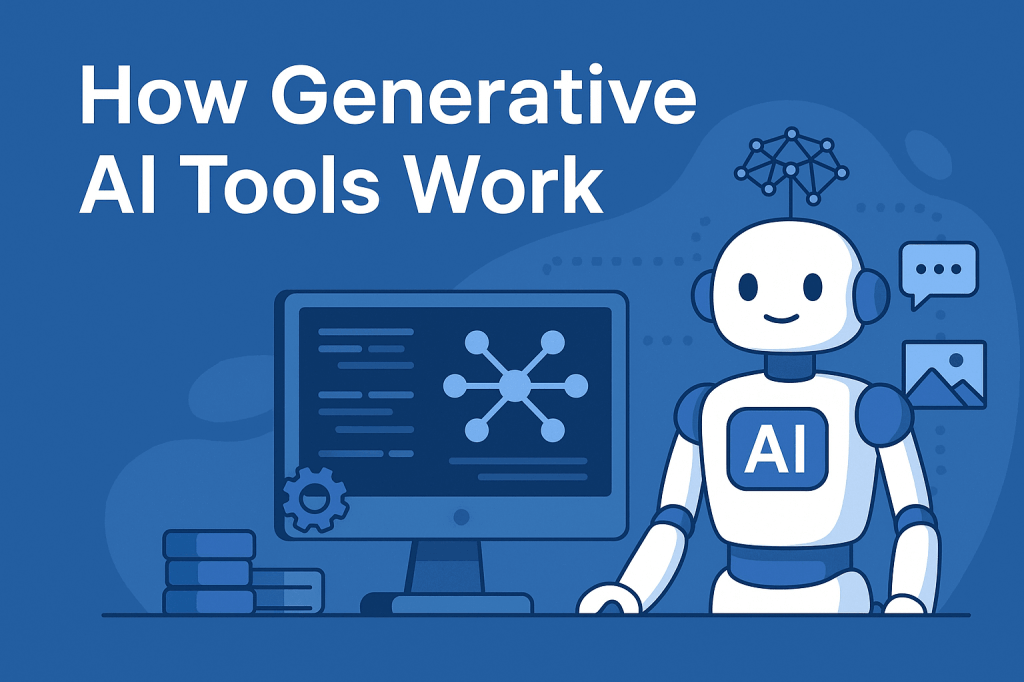
    How do Generative AI tools work?

    Generative AI tools are a revolutionary category of artificial intelligence that can produce entirely new content by learning from vast amounts of data. Unlike conventional AI, which typically analyzes data and provides insights or predictions, Generative AI tools have the ability to create text, images, music, code, and even videos that can appear as if they were produced by humans. This capability is transforming industries ranging from marketing and entertainment to healthcare and software development.

    The importance of Generative AI tools lies in their ability to enhance creativity while significantly increasing efficiency. Companies no longer have to rely solely on human effort for generating ideas, content, or designs. For instance, content writers can use AI to draft articles in minutes, graphic designers can produce multiple visual concepts quickly, and software developers can generate functional code snippets automatically. These tools not only save time but also expand the creative possibilities available to professionals across different fields.

    Understanding how these tools work is essential for businesses and creators who want to implement them effectively. Generative AI tools rely on sophisticated algorithms, large datasets, and continuous feedback to produce outputs that are accurate, relevant, and contextually appropriate. By understanding the mechanics behind these tools, organizations can make informed decisions, customize AI solutions to their specific needs, and ensure ethical and responsible use of AI-generated content.

    The adoption of Generative AI tools is growing rapidly because they provide a combination of automation, creativity, and intelligence that traditional tools cannot match. Whether it is for generating marketing content, designing user interfaces, creating educational materials, or producing entertainment media, these tools are opening up new opportunities for innovation and productivity. To explore some of the leading Generative AI solutions currently available, you can visit Generative AI tools, which provides a curated list of top-performing applications and platforms in this space.

    How Generative AI Tools Work Step by Step

    Collecting and Preparing Data for Generative AI Tools

    The foundation of any Generative AI tool is high-quality and diverse data. These tools require extensive datasets to learn patterns and structures that they can use to generate new content. The type of data depends on the tool’s purpose. For example, text-generating AI tools are trained on books, articles, websites, and other written materials, while image-generating tools rely on millions of images with detailed annotations. Music-generating AI tools are trained on audio tracks, notes, and melodies from various genres.

    Once the data is collected, preprocessing is essential to ensure the AI learns effectively. Preprocessing involves cleaning the data to remove errors, duplicates, or irrelevant information. For text data, this could include correcting grammar, removing spam, and standardizing formats. For images, preprocessing might involve resizing, adjusting colors, and labeling objects accurately. Proper preprocessing ensures that the AI tool receives high-quality inputs, which directly impacts the accuracy, creativity, and reliability of the generated outputs.

    Data diversity is another critical factor. A Generative AI tool trained on a narrow or biased dataset may produce outputs that are repetitive or fail to generalize across different contexts. By using a diverse dataset, the AI can learn a wide range of patterns, styles, and nuances, allowing it to generate content that is not only accurate but also creative and adaptable to various scenarios.

    Training Generative AI Models

    After preparing the data, the next step is training the Generative AI model. This process allows the tool to learn patterns and relationships within the data so that it can produce new content that mirrors the style and structure of the original material. Different machine learning techniques are used during training to achieve this goal.

    Supervised learning is commonly employed, where the AI model is given input-output pairs to learn the relationship between them. For instance, a text-generation model may receive a sentence and the expected continuation. Unsupervised learning is used to help the AI recognize patterns in unlabelled data, such as clustering similar images or understanding the structure of language without explicit instructions. Reinforcement learning is another key technique, where the AI receives feedback or rewards for producing desirable outputs. This helps fine-tune the model to generate high-quality content consistently.

    Modern Generative AI tools often rely on neural networks and transformer architectures. Neural networks are designed to mimic the human brain’s ability to recognize complex patterns, while transformers, such as GPT, excel at understanding context in long sequences of data. Transformers enable the tool to generate coherent, contextually accurate text or maintain stylistic consistency in images and music. These architectures form the backbone of the most advanced Generative AI tools available today.

    Content Generation by Generative AI Tools

    Once the model is trained, it is ready to generate content. The generation process involves predicting the next element in a sequence based on the patterns the AI has learned. In text generation, this means predicting the next word or sentence. In image generation, it involves determining pixel patterns and structures. In music generation, the AI predicts subsequent notes or rhythms. The process is probabilistic, meaning the AI considers multiple possible outputs and selects the one that best fits the context, which introduces creativity and variety into the generated content.

    Generative AI tools are capable of producing outputs that range from highly structured to creatively flexible. Text-generating tools can draft articles, write product descriptions, or compose poetry. Image-generating tools can create realistic visuals, conceptual art, or even photorealistic human faces. Music-generating tools can compose melodies in different styles, while code-generating tools can produce functional programming scripts. These tools are not only capable of creating content rapidly but also maintain a level of quality and coherence that was previously achievable only by humans.

    The use of Generative AI tools is transforming industries by streamlining workflows and enhancing creativity. Businesses can automate repetitive content generation tasks while focusing on strategy and innovation. Designers can explore multiple concepts in less time, and marketers can produce personalized content for diverse audiences. The industrial impact of these tools is immense, and you can learn more about this transformation in practice by exploring Generative AI Tools Are Revolutionizing Industries.

    Fine-tuning and Optimizing Generative AI Tools

    Even after training, Generative AI tools often need fine-tuning to perform optimally for specific tasks or industries. Fine-tuning involves training the model on specialized datasets to enhance its accuracy and relevance. For example, a general-purpose text-generating AI can be fine-tuned to write legal documents, marketing copy, or technical manuals. Similarly, an image-generating AI can be adapted to focus on specific artistic styles or product design standards.

    Optimization also includes adjusting hyperparameters, testing different configurations, and evaluating performance iteratively. Transfer learning is widely used in this stage, allowing a pre-trained model to adapt quickly to a new domain without extensive retraining. Fine-tuning and optimization ensure that the Generative AI tool not only generates content efficiently but also meets the quality and contextual requirements necessary for professional or commercial use.

    Human-in-the-loop and Feedback in Generative AI Tools

    Despite their advanced capabilities, Generative AI tools benefit significantly from human oversight. Human-in-the-loop mechanisms involve reviewing the AI-generated outputs, providing corrections, and guiding the AI to produce more accurate and contextually appropriate content. This approach ensures that the AI aligns with ethical, cultural, and creative standards, which is essential for real-world applications.

    Feedback mechanisms are integrated into most modern Generative AI tools to improve their learning continuously. Users can rate outputs, suggest edits, or provide additional examples, which the AI incorporates to refine its future content generation. This combination of AI efficiency and human judgment results in outputs that are reliable, high-quality, and tailored to specific user needs or industry requirements.

    Conclusion: Harnessing Generative AI Tools for Business and Creativity

    Generative AI tools are redefining the boundaries of creativity and productivity across industries. By learning patterns from extensive datasets, leveraging sophisticated architectures such as neural networks and transformers, and integrating human feedback, these tools can produce content that is not only accurate but also highly creative and contextually relevant. The ability to generate text, images, music, code, and other forms of content opens new possibilities for businesses, content creators, and developers, allowing them to achieve more in less time.

    The step-by-step process behind Generative AI tools—from data collection and preprocessing to model training, content generation, fine-tuning, and human-in-the-loop feedback—ensures that the outputs are reliable, adaptable, and aligned with specific needs. Data collection and preprocessing lay the groundwork by providing the model with quality information, while training enables the AI to recognize complex patterns. The generation phase transforms these patterns into tangible content, which is further refined through fine-tuning and optimization. Human oversight ensures that the results maintain ethical standards, creativity, and practical usefulness.

    The impact of Generative AI tools is evident in numerous industries. Marketing teams can automate content creation, producing personalized messages for diverse audiences without sacrificing quality. Designers can experiment with multiple visual concepts quickly, accelerating the creative process and reducing time-to-market. Developers can generate functional code or prototypes, speeding up software development cycles and improving innovation. Even the entertainment industry is leveraging these tools to produce music, videos, and visual effects at an unprecedented pace. These applications highlight how Generative AI tools are not just technological novelties but practical instruments that enhance efficiency, creativity, and business outcomes.

    Adopting Generative AI tools also encourages strategic innovation. Businesses can use these tools to identify new opportunities, explore creative directions, and maintain a competitive edge in a fast-paced market. The combination of automation and creativity allows organizations to allocate human resources to higher-level decision-making and strategy while the AI handles repetitive or pattern-based tasks. This synergy between human intelligence and artificial intelligence is what makes Generative AI tools indispensable in today’s digital landscape.

    For organizations looking to implement Generative AI solutions or leverage the expertise of professionals in this domain, connecting with specialized companies can provide significant advantages. These companies offer tailored solutions, training, and support to ensure that the tools are integrated effectively and deliver measurable results. To explore expert providers and development companies specializing in Generative AI, you can visit Generative AI development companies.

    In summary, Generative AI tools are more than just technological innovations. They are powerful instruments that empower businesses and creators to produce high-quality content at scale, drive innovation, and achieve new levels of productivity. Understanding how these tools work, leveraging them thoughtfully, and integrating human feedback can unlock their full potential and open doors to possibilities that were unimaginable just a few years ago. As the technology continues to evolve, the role of Generative AI tools in shaping industries, enhancing creativity, and driving efficiency will only become more significant, making them essential for any organization or individual looking to thrive in the modern digital world.
  • How to Build Your First ML Model with Python

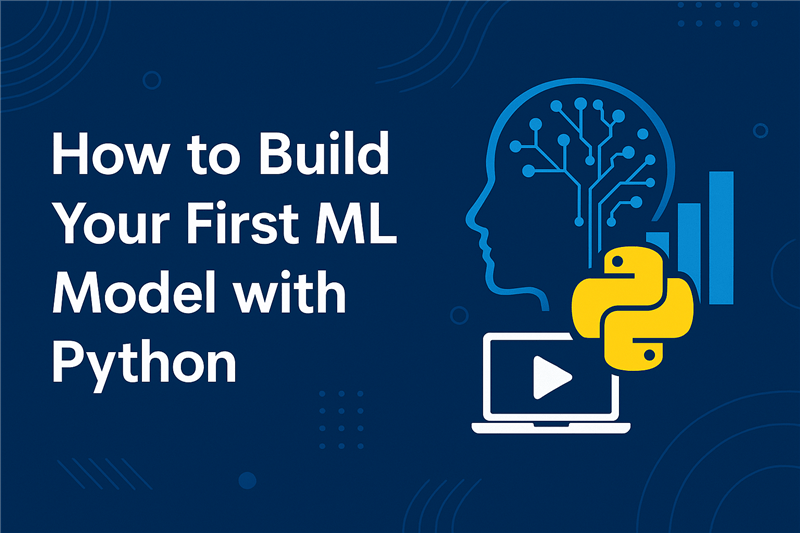
    How to Build Your First ML Model with Python

    Machine learning (ML) is transforming industries by enabling computers to learn from data and make predictions or decisions without being explicitly programmed. Python has emerged as the leading language for ML because of its simplicity and rich ecosystem of libraries. If you’re new to ML, building your first model may seem intimidating. But by breaking it down into clear steps, you can grasp the process and start experimenting quickly. In this guide, we’ll take you through each essential step to build a basic machine learning model using Python — from setup to deployment and maintenance. This foundation will prepare you for more advanced projects in the future.

    Set Up Your Python Environment

    Before you start building a machine learning model, it’s important to have a proper Python environment set up. Python 3 is recommended because it supports all modern libraries and features. You’ll need to install several key libraries that make machine learning easier and more efficient.

    First, install Python from the official website or use a distribution like Anaconda, which comes bundled with many useful packages and tools. Anaconda also provides an easy way to manage environments, so you can keep different projects isolated.

    Key Python libraries you will need include:

    • NumPy: This library provides support for large, multi-dimensional arrays and matrices, along with a collection of mathematical functions. It’s fundamental for numerical computations in ML.
    • Pandas: Pandas makes data manipulation and analysis straightforward. It helps you load data, handle missing values, and organize datasets in tables (called DataFrames).
    • Matplotlib: Visualization is essential to understand data patterns. Matplotlib allows you to create graphs and charts easily.
    • scikit-learn: This is one of the most popular ML libraries. It provides simple and efficient tools for data mining, preprocessing, model building, and evaluation.

    To keep your project tidy and avoid conflicts between library versions, create a virtual environment using venv or Conda. This lets you install dependencies only for your project, without affecting the system-wide Python installation. Setting up this environment correctly is a foundational step for a smooth ML experience.

    Understand the Problem

    Before jumping into coding, it’s crucial to clearly understand the problem you want your machine learning model to solve. Machine learning is a tool to automate decision-making based on data patterns, so you need to define the exact goal.

    Start by asking yourself: What question am I trying to answer? For example, are you trying to predict whether an email is spam or not? Or maybe you want to estimate house prices based on features like size and location?

    Understanding the type of problem helps you pick the right kind of model. Machine learning problems usually fall into two broad categories:

    • Classification: The goal here is to categorize data points into discrete classes. For example, classifying images as cats or dogs, or detecting fraudulent transactions. The output is a label or category.
    • Regression: This involves predicting a continuous value. Examples include forecasting sales numbers, predicting temperatures, or estimating real estate prices.

    Defining the problem correctly ensures you choose appropriate algorithms and evaluation metrics. It also helps guide how you prepare your data and interpret the results later.

    Collect and Prepare Data

    Data is the backbone of any machine learning model. Without quality data, even the best algorithms will perform poorly. The first step is to collect a dataset relevant to your problem. You can find datasets from public sources like Kaggle, the UCI Machine Learning Repository, or create your own from business records or sensors.

    Once you have the data, load it into Python using the pandas library, which makes handling data tables easy and efficient. Start by exploring the dataset: look at its structure, types of features, and spot any missing or inconsistent values.

    Data preparation involves several important tasks:

    • Handling Missing Values: Data often has gaps. You can fill these using statistical methods like mean or median, or remove rows or columns if too many values are missing.
    • Encoding Categorical Variables: Many machine learning algorithms require numerical input. Convert categories (like “red”, “blue”, “green”) into numbers using techniques such as one-hot encoding or label encoding.
    • Feature Scaling: Features may have different units and scales, which can confuse models. Normalize or standardize features so they have similar ranges. This improves model convergence and performance.

    Thorough data cleaning and preprocessing make your dataset ready for the learning process and significantly boost the chances of building an effective model.

    Split the Data

    Splitting your dataset into training and testing sets is a critical step to evaluate how well your machine learning model will perform on new, unseen data. The training set is used to teach the model, while the testing set is used to validate its predictions.

    A common practice is to allocate around 80% of the data for training and 20% for testing. This split helps ensure the model learns enough patterns without overfitting and still has sufficient data to be evaluated fairly.

    Python’s scikit-learn library offers the convenient function train_test_split, which randomly divides the dataset while preserving the distribution of target classes. This randomness helps the model generalize better by exposing it to varied examples during training.

    Without this step, you risk building a model that performs well on the data it has seen but poorly on new data — a problem known as overfitting. Proper data splitting safeguards against this and provides a realistic measure of model effectiveness.

    Choose a Model

    Choosing the right machine learning model depends on the nature of your problem and the type of data you have. For beginners, it’s best to start with simple and well-understood algorithms before moving to complex ones. This helps you understand the basics of how models learn and make predictions.

    Here are some common models suitable for beginners:

    • Linear Regression: Ideal for regression problems where you predict continuous values. It finds a straight line that best fits the relationship between input features and the target variable.
    • Logistic Regression: Used for binary classification tasks. Despite its name, it’s a classification algorithm that estimates the probability of a data point belonging to a particular class.
    • Decision Trees: These models split the data into branches based on feature values, making decisions at each node. They work for both classification and regression and are easy to visualize.
    • Support Vector Machines (SVM): Effective for classification tasks, especially when classes are clearly separable. SVMs find the hyperplane that best separates different classes.

    As you get comfortable, you can explore ensemble methods like Random Forests or Gradient Boosting, which combine multiple models for improved accuracy.

    Train the Model

    Training your machine learning model means allowing it to learn patterns from the training data. This process adjusts the internal parameters of the model so it can make accurate predictions. In Python, training usually involves calling the .fit() method on your model object and passing in the training data features and labels.

    During training, the model iteratively improves by minimizing the difference between its predictions and the actual target values. For example, a linear regression model adjusts its line to best fit the data points.

    It’s important to monitor the training process to avoid overfitting, where the model memorizes the training data instead of learning general patterns. Overfitting leads to poor performance on new data. Techniques like cross-validation or using a validation set can help detect this issue early.

    Training time can vary depending on the model complexity and dataset size. Starting with smaller datasets helps speed up experimentation and debugging.

    Evaluate the Model

    Once your model is trained, it’s essential to evaluate how well it performs on new, unseen data. Evaluation helps you understand if the model has learned meaningful patterns or if it needs improvement. This is done by using the test dataset that was set aside earlier.

    In Python, use the model’s .predict() method to generate predictions for the test data. Then, compare these predictions against the actual target values using appropriate metrics. The choice of metrics depends on your problem type:

    • Accuracy: The proportion of correct predictions out of all predictions, mainly used for classification problems.
    • Precision, Recall, and F1-Score: These metrics provide deeper insights in classification tasks, especially when classes are imbalanced.
    • Mean Squared Error (MSE) and Root Mean Squared Error (RMSE): Common metrics for regression problems that measure the average squared difference between predicted and actual values.

    Evaluating your model guides you on whether it is ready for deployment or if it requires further tuning or more data.

    Tune Hyperparameters

    Hyperparameters are settings that control how your machine learning model learns, such as the learning rate, number of trees in a forest, or depth of a decision tree. Unlike model parameters, hyperparameters are set before training and can greatly affect performance.

    Tuning these hyperparameters helps you optimize your model’s accuracy and generalization ability. This is usually done by experimenting with different values and comparing results. Manual tuning can be time-consuming, so automated methods like Grid Search or Random Search are commonly used.

    In Python’s scikit-learn, the GridSearchCV class systematically tests combinations of hyperparameters using cross-validation. It finds the best set that maximizes model performance on validation data. Proper tuning reduces overfitting and improves predictions on new data.

    Deploy and Maintain Your Model

    After building and fine-tuning your machine learning model, the next step is deployment—making the model available for real-world use. Deployment means integrating your model into an application or system where it can receive input data and provide predictions in real time or batch mode.

    There are several ways to deploy a model, such as creating a REST API using frameworks like Flask or FastAPI, embedding it into a web app, or integrating it with cloud services like AWS or Azure. Choose the method that best fits your use case and infrastructure.

    Once deployed, it’s important to continuously monitor your model’s performance. Real-world data can change over time, causing the model to degrade. Regularly retrain the model with new data and check for accuracy drops to maintain effectiveness. This maintenance ensures your model stays reliable and delivers value.

    Conclusion

    Building your first machine learning model with Python is an exciting journey that opens doors to solving complex problems with data. By setting up the right environment, understanding your problem, preparing data carefully, choosing and training models, and evaluating them properly, you lay a strong foundation for more advanced ML projects.

    If you want expert help to develop robust Python-based machine learning solutions, consider partnering with a python development company. They bring experience, best practices, and the latest tools to accelerate your ML initiatives and deliver impactful results.

  • Why AI Agents Matter in Business Today?

    In today’s fast-paced business world, efficiency and innovation are more critical than ever. Every business, from startups to large enterprises, is exploring ways to keep up with the competition. One of the most exciting developments in this quest is the rise of AI agents. These intelligent, autonomous software programs are quickly becoming essential in modern business operations, offering businesses the ability to automate processes, enhance customer interactions, and make data-driven decisions—faster and more effectively than ever before.

    But what exactly makes AI agents so important? Simply put, AI agents are designed to think and act on their own, making decisions, learning from experiences, and improving over time. This self-sufficiency allows businesses to scale, respond to customers in real time, and innovate without the constant need for human intervention.

    In this blog, we’ll explore why AI agents matter so much in business today. We’ll discuss how they are transforming industries, improving productivity, and providing companies with a competitive edge in a rapidly evolving market. If you’re considering AI solutions for your business—or are simply curious about the potential—they are no longer just a futuristic concept; they are here and actively shaping the future of business.

    Importance of AI Agents in Business

    AI agents are not just a buzzword anymore; they’re an essential part of modern business operations. As businesses strive to become more efficient and customer-centric, AI agents have stepped in as critical tools that drive innovation and streamline processes. These intelligent systems, powered by machine learning and data analytics, are capable of understanding customer needs, making decisions, and continuously improving over time. They empower businesses to handle complex tasks with precision, boost productivity, and stay ahead of the curve in an increasingly competitive marketplace.

    Let’s dive into why AI agents have become so important in today’s business landscape.

    They Are Built to Think and Act Autonomously

    One of the standout features of AI agents is their ability to think and act independently, mimicking human decision-making processes. Unlike traditional software tools that require constant user input, AI agents are designed to learn from their environment and experiences. This means they can take action based on real-time data without needing human intervention.

    For businesses, this is a game-changer. AI agents can handle complex tasks, such as scheduling, managing workflows, or providing customer support, with minimal oversight. This autonomy frees up valuable time for employees, allowing them to focus on higher-level, strategic activities that require human creativity and judgment.

    For example, an AI-powered chatbot can provide tailored product suggestions to a customer based on their browsing history. In e-commerce, AI agents can even offer real-time discounts or promotions that resonate with specific customer profiles. Whether it’s a virtual assistant handling inquiries, an AI tool predicting market trends, or an automated supply chain management system, the autonomy of AI agents boosts operational efficiency and reduces human error.

    For businesses looking to enhance their operations, one practical approach is to build an AI agent with ChatGPT. This powerful tool can enable businesses to create highly responsive and adaptive agents that can manage customer service, internal operations, and more—without needing constant human oversight.

    They Boost Efficiency Without Increasing Resources

    AI agents are designed to tackle repetitive tasks that would otherwise take up significant time and resources. For businesses, this means they can streamline operations without the need to hire additional employees. By automating tasks such as data entry, customer service responses, and inventory management, AI agents help reduce labor costs while increasing overall productivity.

    Moreover, AI agents are highly scalable. As a business grows, its AI agents can handle the increase in workload without requiring proportional growth in staff. This scalability is especially valuable for small and medium-sized businesses looking to expand without dramatically increasing overhead costs.

    For example, a customer service AI agent can handle thousands of inquiries simultaneously, providing quick, accurate responses around the clock. This not only improves customer satisfaction but also reduces the need for large customer support teams. Businesses can achieve more with fewer resources, allowing for faster growth and higher profitability.

    They Deliver Real-Time Personalization and Engagement

    In today’s digital world, customer expectations are at an all-time high. People want personalized, relevant experiences every time they interact with a business. This is where AI agents truly shine. They are equipped to understand and adapt to individual customer preferences in real time. By analyzing customer data such as previous interactions, browsing behavior, and purchase history, AI agents can craft personalized offers, messages, and recommendations.

    For instance, an AI-powered chatbot can provide tailored product suggestions to a customer based on their browsing history. In e-commerce, AI agents can even offer real-time discounts or promotions that resonate with specific customer profiles. This level of personalized engagement drives customer satisfaction, increases conversions, and ultimately leads to stronger customer loyalty. It’s no longer about sending generic marketing messages; AI agents ensure that every customer feels understood and valued.

    They Support Smarter and Faster Business Decisions

    AI agents are more than just tools for automating tasks—they are powerful decision-making assistants. Powered by data analysis, machine learning, and predictive algorithms, AI agents can analyze vast amounts of data and turn it into actionable insights. This capability allows business leaders to make more informed, data-driven decisions.

    Whether it’s forecasting trends, predicting customer behavior, or analyzing operational efficiency, AI agents provide insights that can improve almost every aspect of business operations. For example, an AI agent can analyze sales patterns and recommend adjustments to inventory levels, ensuring that a business can meet demand without overstocking. By utilizing AI agents to process data and generate reports, businesses can significantly shorten decision-making cycles, react faster to market shifts, and stay ahead of competitors.

    They Enable 24/7 Operations Without Extra Overhead

    One of the most significant advantages of AI agents is their ability to operate continuously without the need for rest. Unlike human workers, AI agents are available 24/7, which is a tremendous asset for businesses in terms of productivity and cost-effectiveness. Whether it’s providing customer support, managing inventory, or handling routine administrative tasks, AI agents can work round the clock without requiring extra resources.

    For example, AI chatbots can handle customer inquiries at any time of day, ensuring that businesses don’t lose opportunities simply because it’s outside of regular working hours. In industries like e-commerce or global services, this round-the-clock operation helps businesses stay agile and responsive to customer needs. AI agents can also automate backend tasks like data entry, billing, and report generation, further reducing overhead and increasing efficiency. By using AI to handle these operations, businesses can save on labor costs and reallocate resources to more strategic activities.

    They Keep Businesses Competitive in an AI-First Era

    As businesses continue to embrace digital transformation, those who integrate AI agents into their operations are gaining a significant competitive advantage. In an increasingly AI-driven market, businesses that adopt AI solutions early are more likely to stay ahead of their competitors. AI agents empower companies to adapt quickly to changes, innovate faster, and meet customer demands more effectively.

    For instance, an AI-powered system can predict trends, optimize marketing campaigns, and adjust business strategies based on real-time data. In a competitive market, this agility allows companies to respond faster to shifts in consumer behavior or market conditions, keeping them at the forefront of their industry. In addition, AI agents improve the speed of product development, help businesses refine their offerings, and provide better insights into customer needs, ensuring that the business remains both relevant and profitable in an AI-first world.

    They Free Up Human Talent for Strategic Growth

    One of the most valuable benefits of AI agents is their ability to handle routine, repetitive tasks, freeing up human talent for more strategic and innovative work. In many businesses, employees spend a significant portion of their time on administrative duties—tasks that can be easily automated with AI. By relieving staff from these time-consuming responsibilities, AI agents allow them to focus on high-level tasks that require human creativity, critical thinking, and problem-solving.

    For example, AI agents can handle the heavy lifting of data entry, scheduling, or customer queries, while employees can focus on building relationships with clients, developing new products, or refining business strategies. This shift not only increases employee satisfaction by reducing monotony but also enhances business growth by leveraging human potential where it matters most. By automating the routine, businesses can empower their teams to innovate and drive the company’s success in a more meaningful way.

    Conclusion: AI Agents Are No Longer Optional—They’re Business Essentials

    In today’s fast-evolving business environment, AI agents are more than just a technological trend—they have become integral to business success. These intelligent, autonomous systems are revolutionizing how companies operate, providing the tools to boost efficiency, make data-driven decisions, and stay competitive in an AI-first world. From automating repetitive tasks to delivering real-time, personalized experiences for customers, AI agents offer unmatched value across various business functions.

    Businesses that leverage AI agents gain significant advantages in scalability, cost-effectiveness, and agility. AI not only enhances operational performance but also empowers human talent to focus on more strategic endeavors, fueling innovation and growth. For businesses looking to stay ahead of the curve, integrating AI agents into their daily operations is no longer optional—it’s essential for long-term success.

    As businesses look for ways to navigate the complexities of the digital age, exploring solutions from top AI agent development companies will ensure that they remain at the forefront of technological advancements. The shift to AI-driven solutions is happening now, and those who embrace this technology will continue to lead in a rapidly transforming market.

  • What are the benefits of choosing the right AI development company?

    Benefits of Choosing Right AI Development Company

    AI is no longer a futuristic concept. It has become a practical tool for improving business efficiency, enhancing customer experience, and unlocking data-driven opportunities. As more businesses turn to AI to solve real-world problems, the need for professional AI development has grown significantly.

    Choosing the right AI development company plays a critical role in this journey. It influences not only how well the solution performs but also how smoothly it integrates with business goals. A trusted partner can bring the right mix of technology, experience, and vision to help businesses harness AI’s full potential. The right choice ensures a smoother process, better results, and long-term value.

    Top Benefits of Choosing the Right AI Development Company

    As AI continues to evolve, businesses are seeing its value across various departments. From smarter automation to deeper customer insights, AI-powered tools are reshaping the way companies operate. However, realizing these benefits depends largely on who builds and delivers the AI solution. A reliable AI development company can make all the difference by offering the right mix of expertise, innovation, and commitment.

    Here are some of the key benefits of making the right choice.

    Tailored AI Solutions That Align With Business Objectives

    Every business has its own structure, challenges, and goals. A dependable AI development company understands this difference and creates AI solutions that fit the specific needs of the business. Instead of applying generic models, they take the time to study business workflows, data patterns, and performance goals. This leads to outcomes that are not only accurate but also practical for real-time use.

    Customized solutions help businesses improve efficiency where it matters most. Whether it’s optimizing supply chain operations or offering personalized customer experiences, AI tools designed with purpose deliver far greater value.

    Work With Skilled AI Experts and Engineers

    One of the strongest benefits of selecting the top AI development company is direct access to skilled professionals. These experts bring knowledge of advanced AI algorithms, machine learning methods, and data engineering practices. More importantly, they have experience applying these techniques across different industries.

    Working with such a team means fewer mistakes, better results, and a stronger understanding of what works best. This level of expertise is hard to build in-house and saves businesses time and cost associated with trial and error. When the work is handled by AI experts, the quality of both the process and the outcome improves significantly.

    Accelerated Delivery With Streamlined Development

    Time plays a crucial role in business success. The right AI development company uses proven processes and efficient workflows to complete projects faster. From planning and prototyping to testing and deployment, every stage is carefully managed to reduce delays and maintain quality.

    With experienced teams and clear communication, businesses can expect a smooth and timely launch of their AI solutions. Faster delivery not only saves time but also helps businesses adapt to market changes more quickly and take advantage of new opportunities without waiting too long.

    Choose the Right AI Technologies From the Start

    Technology selection can influence the success and future of any AI solution. A skilled AI development company helps choose the right tools, frameworks, and platforms based on the unique needs of the business. Among the most important questions to ask AI development company experts is how they choose their tech stack and why. This includes selecting suitable programming languages, AI models, and data infrastructure.

    Making the right choices early on ensures that the solution is scalable, maintainable, and ready to grow with the business. It also helps avoid costly changes or rework in the future. Having expert guidance at this stage provides a strong foundation for long-term performance and adaptability.

    Ensure Compliance and Strengthen Data Security

    Handling data responsibly is a top priority in every AI initiative. A top AI development company brings a clear understanding of compliance standards and data protection laws. Whether it is customer data, financial records, or internal information, security measures are built into every layer of the solution.

    The right AI development partner ensures that data flows are secure, storage is protected, and all operations follow legal guidelines. This not only builds trust with customers and stakeholders but also protects the business from legal risks or reputational damage.

    Communicate Clearly and Collaborate Effectively

    Effective communication can shape the success of an AI project. A professional AI development company maintains open and transparent communication throughout the engagement. From discussing ideas and setting expectations to giving regular progress updates, collaboration remains strong at every step.

    This clarity helps avoid confusion, supports better decision-making, and creates a smoother working relationship. When business teams and AI experts work together closely, the final result becomes more aligned with real-world goals and challenges.

    Save Costs Through Efficient Development Practices

    Cost is a major factor when adopting new technologies. Best AI developers follow structured workflows and proven methods that reduce unnecessary expenses. With well-defined stages, proper planning, and the use of reusable components, the process becomes more efficient.

    This helps businesses avoid hidden costs, delays, and expensive rework. The overall result is a solution that fits the budget while maintaining high quality. Choosing the right partner means getting the best value without sacrificing performance or functionality.

    Stay Future-Ready With Continuous Support and Upgrades

    AI solutions need to evolve with time. A dependable AI development company offers ongoing support even after the initial launch. This includes performance monitoring, updates, system fine-tuning, and adapting the solution to new business needs.

    With continuous improvement, the AI system stays relevant and useful as the market and business environment change. This kind of long-term partnership ensures that the business keeps benefiting from its AI investment without having to start over or look for a new provider.

    Conclusion: The Right AI Development Partner is a Competitive Advantage

    The decision to adopt AI can open many opportunities for businesses, but much of its success depends on who builds the solution. A trusted AI development company brings more than just technical skills. It offers industry insight, efficient processes, strong communication, and a clear understanding of business needs.

    From reducing costs and improving delivery speed to strengthening security and providing long-term support, the benefits of choosing the right partner are both immediate and lasting. It allows businesses to focus on growth while confidently moving forward with technology that truly works for them.

  • AI Agent Development: Hidden and Often Overlooked Costs

    AI Agent Development: Hidden and Often Overlooked Costs

    AI agent development has quickly moved from experimental labs into real-world business environments. From streamlining operations to automating decision-making, the benefits of integrating AI agents are hard to ignore. However, while the spotlight often shines on the transformative potential of these systems, the financial reality behind building and maintaining them is often underplayed.

    Many businesses enter AI agent development projects with a well-defined upfront budget. The focus typically lies on hiring technical experts and choosing the right platforms. Yet, as the project unfolds, several unexpected costs begin to surface. These costs to develop an AI agent may not appear in early planning documents but can significantly impact project outcomes, timelines, and the overall return on investment.

    Understanding these hidden and frequently overlooked expenses is essential for making smarter technology decisions. Beyond coding and model training, there are layers of complexity involving data, infrastructure, security, compliance, and long-term maintenance. Each of these areas can quietly drive up costs if not accounted for early.

    This blog explores the full picture of what it really takes to build AI agents for business use. It breaks down the less-visible costs and offers clarity on what decision-makers should plan for before committing to a new AI project.

    Understanding the Less Obvious Costs in AI Agent Projects

    AI agent development often begins with enthusiasm around automation, performance gains, and innovation. But as businesses dive deeper into implementation, a different story begins to unfold. What seemed like a straightforward technology initiative can slowly turn into a series of hidden costs and continuous financial commitments. These AI agent development costs are not always visible at the outset but can disrupt timelines, stretch budgets, and reduce the overall impact of the AI investment.

    Every stage of AI agent development, from setting up the initial environment to long-term maintenance, carries financial implications. Some of these are predictable, but many are not. A clear view of these unseen layers helps avoid surprises and enables better planning across technical, operational, and strategic levels.

    The following highlight some of the key hidden ai agent development costs businesses often overlook during AI agent development.

    The Early Expenses That Appear Simple but Scale Quickly

    At first glance, initial AI agent development costs may seem clear and manageable. Budget plans usually account for software tools, cloud subscriptions, and perhaps an external development partner. However, real-world conditions often introduce variables that were not considered in early projections.

    Custom integrations with legacy systems may require more time and specialized effort than expected. Licensing fees for essential APIs or third-party components may not be fully transparent until integration begins. Even small changes in project scope can lead to revised requirements, pushing resource needs higher than planned.

    AI agent development cost overruns also occur when teams underestimate the complexity of building adaptable AI logic. What appears to be a single feature request can trigger deep architectural adjustments. Without a flexible planning approach, businesses may find themselves revisiting their original estimates more often than anticipated.

    Data Preparation: A Foundational Step That Comes with a Heavy Price

    AI agents depend heavily on quality data, but gathering and preparing that data is rarely simple. Raw data from internal systems is often inconsistent, incomplete, or stored in incompatible formats. Before training an AI agent, that data must be cleaned, organized, and labeled — a process that demands both time and expert resources.

    Hiring external vendors for data cleaning can be costly, and building internal teams for the task requires time-consuming onboarding and workflow design. Additionally, historical data is often not labeled in a way that suits AI agent learning processes. Manually labeling large datasets takes weeks or even months, depending on the volume and complexity.

    Another overlooked element is the recurring nature of data work. AI agents do not improve from static data alone. Continuous learning models require new datasets, updated labeling, and performance validation. Each cycle introduces a repeat of earlier preparation steps, making this cost of building AI agent not just large but ongoing.

    The Rising Cost of Finding and Retaining Skilled Talent

    One of the most underestimated costs in AI agent development is talent. Building effective AI agents requires specialized expertise across multiple roles, including data scientists, machine learning engineers, and AI system architects. These professionals are in high demand, and their salaries often exceed initial expectations.

    The challenge becomes more pronounced when projects need to scale or when specific domain knowledge is required. Freelancers and consultants can fill temporary gaps, but long-term success depends on building an in-house team that understands the business’s evolving goals. This adds pressure to recruitment timelines and increases overhead through salaries, benefits, and retention efforts.

    Beyond hiring, there is also the cost of upskilling existing teams. Even experienced developers may need time and training to work effectively with new AI tools, frameworks, and workflows. Training programs, internal workshops, and onboarding sessions all add to the hidden layers of expense in an AI project.

    Infrastructure Needs That Evolve Faster Than Expected

    AI agent development is not just about code and data. It also depends heavily on the infrastructure that supports it. At the early stage, it may be possible to use existing hardware or shared cloud resources. But as models grow in complexity and data volumes increase, those initial setups often fall short.

    Processing power becomes a central concern. AI models require high-performance computing to train effectively, especially when dealing with real-time predictions or natural language processing. Renting GPU-enabled cloud instances or investing in dedicated servers can significantly raise costs.

    Storage is another critical area. Datasets for AI agents are not just large but constantly expanding. Proper data handling demands fast, secure, and scalable storage systems that can accommodate growth without performance issues.

    There is also the cost of downtime and slow performance. When infrastructure lags, it not only slows the project but can disrupt other business operations. Investing in scalable and reliable infrastructure from the start helps avoid this, but it requires a larger upfront investment than many teams anticipate.

    Maintaining AI Agents Is a Continuous and Costly Process

    Once an AI agent is deployed, the work does not end. Regular maintenance becomes necessary to ensure the system performs accurately and adapts to new data patterns. This includes updating models, monitoring outputs, fixing bugs, and addressing unexpected behavior as the agent interacts with real-world environments.

    AI models can become outdated or biased if not refreshed periodically. Retraining a model is not only time-intensive but also demands computing resources and human oversight. This retraining cycle can repeat multiple times throughout the year, depending on how quickly the underlying data changes.

    There are also costs related to troubleshooting and debugging. Unlike traditional software, issues in AI systems are often harder to trace. They require deeper analysis, possibly even rebuilding certain logic pathways. All of this leads to a recurring financial commitment that many businesses underestimate when planning for AI agent development.

    Compliance and Security That Come with Their Own Set of Costs

    Working with AI agents introduces new responsibilities around data privacy, security, and regulatory compliance. These responsibilities carry direct and indirect costs, especially when sensitive customer or operational data is involved.

    Data protection laws require businesses to follow strict standards around how data is collected, stored, and processed. Failing to meet these requirements can lead to financial penalties or legal complications. Ensuring compliance often involves consulting legal experts, investing in governance tools, and conducting audits to validate systems.

    Security is another critical concern. AI agents typically access large volumes of information, making them a potential target for cyber threats. Safeguarding these systems requires dedicated security protocols, advanced encryption, regular vulnerability testing, and ongoing monitoring. These protections are necessary but rarely included in early-stage planning, which makes them one of the more overlooked areas in AI agent development.

    Energy Usage and Environmental Impact That Add Up Over Time

    AI agent development requires substantial computing power, which often translates into higher energy consumption. The training and operation of large models involve multiple processing cycles, extended runtimes, and large-scale data handling — all of which demand continuous power.

    As the project grows, so does the energy requirement. Businesses that initially rely on shared cloud services may find their usage increasing sharply, leading to higher bills and a heavier carbon footprint. Even when using energy-efficient systems, the cumulative impact of ongoing training, testing, and real-time processing is significant.

    Some businesses aim to shift toward greener infrastructure to offset environmental concerns, but sustainable technology often comes at a premium. Whether switching to renewable-powered data centers or adopting carbon credits, the AI agent development costs associated with reducing environmental impact become another line item in the overall budget.

    Lost Opportunities When AI Expectations Are Misaligned

    AI agent development is often approached with high expectations. The promise of automation, cost savings, and smarter decision-making can lead to optimistic projections. However, when the outcomes do not match the original goals, the gap between expectation and reality becomes costly in more ways than one.

    Misaligned goals can lead to wasted resources on features that were not needed or on systems that do not integrate well with existing operations. Projects may need to be paused or restructured midway, causing delays and added labor.

    There is also the broader strategic cost of falling behind competitors who implement AI more effectively. When AI agents do not deliver the anticipated value, businesses not only lose money but also risk losing momentum in the market. These opportunity costs are rarely part of initial planning but can impact long-term performance and decision-making confidence.

    Why Being Cost-Aware Matters in AI Agent Development!

    AI agent development holds great potential for businesses looking to streamline operations, enhance customer interactions, and make smarter use of data. However, the journey from concept to deployment involves more than coding and system setup. Hidden costs can appear at every phase, turning what seems like a well-bounded investment into a constantly expanding financial commitment.

    When overlooked, these AI agent development costs have the power to slow down innovation, stretch budgets, and create internal roadblocks that limit scalability. For businesses exploring AI agent development, it is essential to recognize that the real investment includes not just upfront spending but also ongoing infrastructure, talent, compliance, and long-term optimization efforts.

    Taking a more comprehensive view of the cost landscape enables smarter planning, better financial control, and more realistic outcome forecasting. This becomes especially important as more enterprises look toward AI as a core component of their digital strategies. Evaluating solutions and insights from top AI development companies can also help refine that understanding and avoid repeating common missteps seen across industries.

    By focusing on the full picture rather than surface-level projections, businesses are better positioned to turn AI agents into practical, sustainable assets that support long-term goals.

  • How Do Multimodal AI Models Work?

    Artificial intelligence has evolved significantly, enabling systems to process and analyze diverse forms of data. Multimodal AI models take this a step further by integrating multiple data types, such as text, images, audio, and video, into a single framework. This capability allows AI to interpret information more accurately, improving decision-making and enhancing real-world applications.

    Businesses across industries are leveraging multimodal AI models to enhance user experiences, automate complex workflows, and improve predictive accuracy. The best multimodal AI development companies are utilizing these models to create AI systems that bridge the gap between different types of data, making them highly effective in applications like AI-powered image recognition, autonomous systems, and interactive AI assistants.

    To fully understand how multimodal AI models work, it is essential to explore their core mechanisms, processing steps, and integration techniques. The following content provides a structured breakdown of how these models function and the strategies that make them effective.

    How Do Multimodal AI Models Work?

    Multimodal AI models function by integrating and analyzing multiple data types within a single system. Unlike traditional models that rely on a single data source, multimodal AI processes text, images, audio, and video simultaneously. This enables businesses to develop AI systems that understand context more effectively, leading to accurate insights and improved decision-making. These models follow a structured approach, ensuring that data from different modalities is processed, aligned, and combined efficiently.

    Step 1: Data Collection

    Multimodal AI models begin with collecting data from various sources. This includes text documents, images, audio recordings, and videos. Each data type serves a unique role in providing contextual information. For example, AI-powered image recognition systems combine visual and textual data to improve object detection and classification. Businesses ensure that data is diverse and high-quality to enhance model performance.

    Step 2: Data Preprocessing

    Once the data is collected, it undergoes preprocessing to remove inconsistencies and improve structure. This involves cleaning text data by eliminating errors, resizing images for uniformity, and filtering background noise in audio files. Preprocessing ensures that all data types are formatted correctly before they are analyzed together. AI development companies use advanced techniques such as normalization and feature scaling to improve data consistency across different modalities.

    Step 3: Feature Extraction

    After preprocessing, the model extracts relevant features from each data type. This step involves identifying important patterns, relationships, and structures within the data. For instance, AI-powered image recognition systems extract visual features such as shapes, colors, and textures, while natural language processing models analyze text for sentiment, keywords, and intent. Feature extraction allows the AI model to retain essential information from each modality while reducing noise and irrelevant data.

    Step 4: Modality Alignment

    Once features are extracted, the model aligns data from different modalities to ensure consistency. This step is critical because each data type may have different structures and time dependencies. For example, in an AI system processing video and audio together, the speech must be synchronized with the corresponding frames. Techniques such as attention mechanisms and embeddings help link related information across modalities. Proper alignment ensures that the AI model can accurately interpret relationships between different data sources.

    Step 5: Multimodal Fusion

    After aligning different data types, the model merges them into a unified representation. This process, known as multimodal fusion, allows AI to generate a comprehensive understanding by integrating information from multiple sources. Various fusion techniques are used, including concatenation, attention-based fusion, and transformer models. For example, AI-powered virtual assistants combine voice inputs with visual cues to provide more accurate responses. Effective fusion enhances the model’s ability to interpret context and improve decision-making in real-time applications.

    Step 6: Model Training

    Once the data is fused, the model undergoes training using machine learning and deep learning algorithms. During this phase, the AI system learns patterns, relationships, and dependencies between different modalities. Training methods such as supervised learning, self-supervised learning, and reinforcement learning help improve accuracy and performance. Businesses leverage large datasets to fine-tune their models, ensuring they can generalize well across various tasks. Regular training updates also enhance adaptability, making multimodal AI systems more efficient in evolving environments.

    Step 7: Prediction and Decision-Making

    Once trained, the multimodal AI model generates predictions by analyzing data from different modalities. The model processes new inputs, compares them with learned patterns, and provides outputs based on the combined understanding of multiple data sources. For example, AI-powered image recognition systems can identify objects more accurately by using both visual and textual descriptions. Businesses use multimodal AI to improve decision-making in areas such as fraud detection, healthcare diagnostics, and personalized recommendations.

    Step 8: Continuous Learning and Optimization

    To maintain accuracy and efficiency, multimodal AI models undergo continuous learning and optimization. This involves refining algorithms, updating datasets, and retraining the model with new information. Feedback loops and real-time data streams allow the AI to adapt to changing conditions. Businesses implement optimization techniques such as fine-tuning and transfer learning to improve performance and scalability. Continuous learning ensures that AI systems remain relevant and effective in dynamic environments.

    Conclusion

    Multimodal AI models have transformed the way businesses leverage artificial intelligence by integrating multiple data sources for enhanced decision-making. These models process text, images, audio, and video together, enabling a deeper understanding of complex scenarios. By following structured steps such as data collection, preprocessing, feature extraction, modality alignment, fusion, training, and continuous optimization, businesses can develop AI systems that provide accurate insights and seamless automation.

    Top AI development companies are utilizing multimodal AI to build intelligent solutions that improve customer experiences, streamline operations, and enhance predictive analytics. As advancements in artificial intelligence continue, businesses adopting multimodal AI will gain a competitive edge by making data-driven decisions with greater precision. Understanding how these models work is essential for businesses looking to implement AI solutions that drive innovation and efficiency.

  • How Do I Choose the Right AI Development Company for My Business?

    Artificial intelligence is no longer a futuristic concept. It is a core driver of business innovation. Businesses across industries are leveraging AI to enhance decision-making, automate operations, and gain a competitive edge. However, implementing AI successfully requires more than just the right idea. Choosing the right AI development company plays a crucial role in determining the success of your AI initiatives.

    The challenge lies in identifying a company that aligns with your business objectives, understands industry-specific requirements, and possesses the technical expertise to deliver scalable AI solutions. Not all AI development companies offer the same level of service, and a wrong choice can lead to costly delays, inefficiencies, or ineffective AI models. A well-informed selection process can help you avoid these pitfalls and ensure that your investment in AI translates into tangible business value.

    This guide provides a structured approach to choosing an AI development company that meets your needs. It breaks down essential factors to evaluate, including industry experience, technical proficiency, security compliance, and post-development support. By following a systematic process, businesses can make confident decisions and build AI solutions that drive growth and efficiency.

    Define Your AI Requirements

    Selecting the right AI development company to hire starts with a clear understanding of your business needs. AI is a broad field, and different solutions serve different purposes. Identifying your specific AI requirements ensures you engage with a company that can deliver a solution tailored to your goals.

    Begin by assessing the challenges you aim to solve with AI. Are you looking to automate repetitive tasks, enhance customer engagement with chatbots, or leverage data analytics for better decision-making? Defining the problem helps in narrowing down potential AI applications.

    Once the objectives are clear, determine the type of AI technology that aligns with your business. Machine learning, natural language processing (NLP), computer vision, and generative AI all serve distinct functions. If you’re unsure which technology fits best, a development service provider with consultative expertise can guide you through the process.

    Scalability is another key factor. Will the AI solution need to handle increasing data loads or integrate with existing software? Defining these technical expectations early will help in choosing a company that builds future-ready AI systems.

    A well-defined AI roadmap not only simplifies vendor selection but also ensures that development efforts align with long-term business objectives.

    Assess Industry Experience

    AI solutions should align with industry-specific challenges, making domain expertise a critical selection criterion. A company with experience in your sector understands regulatory requirements, market dynamics, and operational workflows, reducing the learning curve and speeding up development.

    Start by reviewing their past projects. Have they developed AI solutions for businesses similar to yours? Case studies and client success stories can offer insights into their expertise. A company specializing in AI for healthcare, for example, will be well-versed in HIPAA compliance and medical data privacy, while an AI partner for finance should understand fraud detection and risk analysis.

    Industry experience also influences AI model accuracy and efficiency. A retail-focused AI company, for instance, will have a deep understanding of customer behavior analytics and recommendation engines, making them a better fit for eCommerce businesses.

    Another indicator of expertise is partnerships and certifications. AI development firms collaborating with major cloud providers or AI research organizations often have access to cutting-edge tools and frameworks. Evaluating these credentials can help in identifying a company that stays ahead in AI advancements.

    Choosing an AI development company with strong industry experience ensures that your solution is not only technically sound but also practical and relevant to your business needs.

    Evaluate Technical Expertise

    AI development requires a deep understanding of complex technologies, algorithms, and frameworks. Not all companies have the same level of expertise, so evaluating their technical capabilities is crucial.

    Start by examining their proficiency in core AI technologies such as machine learning, deep learning, natural language processing (NLP), computer vision, and generative AI. A skilled AI developers should be familiar with popular frameworks like TensorFlow, PyTorch, and Scikit-learn, as well as cloud-based AI platforms such as AWS AI, Google Cloud AI, and Microsoft Azure AI.

    Beyond technical knowledge, assess their ability to design scalable AI architectures. Can their solutions handle increasing data loads and evolving business requirements? Scalability is essential, especially for businesses expecting rapid growth.

    Another key factor is model training and optimization. The effectiveness of an AI solution depends on the quality of data processing, training methodologies, and fine-tuning. A reliable AI development company should follow best practices in data preprocessing, model validation, and continuous learning to improve accuracy over time.

    AI integration capabilities also matter. The company should be able to seamlessly integrate AI solutions with your existing systems, whether it’s a CRM, ERP, or cloud infrastructure. A strong technical foundation ensures that the AI implementation is efficient, reliable, and aligned with your business objectives.

    Review AI Company’s Portfolio and Case Studies

    An AI company’s past projects reveal a lot about its expertise and ability to deliver results. Reviewing portfolios and case studies provides direct insights into their experience with real-world AI applications.

    Start by analyzing the types of AI solutions they have built. Have they worked on projects similar to yours? Look for case studies that highlight problem-solving approaches, technologies used, and the impact of their solutions. Successful implementations in areas like predictive analytics, AI-powered automation, or customer experience enhancement demonstrate their ability to create value-driven solutions.

    Pay attention to innovation and complexity. A strong artificial Intelligence development company doesn’t just build generic models—it develops tailored AI solutions that solve unique business challenges. If their portfolio includes advanced AI models, custom deep learning architectures, or industry-specific AI applications, it’s a good sign of technical capability.

    Also, check for performance metrics in case studies. Tangible results, such as improved efficiency, increased revenue, or enhanced decision-making, indicate the real impact of their AI solutions.

    A well-documented portfolio backed by case studies ensures transparency and helps you gauge whether the company can meet your AI development expectations.

    Check Client Reviews and Testimonials

    Client feedback is a strong indicator of an Artificial Intelligence company’s credibility and reliability. A company with a history of satisfied clients is more likely to deliver quality results and maintain transparency throughout the development process.

    Start by exploring third-party review platforms such as TopDevelopers.co. These online platforms provide verified client testimonials, ratings, and detailed feedback on project execution, communication, and problem-solving abilities. A pattern of positive reviews suggests a company’s commitment to delivering effective AI solutions.

    Direct client references offer additional insights. Reputable AI development companies can provide references from past clients who can share their experiences, including challenges faced and how the company addressed them. If possible, request to speak with a previous client to get an honest assessment of their AI implementation.

    Check for client reviews that mention post-development support and scalability. AI projects require continuous improvement, and a company with strong long-term support ensures that AI models remain optimized and effective over time.

    A high number of satisfied clients and strong testimonials indicate that the company has a proven track record of delivering AI solutions that meet business needs.

    Assess Data Security and Compliance

    AI solutions often process sensitive business data, making security and compliance critical factors in choosing the right AI development company. An AI firm should follow strict security protocols to prevent data breaches, unauthorized access, and compliance violations.

    Start by ensuring they comply with industry regulations relevant to your business. If you operate in healthcare, finance, or eCommerce, the company should demonstrate adherence to GDPR, HIPAA, SOC 2, PCI-DSS, or other necessary standards. Compliance ensures that AI models handle sensitive data responsibly and legally.

    Assess their data handling and storage practices. The company should implement encryption, access controls, and anonymization techniques to protect data throughout the AI development lifecycle. A transparent approach to data privacy policies and security audits reflects a commitment to safeguarding business information.

    Another key aspect is bias detection and ethical AI development. AI algorithms must be designed to prevent discrimination and ensure fairness in decision-making. A responsible AI development company should have practices in place to mitigate biases and enhance model transparency.

    By prioritizing security and compliance, businesses can minimize risks while ensuring that AI solutions align with legal and ethical standards.

    Understand Pricing and Engagement Models

    AI development costs can vary significantly based on project complexity, technology stack, and engagement model. Understanding these factors helps in selecting a company that fits your budget without compromising on quality.

    Start by exploring different pricing structures. AI companies typically offer three models:

    • Fixed-price model – Best for well-defined projects with a clear scope.
    • Time and material model – Suitable for projects that require flexibility and iterative improvements.
    • Dedicated team model – Ideal for long-term AI development, providing full-time specialists working exclusively on your project.

    Request detailed cost breakdowns before committing to a service provider. A transparent AI development company should outline expenses related to data processing, AI model training, cloud hosting, and post-deployment support. Be cautious of companies that provide vague pricing estimates without defining deliverables.

    Compare pricing with the expected return on investment (ROI). The cheapest option isn’t always the best if it leads to low-quality AI models that require frequent rework. A reliable company will balance cost-effectiveness with high-performance AI solutions that drive long-term business value.

    Evaluate Post-Development Support

    AI solutions require continuous monitoring, fine-tuning, and upgrades to remain effective. Choosing a professional AI development company that offers strong post-development support ensures that your AI model performs optimally over time.

    Check if the company provides ongoing maintenance, bug fixes, and model retraining. AI systems improve through continuous learning, and regular updates help adapt to changing business needs. Without proper maintenance, AI models can become outdated or inefficient.

    Assess their response time and support availability. Do they offer 24/7 support or a dedicated account manager? A well-structured support system minimizes downtime and ensures seamless AI operations.

    Understand their approach to scalability and future enhancements. Business needs evolve, and AI solutions should be adaptable. Top-most AI development company that offers Artificial Intelligence model optimization and scalability planning helps future-proof your AI investment.

    A well-defined support strategy ensures that AI implementations remain efficient, secure, and aligned with business growth.

    Ask the Right Questions to the AI Company Before Hiring

    Choosing a company-building AI requires a thorough evaluation process. Asking the right questions helps businesses assess technical expertise, industry experience, and long-term support before making a decision.

    Start by understanding their AI development capabilities:

    • What AI technologies and frameworks do you specialize in?
    • How do you handle AI model training, optimization, and scalability?
    • Can you share case studies or examples of AI projects similar to ours?

    Evaluate their data handling and security measures:

    • What compliance standards do you follow (GDPR, HIPAA, SOC 2, etc.)?
    • How do you ensure data privacy and security throughout the AI lifecycle?
    • What steps do you take to minimize AI bias and enhance model transparency?

    Assess their development process and collaboration model:

    • What engagement models do you offer, and which would best suit our project?
    • How do you handle unexpected challenges or changes in project scope?
    • What level of involvement do you require from our internal team?

    Discuss support, maintenance, and future scalability:

    • How do you handle post-deployment AI model updates and monitoring?
    • What happens if the AI model requires retraining or improvements after deployment?
    • How do you ensure that AI solutions remain scalable and adaptable to business growth?

    Best AI companies provide clear, well-structured responses to these questions, demonstrating their expertise and commitment to delivering AI solutions that align with business needs. A structured hiring process helps businesses select the right AI partner while avoiding potential risks or inefficiencies.

    Make a Data-Driven Decision

    Selecting an Artificial Intelligence development company requires a strategic approach. Businesses should compare shortlisted companies based on technical expertise, industry experience, and the ability to deliver scalable AI solutions. A structured evaluation ensures that the chosen partner aligns with long-term business objectives.

    Start by analyzing their track record and proven results. Companies with strong portfolios, client success stories, and measurable AI-driven improvements demonstrate their ability to execute complex projects. Look for performance benchmarks, case studies, and industry-specific solutions that showcase their effectiveness.

    Assess the depth of AI expertise beyond basic development skills. Dedicated AI developers stay ahead of emerging technologies, integrating advancements like generative AI, reinforcement learning, and automated machine learning (AutoML) into their solutions. Businesses benefit from AI partners who continuously innovate and refine their methodologies.

    Compare pricing transparency and value proposition. While cost is an important factor, businesses should prioritize long-term ROI over short-term savings. The right AI partner will offer a balance of affordability, high-quality solutions, and ongoing optimization to ensure the AI model remains relevant as business needs evolve.

    An objective, data-driven selection process minimizes risks and ensures that businesses invest in AI solutions that drive efficiency, automation, and competitive advantage. Evaluating companies based on measurable criteria leads to better decision-making and long-term success.

    Conclusion

    Investing in AI can transform business operations, but the success of an AI initiative depends on selecting the right development partner. A structured evaluation process ensures that businesses collaborate with a company that aligns with their goals, industry requirements, and technical needs.

    The selection process of AI company should begin with a clear definition of AI requirements and a thorough assessment of a company’s industry experience, technical expertise, and past projects. Security compliance, pricing transparency, and long-term support play a critical role in determining whether an AI solution will remain efficient and scalable over time.

    Top AI development companies stand out by demonstrating a strong portfolio, proven results, and a commitment to innovation. Businesses should prioritize partners who understand AI beyond standard implementation—those who focus on continuous learning, adaptability, and long-term value.

    An informed decision leads to AI solutions that not only meet immediate business needs but also drive future growth. By following a structured approach, businesses can reduce risks and maximize the impact of AI within their operations.

Design a site like this with WordPress.com
Get started