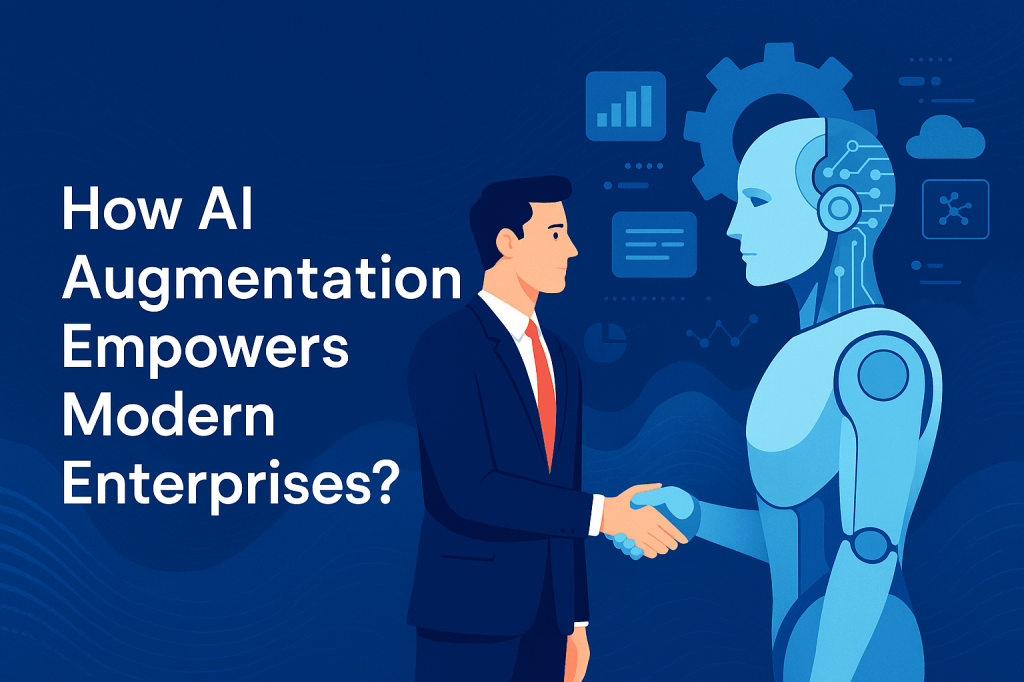
Artificial Intelligence has moved far beyond simple automation. Modern businesses no longer use AI just to replace repetitive tasks. Instead, they are embracing a new approach called AI augmentation, where AI works alongside humans as a powerful digital partner. Rather than taking over jobs, it enhances human skills, improves decision-making, and opens new opportunities for innovation.
In today’s competitive market, enterprises face overwhelming data, rapidly changing customer demands, and increasing operational complexity. AI augmentation helps them tackle these challenges without removing the human element. It combines the speed and precision of machines with the creativity, empathy, and strategic thinking of humans.
Let’s understand what AI augmentation is, how it works, and why it is becoming essential for enterprises that want to stay ahead.
What is AI Augmentation?
AI augmentation refers to the practice of enhancing human intelligence and capabilities with the help of AI technologies. Instead of replacing employees, AI acts as a collaborative assistant. It processes massive amounts of information, finds patterns, and gives recommendations, while humans make the final decisions.
For example, a customer service agent can use an AI chatbot to handle routine questions, while focusing on complex issues that require empathy. A business analyst can rely on AI-generated data insights but still apply human judgment before making a strategic move. This combination makes work faster, smarter, and more effective.
The key difference between AI augmentation and full automation is human control. Automation removes human intervention completely, but augmentation enhances human roles by reducing workload and improving outcomes.
How Does AI Augmentation Work?
AI augmentation works by integrating advanced AI tools into business workflows. These tools:
- Analyze complex data: AI scans structured and unstructured data to extract meaningful insights.
- Predict outcomes: Machine learning models forecast trends, risks, and opportunities for better decision-making.
- Assist in real time: AI systems suggest actions or solutions instantly during ongoing processes.
- Learn continuously: Over time, AI improves its accuracy through user feedback and new data.
This process keeps humans in charge while giving them the superpower of data-driven intelligence.
Core Characteristics of AI Augmentation
AI augmentation is not just about adding smart tools to your business. It’s about creating a balanced partnership between humans and machines. For enterprises, this means building a system where technology amplifies human strengths while still relying on human judgment. Here are the core characteristics that define AI augmentation:
Human-in-the-Loop
One of the most important aspects of AI augmentation is keeping humans involved. Unlike full automation, where machines operate independently, augmented systems always include human oversight. AI can provide recommendations, detect errors, or automate routine tasks. But the final decision or action often remains in the hands of humans. This approach improves trust and reduces risks caused by blind automation.
Contextual Awareness
AI augmentation is designed to understand the context in which it operates. For example, it doesn’t just analyze raw data—it considers business goals, customer preferences, and external market factors. This helps the system provide more accurate insights. A sales forecasting tool, for instance, might adjust predictions based on economic changes or seasonal demand rather than relying on historical data alone.
Explainability and Trust
Enterprises need to trust the decisions suggested by AI. That’s why augmented AI solutions focus on transparency. They use Explainable AI (XAI) techniques to show how and why a recommendation was made. For example, if an AI model suggests a pricing strategy, it will also explain which data points influenced its decision. This transparency builds confidence among employees and leadership teams.
Interactive Interfaces
AI augmentation is effective only when it is easy to use. Augmented systems often come with interactive dashboards and visual tools that allow employees to communicate with AI seamlessly. For instance, a manager can ask a virtual assistant for performance insights and receive a clear visual report instantly. This makes AI accessible to both technical and non-technical users.
Continuous Learning
AI augmentation is not static. It evolves continuously as it learns from new data and user feedback. Over time, the system becomes more intelligent and better aligned with the business’s needs. For example, a recruitment AI might learn to better predict cultural fit as it reviews more successful hiring cases over time.
Multi-Modal Fusion
Modern AI augmentation combines different types of data for deeper insights. It can process text, images, videos, audio, and numerical data all at once. For example, a healthcare AI might analyze patient records, lab reports, and medical imaging together to assist doctors in diagnosis. This multi-modal approach makes AI augmentation more powerful and versatile.
These core characteristics ensure that AI augmentation remains a supportive partner rather than a replacement for human intelligence. It gives enterprises a way to scale knowledge, improve performance, and make better decisions without losing the human touch.
Why Do Modern Enterprises Need AI Augmentation?
Enterprises today are operating in a highly dynamic environment. They face massive data flows, unpredictable market shifts, increasing competition, and growing customer expectations. Relying only on human capabilities is no longer enough. At the same time, fully automating processes may remove the creativity and ethical reasoning that humans bring. This is where AI augmentation becomes critical. It provides the perfect balance between human expertise and machine intelligence.
Here are some key reasons why modern enterprises must embrace AI augmentation:
Handling Complexity
Businesses deal with large volumes of complex data every day. Analyzing this manually is slow and prone to errors. AI augmentation can process massive datasets in seconds, identify hidden patterns, and offer meaningful insights. For example, a financial firm can use AI to detect fraudulent transactions from millions of records. However, humans still interpret the final results, ensuring the decisions are accurate and ethical. This combination helps enterprises manage complexity effectively.
Scalable Personalization
Customers now expect personalized experiences at every touchpoint. AI augmentation makes it possible to deliver tailored services at scale. For instance, AI can analyze customer buying history, social media interactions, and preferences to suggest the best product or service. Meanwhile, marketing teams add the human touch by crafting creative campaigns based on these insights. This hybrid approach improves customer satisfaction and brand loyalty.
Cost-Efficient ROI
Unlike full automation projects that can be expensive and risky, AI augmentation is more cost-effective. It can be implemented step by step, focusing on critical areas where AI can support employees. This approach reduces operational costs, improves productivity, and delivers faster returns on investment. For example, augmented AI tools in customer service can lower support costs while improving response times, without removing the need for human agents.
Operationalized AI
AI augmentation seamlessly integrates into everyday workflows. It doesn’t require employees to change the way they work entirely. Instead, it acts as a smart assistant that provides recommendations and insights in real time. A sales team, for example, can receive AI-driven lead scoring directly inside their CRM system. This integration makes AI practical and easy to adopt across different departments.
Faster Decision-Making
In highly competitive industries, timing is everything. AI augmentation enables businesses to make faster and smarter decisions. It continuously monitors data, predicts possible outcomes, and alerts decision-makers about risks or opportunities. Humans then take immediate, well-informed actions. This helps enterprises stay ahead of competitors and respond quickly to market changes.
Empowering Human Creativity
When routine and data-heavy tasks are handled by AI, employees gain more time to focus on creative and strategic work. For example, designers can use AI-generated ideas as a starting point and then refine them with their creative skills. Similarly, business leaders can spend less time crunching numbers and more time on innovation and long-term strategy. This human-AI collaboration unlocks new levels of productivity and innovation.
In short, AI augmentation helps enterprises work smarter, serve customers better, and adapt quickly to market changes. It bridges the gap between technology and human expertise, enabling organizations to grow without losing their unique human value.
How AI Augmentation Transforms Key Business Areas
AI augmentation is not limited to a single department. It has the potential to enhance multiple areas of an enterprise, from customer-facing operations to internal workflows. By combining machine efficiency with human expertise, it creates new opportunities for innovation and growth. Let’s explore how AI augmentation is reshaping key business functions.
Customer Experience
Delivering a seamless and personalized customer experience is now a top priority for enterprises. AI augmentation helps in several ways. AI chatbots can handle routine inquiries instantly, reducing wait times for customers. At the same time, human agents can step in for complex or sensitive issues. AI also analyzes customer feedback, behavior, and preferences, enabling businesses to create hyper-personalized offers and improve satisfaction rates. For example, an AI-augmented support team can proactively reach out to customers before they face a problem, creating a truly customer-centric experience.
Decision-Making & Strategy
Making strategic business decisions requires accurate insights. AI augmentation empowers leaders with real-time data analysis and predictive analytics. For example, a retail business can use AI to forecast demand, optimize inventory, and avoid stock shortages. Executives still use their judgment to align these insights with long-term goals. This mix of machine-driven data intelligence and human strategic thinking reduces risks and supports smarter decisions across the enterprise.
Employee Productivity
Employees often spend too much time on repetitive tasks such as data entry, report generation, or scheduling. AI augmentation automates these routine activities, freeing up employees to focus on meaningful work. For example, AI can create a draft report, while the employee only needs to review and finalize it. Augmented tools can also provide real-time suggestions, improving accuracy and reducing errors. As a result, employees become more productive and engaged in tasks that truly add value.
Data Analysis and Insights
Enterprises are generating enormous amounts of data every day. Without AI, analyzing such large datasets is time-consuming and overwhelming. AI augmentation makes it easier by filtering, organizing, and analyzing data at scale. For instance, an AI-powered analytics platform can highlight key trends, anomalies, and opportunities hidden in raw data. Human analysts then interpret these findings and make strategic decisions. This collaboration between AI and humans results in faster, more accurate insights.
Sales and Marketing
In sales and marketing, AI augmentation enhances customer targeting and campaign effectiveness. AI can segment audiences based on their behavior, predict which leads are more likely to convert, and suggest the best messaging for each segment. Marketing teams can then use these insights to craft creative campaigns that resonate with the audience. In sales, AI can prioritize leads for follow-up, saving time and increasing the chances of closing deals. This hybrid approach maximizes both efficiency and creativity in driving revenue growth.
Innovation and R&D
Innovation often requires analyzing vast information from different sources, spotting trends, and generating new ideas. AI augmentation speeds up this process. For example, in pharmaceuticals, AI can analyze millions of research papers and clinical trial results to suggest new drug formulations. Human scientists then validate these findings and innovate further. This accelerates research and helps enterprises stay ahead of competitors in developing new products and services.
By transforming these core business areas, AI augmentation ensures that enterprises become more agile, customer-focused, and data-driven while still retaining the human values that drive creativity and trust.
The Future of AI Augmentation in Enterprises
The future of enterprises will be shaped by a deeper collaboration between humans and AI. As AI technologies evolve, they will become even more intelligent, adaptive, and easier to integrate into daily workflows. But instead of replacing people, the future trend points toward an amplified partnership. Humans will focus on high-value creative and strategic tasks, while AI will take care of data-heavy, repetitive, and analytical work.
Here’s what we can expect in the future of AI augmentation:
Deeper Integration with Enterprise Systems
AI augmentation will be seamlessly embedded into enterprise platforms like CRMs, ERPs, and collaboration tools. Employees won’t have to switch between different applications. Instead, AI assistants will work within the tools they already use, providing real-time insights and recommendations. This will make AI support more accessible and intuitive for everyone in the organization, from frontline workers to executives.
Advanced Personalization
Future AI systems will go beyond basic personalization. They will understand not only customer behavior but also emotions and intent. This means businesses will deliver experiences that feel more human-like. For example, AI could detect when a customer is frustrated and alert a human agent to step in with empathy. This emotional intelligence layer will redefine how enterprises engage with their audiences.
Autonomous yet Guided AI
While AI will become more autonomous, human oversight will remain crucial. We will see hybrid decision-making models where AI can initiate actions but still requires final approval from humans for critical decisions. This approach will maintain ethical standards and ensure that AI remains aligned with organizational values.
Continuous Learning and Adaptation
AI augmentation will not remain static. Future systems will continuously learn from real-world feedback, evolving to become more accurate and reliable over time. For instance, AI tools used in healthcare will improve diagnostic accuracy with each new case, while in finance, they’ll become better at predicting market shifts based on live data. This self-improving capability will keep enterprises ahead of rapid market changes.
Augmented Workforce
The workforce of the future will rely heavily on augmented intelligence. Employees will use AI-driven tools as “digital co-workers” that help them brainstorm ideas, find relevant information, and speed up execution. Job roles will shift from task-oriented to value-oriented, with humans focusing on creativity, empathy, and leadership while AI handles execution-heavy tasks. This will create a more empowered and productive workforce.
Ethical and Responsible AI Practices
As AI augmentation becomes more widespread, enterprises will need strong governance frameworks to ensure ethical use. Transparency, data privacy, and fairness will be key priorities. Companies that invest in responsible AI will build more trust with customers and employees, securing a competitive advantage in the long run.
Overall, the future of AI augmentation will lead to enterprises that are smarter, more adaptable, and more human-centric. It will enable organizations to innovate faster, respond quickly to challenges, and create better experiences for customers and employees alike.
Conclusion
AI augmentation is transforming the way modern enterprises operate. It doesn’t aim to replace people but instead enhances human intelligence, creativity, and decision-making. By leveraging AI to handle complex data analysis, repetitive tasks, and predictive insights, businesses can focus on delivering higher value to customers and driving innovation. This human-AI collaboration creates smarter, more agile organizations that can stay ahead in today’s competitive markets.
From improving customer experience to boosting employee productivity and accelerating innovation, AI augmentation touches every aspect of a business. And as technology evolves, its impact will only grow deeper—making enterprises more efficient, ethical, and human-centric at the same time.
If you’re looking to harness the power of AI for your enterprise, partnering with the right experts is crucial. Explore the best solutions with a Top AI Development Company and take the first step toward building an augmented future for your organization.


 AI Innovation