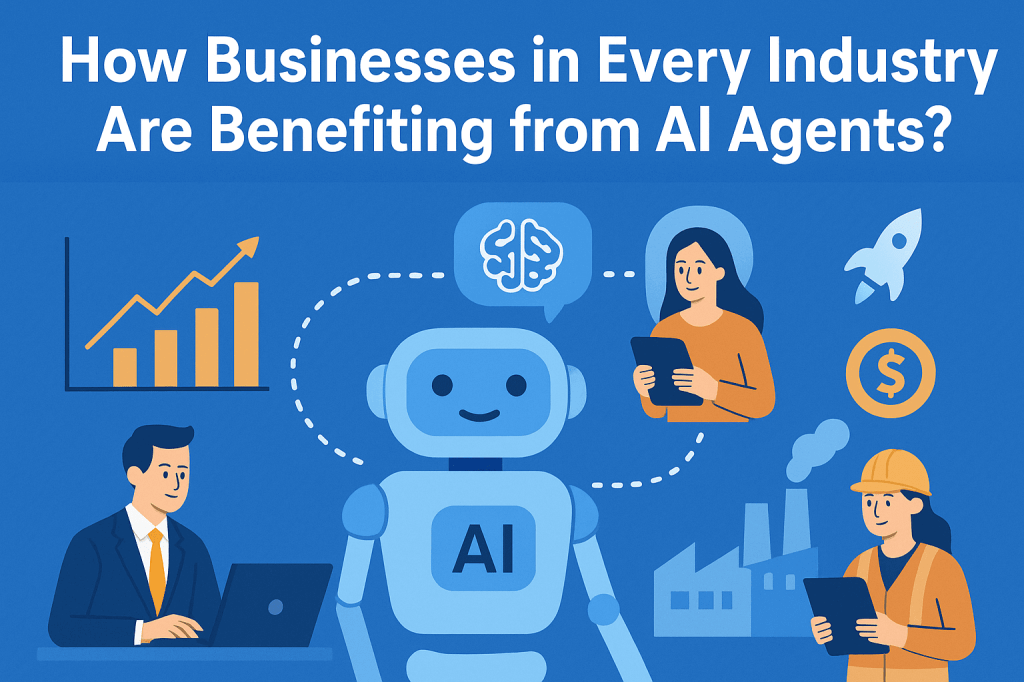
Artificial Intelligence is no longer a distant technology reserved for research labs. It is now an essential part of everyday business. Across healthcare, finance, retail, logistics, education, and many other sectors, companies are using AI agents to change how they operate. These agents work like intelligent assistants that can observe what is happening, analyze large volumes of data, and take actions that once required human attention. This is not about replacing people but about creating better systems where people and intelligent software work together.
Businesses face constant pressure to improve speed, accuracy, and customer satisfaction while keeping costs under control. Traditional methods often rely on manual processes that are slow, prone to errors, and difficult to scale. AI agents solve this by running continuously without fatigue, providing real time responses, and managing repetitive tasks that consume valuable staff hours. As a result, companies can focus their teams on innovation, strategic growth, and complex problem solving rather than spending time on routine tasks.
In this article, you will learn how businesses in different industries are benefiting from AI agents. We will explore their core components, explain their universal benefits, review how they are being used in major sectors, and show why now is the right time for every organization to consider them. Each section offers a clear perspective that can help business owners, managers, and decision makers understand the potential of AI agents and how they can bring lasting impact.
What Are AI Agents and Why They Matter
AI agents are intelligent software programs that can observe their surroundings, process information, and act based on what they learn. They are built to perform tasks that would usually require a person to monitor, decide, and execute. Unlike simple automation tools that only follow fixed instructions, AI agents are capable of learning patterns, adapting to changing conditions, and responding intelligently to new situations.
These agents use a combination of perception, decision making, and action to carry out their responsibilities. Perception involves collecting data from various sources such as sensors, databases, online interactions, or connected devices. Decision making allows the system to analyze this information using rules, algorithms, or machine learning techniques to identify the best possible response. Finally, action is the step where the AI agent executes its task, such as updating a database, sending a message, managing a customer query, or even controlling physical devices in a factory or a warehouse.
Businesses are adopting AI agents because they provide a level of speed and consistency that manual processes cannot match. They operate round the clock without breaks and do not lose focus. They reduce the chances of human errors and bring real time visibility into key operations. With their ability to handle large volumes of data and execute tasks instantly, AI agents free employees from repetitive work, making teams more productive and allowing them to focus on strategic goals.
AI agents matter today more than ever because the pace of business has accelerated. Customers expect immediate answers, supply chains need constant adjustment, and data flows are too large for manual processing. AI agents bridge this gap. They serve as reliable digital colleagues that enhance human decision making rather than replacing it. Their role is to amplify the efficiency of organizations, keep operations steady during high demand, and open doors for new services that were not possible before.
Key Benefits of AI Agents for Businesses
Improved Efficiency and Productivity
One of the most significant advantages of using AI agents is the way they improve efficiency. They manage repetitive tasks such as scheduling, data entry, or responding to simple customer questions. This allows employees to spend their time on more valuable work. For example, instead of answering the same customer queries repeatedly, staff can focus on solving complex problems or creating new strategies.
AI agents work without interruptions, so they keep processes running smoothly even during high workload periods. This continuous operation means projects move forward faster and tasks are completed on time. Productivity increases naturally because employees have more time and energy for activities that require creativity, analysis, or innovation.
Cost Savings and Operational Optimization
Reducing costs is a core priority for any business, and AI agents directly contribute to this goal. By automating repetitive processes, companies save on labor costs and reduce the need for excessive overtime. Fewer errors mean fewer resources spent on corrections or rework. AI agents also help streamline workflows by removing unnecessary steps and delays, resulting in smoother operations.
In many industries, AI agents assist with inventory control, resource planning, and maintenance scheduling. This ensures that supplies are available when needed without overstocking. Operational expenses decrease because decisions are based on accurate, real time data rather than guesswork.
Better Customer Experience
Customers today expect fast and personalized support. AI agents provide instant responses through chatbots, virtual assistants, and automated help desks. They can remember previous interactions, analyze preferences, and deliver recommendations that feel customized for each user.
This leads to higher customer satisfaction and loyalty. People appreciate services that respect their time and provide clear, consistent information. Businesses benefit from stronger relationships and positive reviews, which can drive more sales and improve their reputation.
Data Driven Decision Making
AI agents collect and process data continuously. They analyze patterns in customer behavior, market trends, or internal performance metrics. This gives managers reliable insights that support smarter decisions.
Instead of waiting for monthly reports or making decisions based on incomplete information, leaders can respond quickly to real time changes. This improves planning, forecasting, and overall agility in a competitive market.
How AI Agents Are Used Across Industries
Healthcare
Healthcare organizations are using AI agents to make patient care faster and more accurate. These agents help manage appointments, organize patient records, and provide quick responses to inquiries. Doctors and nurses receive timely alerts about patient conditions, which helps them act before problems become serious.
AI agents also assist in diagnostics by analyzing medical images or test results. They help reduce the time it takes to identify potential health risks and ensure that treatment plans are based on accurate data.
- Scheduling assistance Appointment booking and follow up reminders are automated.
- Diagnostic support Images and reports are analyzed for early detection of issues.
- Patient engagement Personalized communication improves care adherence.
Finance and Banking
Financial institutions use AI agents to improve security, reduce fraud, and deliver faster services. They monitor transactions in real time and alert teams when unusual patterns appear. Virtual banking assistants guide customers through basic account tasks, loan inquiries, and payment updates.
AI agents also assist with regulatory compliance by checking large volumes of data and generating accurate reports. This reduces the risk of penalties and helps banks maintain trust with regulators and customers alike.
- Fraud detection Suspicious transactions are identified and flagged immediately.
- Customer support Automated systems provide fast answers to routine questions.
- Compliance management Reporting and data verification are completed faster.
Retail and E Commerce
Retailers are adopting AI agents to create more personalized shopping experiences. These agents recommend products based on customer preferences, track inventory levels, and help with order processing. Shoppers receive real time updates about their purchases, while store owners avoid overstocking or running out of key products.
AI agents also enhance customer service by answering product questions or guiding users through returns and exchanges. This builds loyalty and increases sales.
- Inventory control Stock levels are monitored to meet demand accurately.
- Personalized marketing Recommendations are based on past behavior and interests.
- Order management Tracking and return processes are streamlined.
Manufacturing and Logistics
Factories and supply chain networks use AI agents to keep production running smoothly. They predict equipment failures, optimize delivery routes, and manage warehouse operations with minimal delays. This reduces downtime and prevents costly disruptions.
Companies also use AI agents to coordinate materials, track shipments, and adjust schedules when conditions change. These capabilities save money and ensure goods reach customers on time.
- Predictive maintenance Machines are serviced before breakdowns occur.
- Route optimization Delivery schedules adjust to traffic and weather changes.
- Warehouse automation Sorting and stock updates happen automatically.
Education and Learning
Schools and online platforms use AI agents to provide personalized learning experiences. Students receive customized study paths based on their progress. Teachers gain tools that help them grade assignments, track performance, and give real time feedback.
AI agents also improve access to resources by answering student questions and helping them find materials that match their goals. This creates a more engaging and effective learning environment.
- Adaptive learning Lessons adjust to each student’s pace and style.
- Automated grading Assignments are checked quickly and fairly.
- Student support Instant answers help learners stay on track.
Energy and Utilities
Energy companies use AI agents to manage power grids and reduce outages. They forecast energy demand, detect faults, and send alerts to maintenance teams before problems spread. Renewable energy management also improves because agents analyze weather patterns to balance supply.
This leads to fewer disruptions for consumers and more efficient use of energy resources.
- Grid monitoring Live data highlights risks before they grow.
- Outage management Repairs are planned with better accuracy.
- Renewable integration Wind and solar supply are predicted more effectively.
Why Every Business Should Embrace AI Agents
The business landscape is changing quickly. Customers expect instant service, competition is increasing, and operations must remain efficient even in unpredictable markets. AI agents offer a reliable way to meet these demands. They handle large amounts of work without delays and provide consistent quality across all operations.
Companies that adopt AI agents early often gain an advantage over competitors who rely on traditional processes. They respond faster to market changes, improve their customer relationships, and manage resources more effectively. Waiting too long to integrate these tools can result in missed opportunities and higher costs as competitors move ahead.
AI agents also help create an adaptable organization. They make it easier to scale operations when demand increases and to adjust strategies when conditions shift. This flexibility is essential for businesses that want to remain stable in uncertain times.
How To Start With AI Agents
Introducing AI agents into your business does not have to be complicated. The best results come from starting small, testing the approach, and expanding gradually. Here are a few steps that can guide a smooth implementation.
- Identify a clear use case Choose one process that consumes too much time or creates frequent delays. It should be measurable and have a clear benefit when improved.
- Map the workflow Understand each step, where data comes from, and how tasks move from one stage to another. This helps design the AI agent to fit existing operations.
- Define success metrics Set measurable goals such as reduced processing time, lower error rates, or improved customer response times.
- Involve key team members Employees who use or manage the process should provide input and feedback. Their knowledge improves the results and builds trust in the solution.
- Start with a pilot project Launch the AI agent in a limited scope. Monitor the results closely and collect feedback to refine its performance.
- Expand gradually Once the first use case delivers consistent value, extend AI agent adoption to other departments or workflows.
Conclusion
AI agents are no longer a concept for the future. They have become an essential tool for modern businesses that want to stay competitive. By managing repetitive work, analyzing complex data, and providing real time insights, they free human teams to focus on strategy, creativity, and customer relationships. The result is a more efficient, adaptable, and customer focused organization.
Across industries such as healthcare, finance, retail, manufacturing, and education, the positive impact is already visible. Companies see lower operational costs, faster decision making, and stronger loyalty from their customers. As these technologies continue to evolve, the gap between businesses that embrace AI agents and those that delay adoption will only grow wider.
If your organization is ready to explore the potential of AI agents, working with experts is the best first step. Experienced ai agent development companies can help you identify the right use cases, design tailored solutions, and implement them with minimal disruption to your existing operations. This approach ensures that the technology aligns with your goals and delivers measurable value from the start.
Adopting AI agents is not just about automation. It is about building a smarter and more responsive business that can grow and compete in a fast moving market. The sooner you begin, the sooner you can unlock the full benefits they offer.
 AI Innovation